
Electrical insulators are regarded as very important components in power systems. They play essential role in protection process, providing electrical isolation and prevent dangerous electrical leakage, shorts, and other hazards. There are many types of insulators in power system that allow safe and reliable power transmission and distribution at various voltage levels and environmental conditions.
Pin insulators:
For lower voltage levels on distribution lines, pin insulators are used. These insulators are attached to poles and provide straight-forward and less expensive insulation for short spans.
They are commonly made from Porcelain, glass, and polymers have pin insulators, and each one has its advantages. Insulators made with porcelain are constructed from an excellent clay, quartz, and feldspar mixture that is fired at high temperatures, giving the insulator excellent electrical insulation and high mechanical strength.
As for glass insulators, they are made with tempered glass that is also easy to visually inspect for defects, and it also has good dielectric strength. Finally, the newer designs for polymer pin insulators are a fiberglass core that is constructed with silicone rubber or silicate polymers. This design has high lightweight construction, resistance to pollution, moisture, defacement, and excels under adverse environmental conditions.
Suspension insulators:
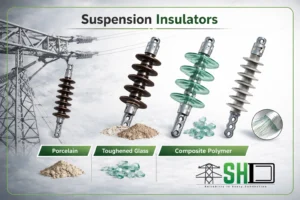
Suspension insulators are one of different types of insulators in power system used on high-voltage transmission lines. They are made up of individual units which are combined consecutively so that they can meet higher mechanical and voltage requirements.
They are constructed from one of three materials: porcelain, toughened glass, or composite polymer. Porcelain insulators are made out of a high-strength insulation material, comprised of refined clay and quartz mixed with feldspar, and fired at high temperatures.
Toughened glass insulators are easy to detect damage from because they shatter, and they also have a high dielectric strength. Composite suspension poles consist of a silicone rubber rod cover and housing, which may be reinforced with glass filaments. This construction approach is lightweight, and offers less clay performance, and improved performance in adverse, coastal, and industrial places.
Post insulators
Post insulators provide structural and electrical support for busbars and other equipment, and are used in substations and switchyards.
Depending on application and voltage level, post insulators may use porcelain, composite polymer, or types of epoxy resins. Post insulators made of porcelain have a greater degree of electrical and mechanical strength due to high-quality clay, quartz, and feldspar which have been fired to high temperatures.
Composite post insulators are lightweight because of a core of fiberglass and silicone which is highly resistant to pollution and moisture. Epoxy resin post insulators are used for indoor applications and are compact, and easy to install while providing good insulating properties.
How to choose the best type of electrical insulators?
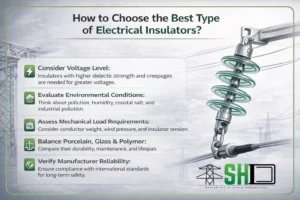
Choosing the best types of insulators in power system is very important to keep the performance of electrical system stable and away from dangers.
- Think about the voltage level of the power system. Insulators with higher dielectric strength and creepages are needed for greater voltages.
- Evaluate the environmental conditions that pollution, humidity, coastal salt, and industrial pollution may cause and the effect.
- Evaluate mechanical load requirements such as conductor weight, wind pressure, and insulator tension.
- For the specific application, balance the advantages of porcelain, glass, and polymer for the durability, maintenance, and life of the insulators.
- For the safety of the insulators in the long term, ensure that the manufacturer is compliant with the international standards and is reliable.
Comparison between types of insulators in power system
| Comparison Aspect | Pin Insulators | Post Insulators | Suspension Insulators |
| Typical Voltage | Low voltage distribution | Medium to high voltage | High and extra-high voltage |
| Installation | Mounted on poles | Used in substations/switchyards | Hung from towers |
| Mechanical Load | Low | Medium to high | Very high |
| Construction | Single unit | Rigid solid unit | Disc units in series |
| Common Use | Distribution lines | Busbars and equipment | Transmission lines |
Conclusion :
Understanding types of insulators in power system are crucial for the protection of electric power systems so that they can function safely and reliably. Selection of insulators such as pin, post or suspension types depend on the voltage level and extent of mechanical load and environmental factors. Selection of the appropriate insulator type guarantees the insulation of the electricity, and the mechanical support, stability of the system, reduced maintenance and longevity of the insulator’s use in the transmission and distribution system.