
Insulators on transmission lines are used to support conductors as well as separate them electrically from the towers and poles. Insulators used in Transmission Lines must avoid current flow to the ground are exposed to high levels of voltage stress, and must support the mechanical stresses due to the weight of the conductors as well as from wind and ice. The right choice of transmission line insulator types is critical to safe operation, reducing power loss, and ensuring the reliability of the transmission of electric power over long distances in different weather conditions.
Main Types of Insulators Used in Transmission Lines
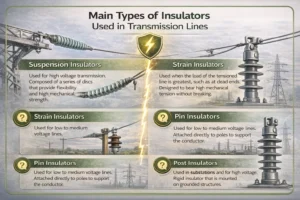
There are many transmission line insulator types with different purposes and features.
Suspension Insulators
Suspension insulator in transmission line are commonly used as high voltage transmission. The construction of these insulators consists of the combination of a number of discs that are out of construction insulators. The construction of suspension insulators provides high mechanical strength, a good structure, and the ringing and a certain load due to the flexibility of the wind, so using a suspension insulator in transmission line will be a suitable choice.
Strain Insulators
Strain insulators are most insulators where the load of the tensioned transmission lines is greatest, that is, at the dead end, at the level of a distended crossing of the river at the position of a distended crossing of the river at the end of the resonance of the river. The function of strain insulator is located to ensure the separation of the mechanical-pulling load at the level above the insulators. The strain insulators achieve the necessary stability of the conduction in the insulators, and the insulators limit the conduction in the insulators, and the insulators limit the conduction in the insulators.
Pin Insulators
Pin insulators are used on low and medium voltage power lines, and are easily attached to poles and crossarms with metal pins to hold the wire in place. Pin insulators are designed simply and economically for the short spans and low wire tension encountered on low voltage lines. There are also insulation and mechanical restrictions that limit their use to low voltage applications.
Post Insulators
Post insulators are rigid insulators that are used to support conductors and busbars in substations and, less frequently, in transmission lines. They are designed to provide mechanical support and electrical insulation for high stresses and heavy loads. Available in porcelain and polymer construction, post insulators are ideal for medium and high voltage applications where strong and permanent support is required.
What Are 5 Examples of Electrical Insulators
There are main five examples of electrical insulators used in transmission lines
Porcelain
Porcelain is one of the most common materials for creating electrical insulators in power systems. Porcelain offers great mechanical power, good dielectric properties, and also has a very long useful life. Porcelain insulators are able to withstand the elements and stress of high voltages. Therefore, they are used in substations, switch yards, and transmission lines where long lasting durability is needed.
Glass
Glass insulators are made from toughened glass and have great dielectric strength and uniformity. Their glass structure is a big plus because when they break they can easily be seen, making inspections easier. They are used in high tension wires and are great insulators. They have great define weather resist and electrical performance in the long run.
Polymer
Polymer insulators, which are made from fiberglass, are lightweight, stand up to pollution, and other nasty stuff making them good for coastal areas. They have great hydrophobia, which helps reduce leak currents and the possibility of a flashover. Therefore, they see a lot of use where transmission and distribution lines are required to have very little maintenance and higher safety.
Composite
Composite insulators combine different materials typically including a fiberglass core and polymer housing and sheds. This composition gives insulators high mechanical strength and good electrical insulation. They provide improved performance against pollution, are more vandal resistant, and are lighter. Because of this, composite insulators are being as high voltage transmission insulator and more extreme environments where older materials won’t perform as well.
Ceramic
Ceramic insulators are composed of one or more inorganic, non-metallic materials and are engineered for high temperature and electrical stress environments. They possess superior insulation, and very good thermal stability as well as resistance to aging of the environment, or environmental aging. Ceramic insulators are used extensively in electrical equipment and switchgear; as well as, in some power system applications where a rigid structure, heat resistance, and long-term reliability are essential.
How to Choose the Right Insulator for Transmission Line
To choose the best type, many factors must be considered while choosing insulators used in transmission lin
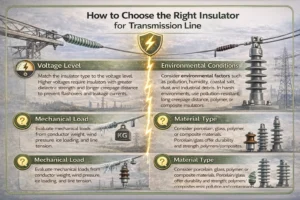
esVoltage Level
When choosing insulators for transmission lines, one of the most critical factors is the voltage level. Higher voltages demand insulators with higher dielectric strength, in addition to requiring a longer creepage distance to mitigate flashovers and leakage currents. Higher voltage levels also mean that suspension or post insulators are used, while pin insulators are restricted to low and medium voltage applications.
Environmental Conditions
Environmental factors also play a critical role in insulators performance as well as selection. Pollution, humidity, coastal salt, dust, and industrial debris tend to worsen the likelihood of surface leakage and flashovers, and insulators are designed for harsher conditions that facilitate long-term reliable operation. In most cases, insulators using pollution-friendly materials, longer distance creepage, polymers or composites, are used in harsher environments.
Mechanical Load
Mechanical load refers to the forces applied to the insulator by the weight of the conductor, wind pressure, the weight of ice that may build up (ice loading), and line tension. Insulators are designed to sustain these loads without a mechanical failure. For long spans and heavy conductors, suspension or post insulators are most appropriate, while for lighter loads and shorter spans, pin insulators are appropriate.
Material Type
The type of material used in construction of insulators is essential to their performance, longevity, and levels of maintenance required. Insulators made of porcelain and glass have great mechanical strength and have been proven to endure for long periods of time. On the other hand, insulators made of polymers and composites are resistant to contamination and pollutants. Therefore the material used is selected depending on the environment in which the insulator is placed, the maintenance (if any) that is required, and the expected lifespan of the insulator.
Common Materials Used in Transmission Line Insulator
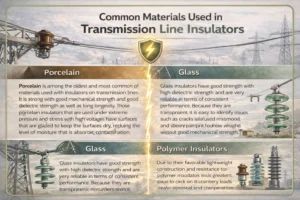
Porcelain
Porcelain is among the oldest and most common of materials used with insulators on transmission lines. It is strong with good mechanical strength and good dielectric strength as well as long longevity. Those porcelain insulators that are used under extreme pressure and stress with high voltages have surfaces that are glazed to keep the surfaces dry, reducing the level of moisture that is absorbed as well as reducing contamination.
Glass
Glass insulators have good strength with high dielectric strength and are very reliable in terms of consistent performance. Because they are transparent, it is easy to identify issues such as cracks and other internal problems. Toughened glass insulators are good in extreme weather and high voltages. With proper maintenance, they are age resistant and provide good mechanical strength.
Polymer Insulators
Due to their favorable lightweight construction and resistance to contaminants, polymer insulators are gaining favor in modern transmission systems. Their construction through silicone rubber and composite materials combine to yield excellent hydrophobic characteristic, leading to lower leakage currents. They are simple to install and maintain, and perform in hot or contaminated coastal environments.
How Insulators Perform Under High Voltage Stress
Creepage Distance
Creepage distance is the distance across the surface of insulators between the live and grounded conductive parts. Under high voltage conditions, longer surface paths (or creepage distance) reduce the likelihood of electrical surface tracking and the movement of moisture. Ensure the insulation surface is designed to create optimum distance to prevent the electrical performance of the insulator from deteriorating prematurely.
Flashover Resistance
Flashover resistance is the ability of insulators to withstand voltage without electrical discharge (through the air or at the surface) at the insulator’s edge or surface. When subjected to high voltage stress, insulators with good flashover resistance are less likely to cause sudden outages and damage to the system. These conditions are dependent on the type of insulator material, surface finish, level of pollution and moisture content, and altitude.
Mechanical Strength
The mechanical strength of insulators helps to ensure that they will be able to endure high voltage operations while bearing the weight of the conductors, wind pressure, ice loading, tension, and other forces. Adequate mechanical strength helps to ensure that the insulator will not undergo breakage or deformation that may result in an electrical defect. The best insulators are able to merge good mechanical strength and electrical insulation to provide stability for the transmission lines over an extended period of time.
Explore High-Quality Transmission Line Insulators
Choosing the right insulator is critical for power transmission reliability. Explore our complete range of transmission line insulators designed for modern power systems.
FAQs
Why Choose Sihedan for High-Quality Transmission Line Insulators
When you choose Sihedan, you are assured of high quality, modern technology, and high control testing. Sihedan ensures the insulators used in transmission lines are durable and provide reliable electrical and mechanical performance and offer tailor-made solutions that are compliant with international standards and project specifications.