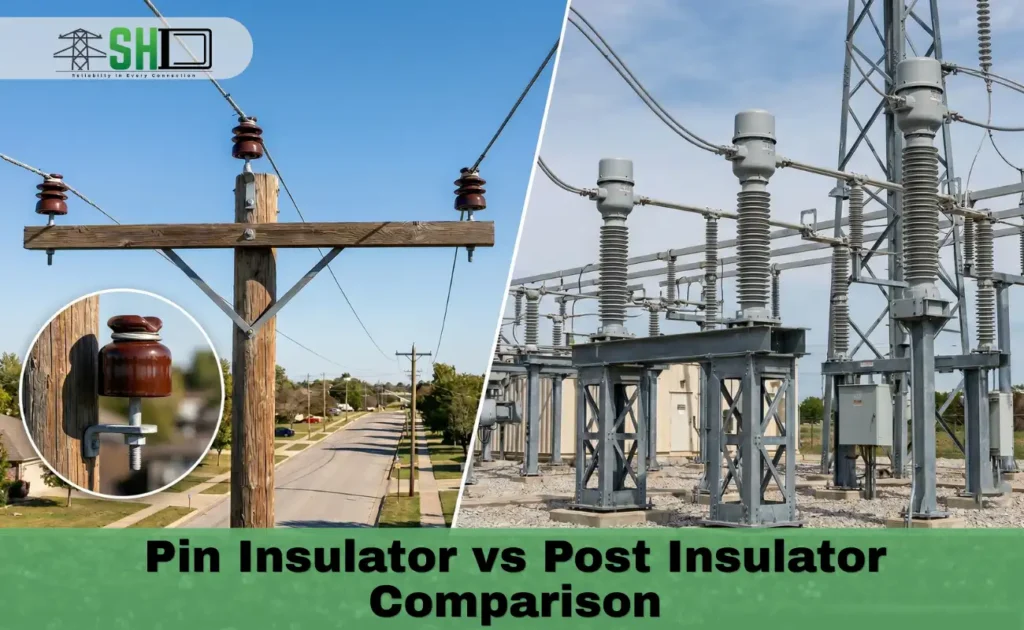
Although pin insulators and post insulators support and insulate conductors, they serve different purposes. Pin insulators are typically used on poles in low and medium voltage distribution lines. In contrast, post insulators are used when greater mechanical strength and higher voltage levels are needed. Therefore, post insulators are usually found in switchyards and substations, where they support busbars and other high voltage electrical equipment.
What Is a Pin Insulator?
Pin insulators are used in overhead power distribution lines to secure and insulate wires from supports. They are placed on a pin attached to a power pole, securing lines. These insulators are used in low and medium voltage lines because the provide reliable insulation and support, are simple and quick to install, and are low cost to short span distribution systems.
What Is a Post Insulator?
Post insulators are used in substations and switchyards of electrical power systems to support and insulate wires and busbars. They must endure high electrical and substantial physical stress. They are made of strong insulating and durable materials such as porcelain, polymer, or epoxy. Post insulators are used for medium and high voltage systems where reliable operation and safe systems are of utmost importance.
Pin Insulator vs Post Insulator – Key Differences:
Structural Design Differences:
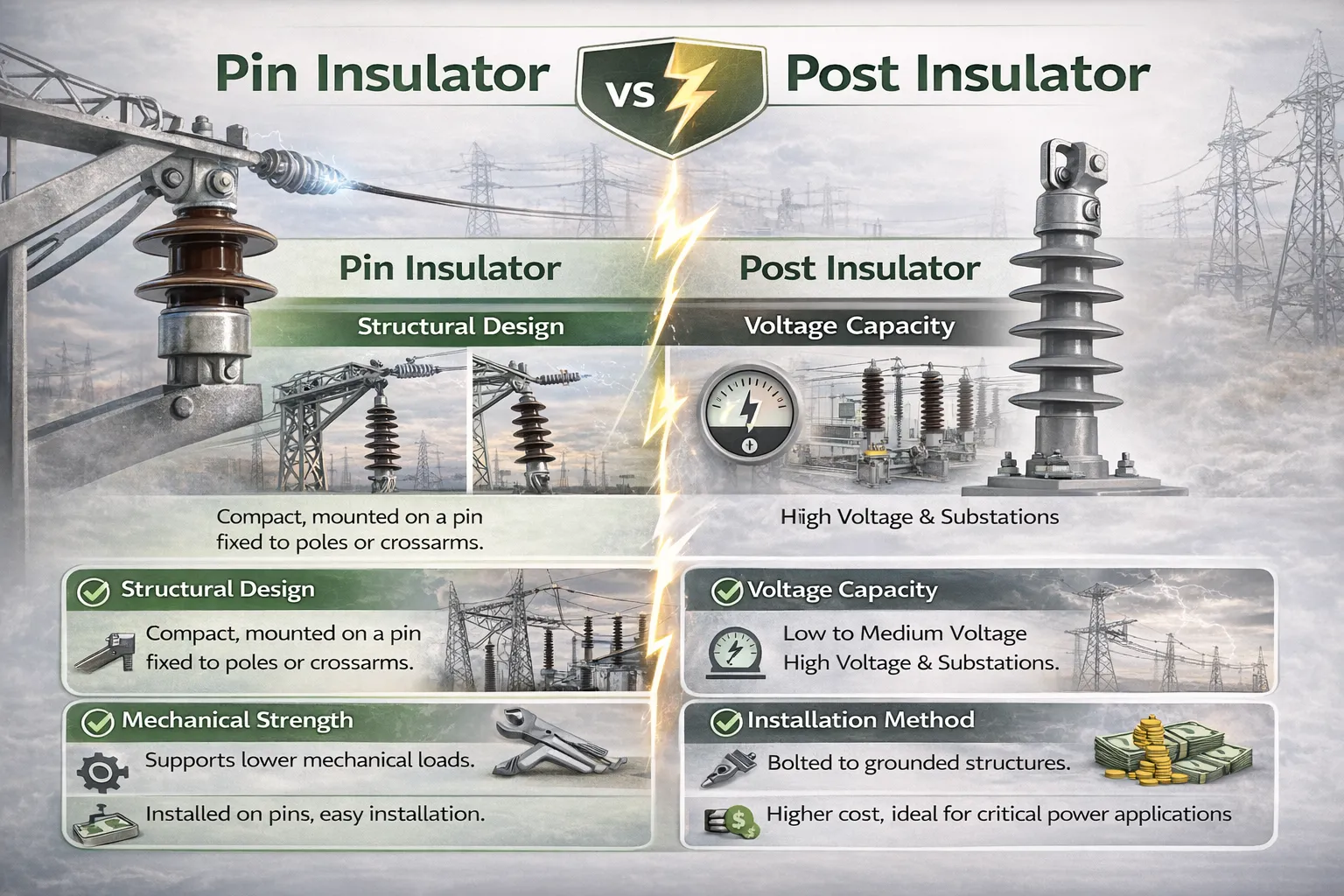
The design of Pin insulators is compact and and can be directly mounted on a pin that is fixed to poles or crossarms, thus being appropriate for distribution lines. The design of Post insulators is made of a robust and rigid structure that can be mounted on a base that is vertically or horizontally grounded. This unique design features allows post insulators to achieve higher stability, lower insulation and better versatility at substations and in high load applications.
Voltage Capacity Comparison:
Due to their shorter creepage distance and shorter length of insulation, pin insulators are only applicable to low and medium voltage applications. As for post insulators, they can be used in applications involving greater heights and for better insulation requirements. This is due to their design, which allows for greater dielectric strength and longer length of insulation, thus, a better option in substations.
Mechanical Strength and Load Handling:
Pin insulators are designed to support lower mechanical loads, and are intended for short spans with low conductor tensions. Post insulators are designed for greater mechanical ruggedness, including bending and compression. Their robust design enables them to carry large busbars and make them mechanically stable under dynamic and long-term loading conditions.
Installation Method:
Pin insulators are installed by simply mounting them onto pins which are fixed to poles or crossarms. This makes installation easy and economical. Post insulators are installed by bolts to grounded structures or equipment, which requires more careful alignment. This installation method provides quasi-stiff support and safety at substations and switchyards, which are safety-critical.
Cost Consideration:
Pin insulators are more economical due to their low weight, low materials, and simple designs. They are great for low-cost distribution networks. In contrast, post insulators provide more performance, more mechanical strength, more insulation for high voltages, and are better for long-term investments in critical power system applications, but are more expensive.
Why Are Pin Insulators Not Used Above 33kV?
Pin insulators are only used up to 33 kV, because their designs do not have the needed insulation properties for higher voltage uses. For voltages above 33 kV, the required creepage distance and dielectric strength become much higher which makes pin insulators. Additionally, high voltage makes flashovers and leakage currents more likely under wet/polluted conditions and there are more mechanical stresses on pin insulators due to the weight of the conductors and span length. Because of this, post and suspension insulators are used above 33 kV.
Applications of Pin and Post Insulators in Overhead Lines:
There are many different applications of pin insulator vs post insulator:
Distribution Lines:
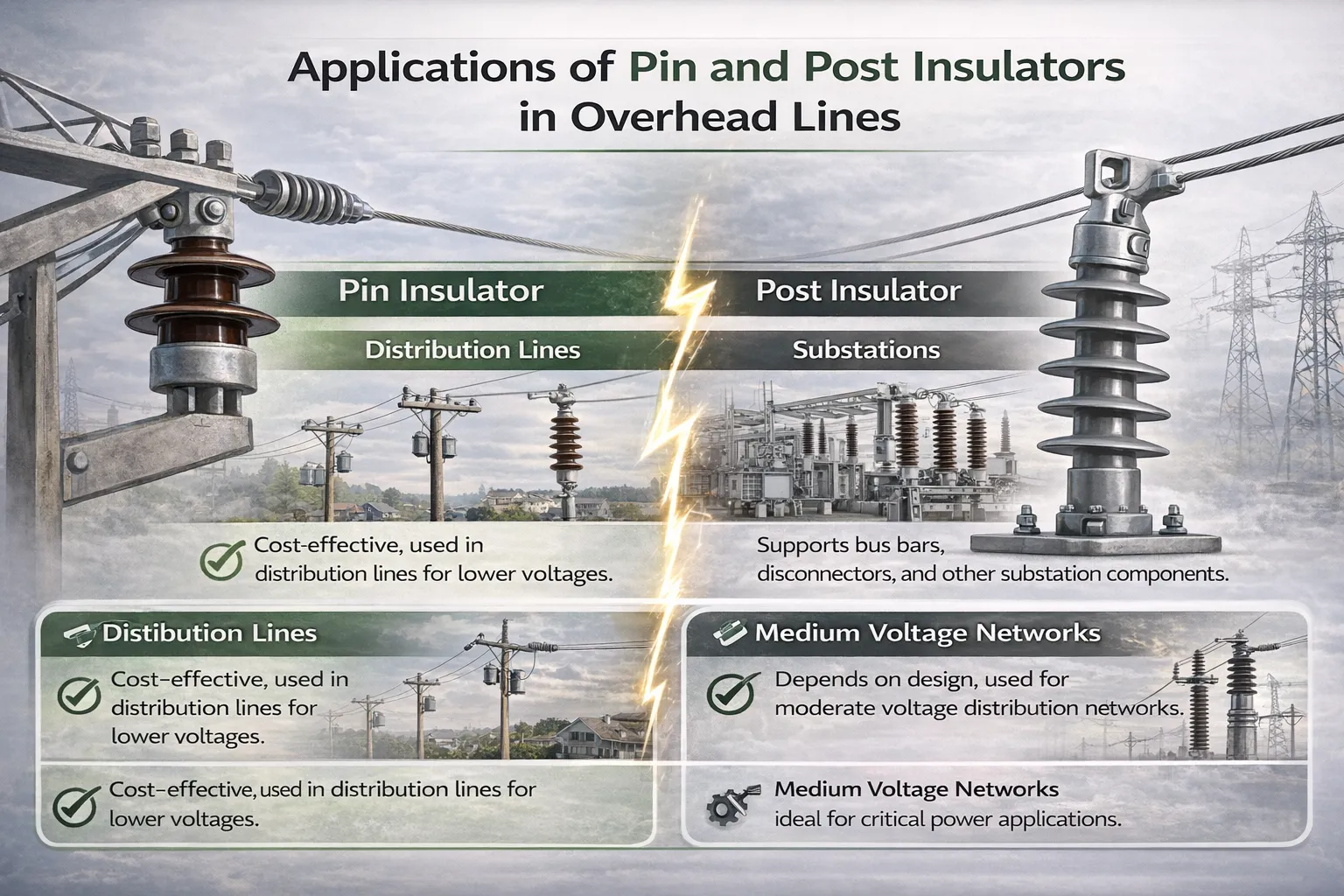
Because of the intricate engineering involved, the production, use, and manufacturing of pin insulators is cost-effective. Finger grip insulators strike a balance between an economic solution and reliability. Post insulators can be utilized in certain cases of distribution structures where greater mechanical strength is needed, or where greater rigidity is needed in how conductors are spaced apart.
Substations
Substations, for instance, routinely use post insulators to support bus bars, disconnectors, and other components that are live. Their post insulators need to be able to hold up against high amounts of physical force, and that is a reality. In other words, post insulators can withstand high levels of stress caused by their electrical components. In substations, pin insulators are seldom used, as post insulators are better options for flexibility, strength to withstand high anticipation, and safety associated with installation stagnation.
Medium Voltage Networks
In medium voltage networks, pin post insulators are used depending on the design post insulator networks that sustenance the middle of the road insulators. In other words, finger grip insulators are the last option when all other post insulator options have been exhausted. For optimal management, post insulators are preferred, as they are less likely to deteriorate over time.
Which Insulator Should You Choose?
It’s important to learn when to choose pin insulator vs post insulator to still in the highest level of safety and reliability:
For Distribution Networks:
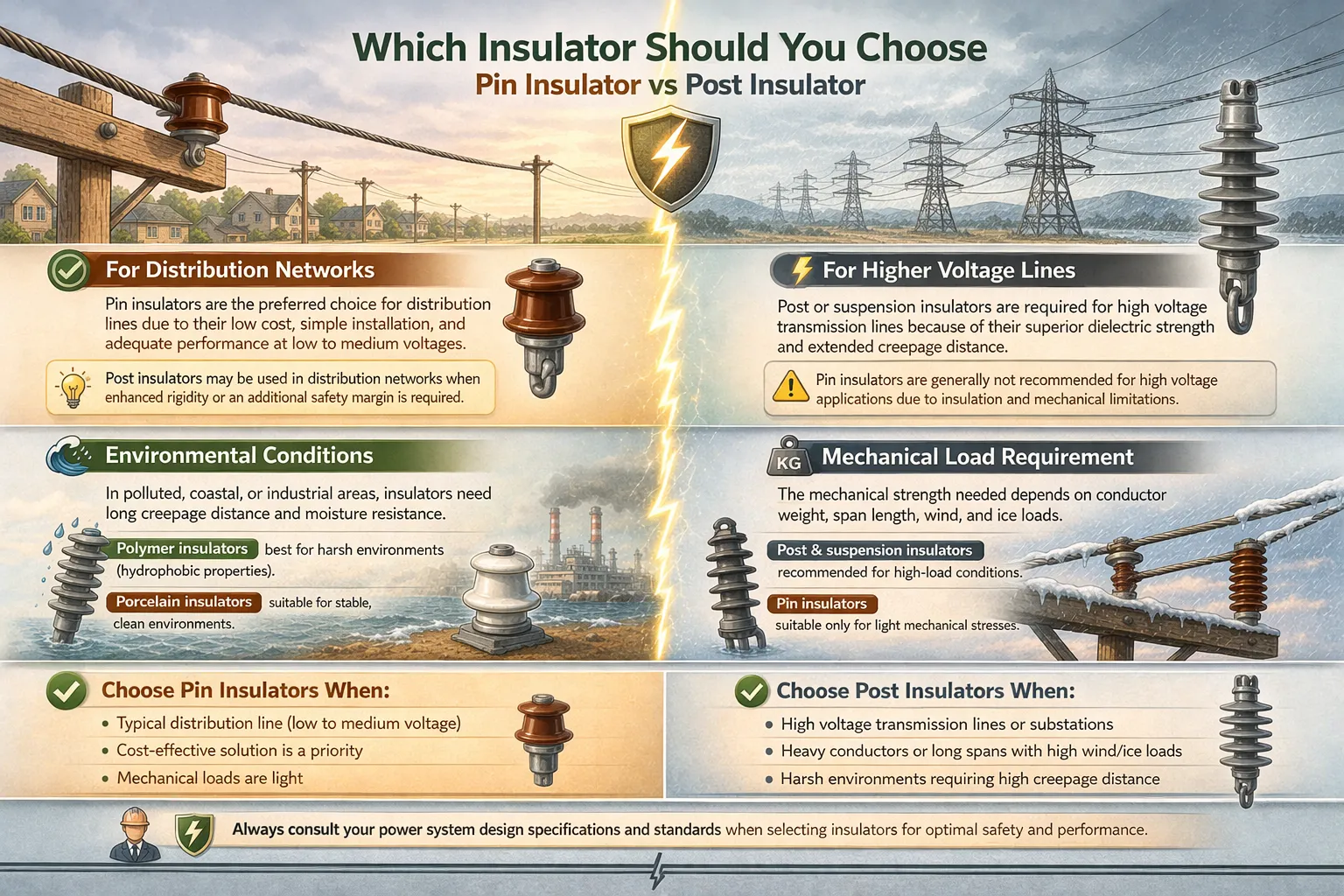
Pin insulators are typically used for distribution networks because of their simple design, low price, and ease of use. They also offer sufficient insulation and supportive structures required at low and medium voltages present in distribution systems. Post insulators are used sometimes for distribution networks also when a higher rigidity or higher safety margin is needed.
For Higher Voltage Lines:
Insulators used on higher voltage transmission lines must also have a stronger dielectric strength and a longer creeping distance. These instances require a suspension or post insulator as they are designed for higher electrostatic stress and better insulation flashover. As a rule, for higher voltages, the use of pin insulators are typically avoided because of both insulation and mechanical limitations.
Environmental Conditions:
Where Insulators are used is a major factor in the selection of suitable insulators. In polluted and coastal environments, as well as in industrial runs, insulators must have a longer creeping distance as well as a better contour of moisture insulation. In these environments, polymers insulate because of hydrophobic properties, while in stable and clean environments porcelain insulates.
Mechanical Load Requirement:
Working requirements are also a factor in the choice of insulators in terms of design and materials. Where lines have heavier conductors longer spans, or higher winds and ice loads mechanical strength insulators. Post and suspension insulators are suitable for high-load conditions, while pin insulators are limited to lighter mechanical stresses.
FAQs:
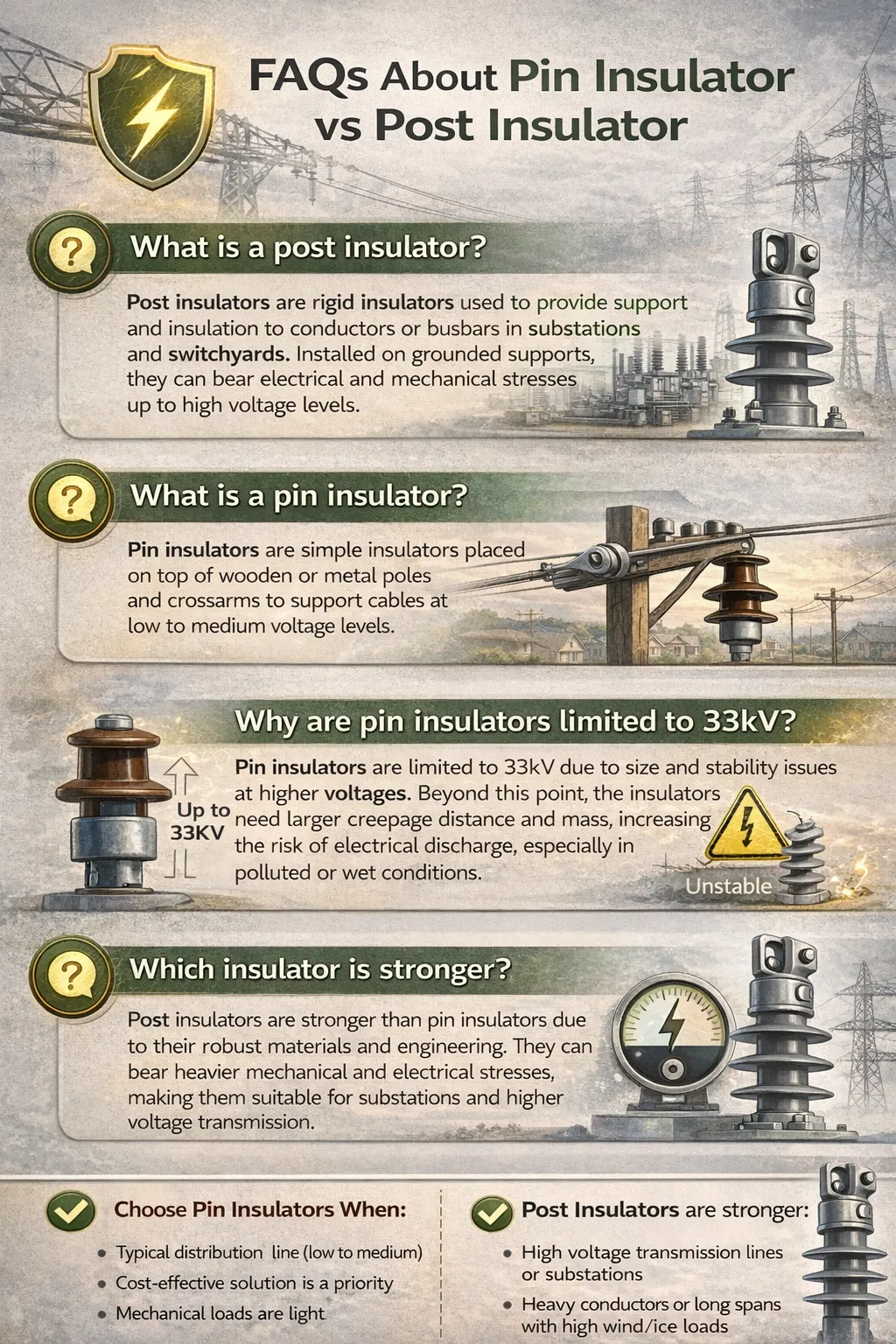
What is a post insulator?
Post insulators are rigid in V sulators that are used to provide support and insulation to conductors or busbars in electrical power substations and switchyards. It is installed on grounded supports and is able to bear the brunt of electrical and mechanical stresses. Post insulators can be used to support insulators in the middle or upper ranges of voltage and power levels.
What is a pin insulator?
Pin insulators support cables in electrical connections on top of wooden or metal poles and cross arms. This is used at low to medium ranges of voltage and power levels. Pin insulators are the simplest insulators and are used to conduct power in short sections and span lines.
Why are pin insulators limited to 33kV?
Pin insulators can only be used on lines that operate at or below 33 kV. This is because as voltage levels and electrical stress increases, the insulators require increased length in the creepage structure, as well as the insulators needing to be made out of dielectric material. After this point the insulators also become large, unstable, and are susceptible to electrical discharge. This becomes more commonplace in polluted and wet conditions. There are also mechanical load restraints that limit the use of pin insulators.
Which insulator is stronger?
Because of the materials and engineering needed, post insulators can bear more weight, more mechanical, and electrical stresses than pin insulators. Because of this, post insulators can be applied in substations, higher voltage systems, as well as in areas that require a rigid support.
Leave a Reply