
Insulators made out of porcelain or polymer are both commonly used in power systems, but polymer vs porcelain insulator comparison is important to use their best advantages. Porcelain insulators were built with high mechanical strength and have long service life and have high proven performance over a number of decades. In comparison, polymer insulators have the advantages of being lightweight, give excellent pollution resistence and perform better in tough environmental and contaminated conditions.
Where to use polymer insulators
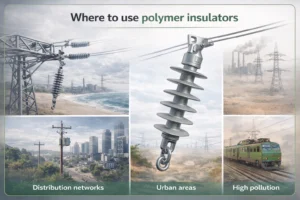
Being lightweight and having high resistance to environmental pollutants as well as superior performance regarding extreme environmental conditions, polymer insulators are the most preferred insulators in modern power systems engineering. Particularly in areas with long-term reliability and safety with minimal maintenance, these characteristics of polymer insulators are useful, Examples include:
- Overhead transmission lines in coastal, industrial, or desert environments with high pollution, salt, and dust contamination
- Distribution networks where insulators must be light in weight to limit the overall mechanical load on poles and structures
- Urban applications where space is limited and safety is paramount
- Railway electrification systems where reliability and resistance to vibration are important
- Areas where polymer insulators are less susceptible to vandalism owing to their resistance to breakage and impact.
Where to use porcelain insulators
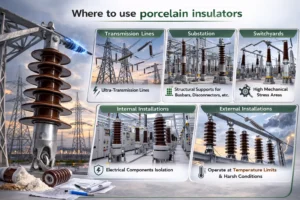
Porcelain insulators offer numerous advantages that makes them the right product choice for many power system applications. Their long-term performance and proven durability helps to reduce maintenance costs, making porcelain insulators an appealing choice when stability and resistance to mechanical stresses are important. Because of these reasons, porcelain insulators are commonly used in the following applications:
- The following list indicates what can be used the packaging items when concerning ultra-transmission lines.
- Transmission/Substation/Switchyards = Structural supports for busbars, disconnector, etc.
- Internals of the installations, whose electrical components are isolated.
- Externals of the installations, those that operate at the temperature limits of porcelain.
- Any device that could produce high mechanical stresses combined with the need for rigid mechanical support.
Comparison between polymer vs porcelain insulator
| Comparison Aspect | Polymer Insulators | Porcelain Insulators |
| Weight | Lightweight, easy to handle | Heavy, rigid structure |
| Pollution Performance | Excellent in contaminated areas | Moderate, requires cleaning |
| Mechanical Strength | High tensile strength | Very high compressive strength |
| Maintenance | Low maintenance | Periodic inspection needed |
Explore Our Polymer and Porcelain Insulators
Conclusion
Polymer vs porcelain insulator is not just a comparison, but an analyzing multiple technical, environmental, and operational considerations. For example, the level of voltage, mechanical load, and performance criteria over the long-term. The environment, and pollution, humidity, coastal locations, and the positioning of the installation and maintenance capabilities also contribute. Safety, weight, and lifespan must be evaluated alongside total life-cycle cost for determining the appropriate insulator type for the design and operational reliability of the power system.