Types of distribution poles include tangent, guyed, and self-supporting structures, typically engineered from wood, steel, concrete, or composite materials like fiberglass to safely route electricity from substations to homes and businesses. Engineers also select pole configurations based on load requirements, environmental conditions, spacing, and maintenance access. Understanding types of distribution pole helps ensure reliability, safety, and cost-effective deployment in diverse areas.
What is a distribution pole?
A distribution pole is a utility pole that carries lower-voltage electricity from local substations to homes and businesses, serving as the grid’s final step: after electricity leaves generating plants via high-voltage transmission lines, it is stepped down at a substation into the distribution network, and distribution poles deliver that power across neighborhoods until nearby transformers reduce it further to safe, usable low voltages like 120V or 240V for individual customer properties.
The Main Types of Distribution Pole Used in Overhead Lines
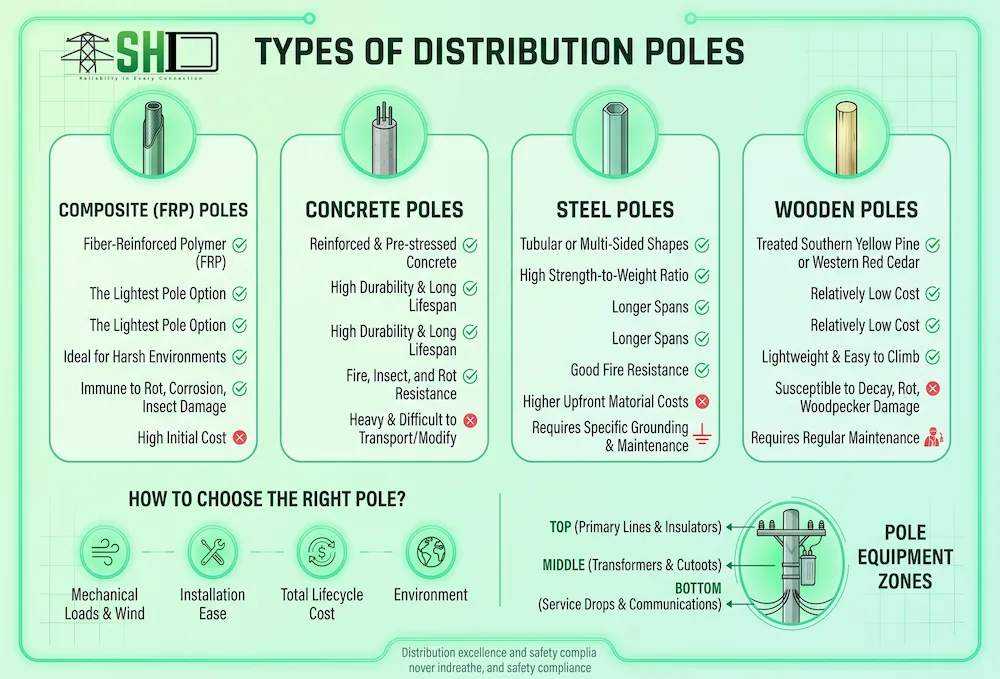
Types of distribution pole carry low- and medium-voltage power to homes and businesses, and four common material-based types are wood, concrete, steel, and FRP composites.
Wood Poles
- Wood poles are types of distribution pole widely used worldwide because they’re relatively low cost, easy to obtain.
- Common materials include treated southern yellow pine, western red cedar, or Douglas fir.
- They provide excellent natural insulating properties, are lightweight, and easy to climb, making them practical for day-to-day line work.
- However, wood is susceptible to decay, rot, and woodpecker damage, so periodic chemical treatments and regular inspections are required.
Concrete Poles
- Concrete poles (RCC and pre-stressed) are increasingly used in urban and rural areas due to durability.
- Concrete poles such as reinforced cement concrete (RCC) and pre-stressed concrete poles are electrical distribution pole types.
- Built by embedding steel rebar in poured concrete for strength.
- Pros: very long lifespan, high mechanical strength in heavy winds, strong resistance to fire, rot, and insects; low maintenance.
- Cons: very heavy (hard to transport/install) and difficult to drill or modify once installed.
Steel Poles
- Steel poles are types of pole used in distribution system, especially in urban areas and regions prone to severe weather or wildfires.
- Common forms include tubular, multi-sided, or rolled steel shapes; they must be galvanized or painted to prevent rust.
- Pros: strong strength-to-weight ratio, longer spans, and good fire resistance.
- Cons: higher upfront material costs and more specific grounding/maintenance needs than wood.
Composite (FRP) Poles
- Composite (FRP) poles are a modern option made from fiber-reinforced polymer (often fiberglass).
- They’re different types of distribution lines constructed from woven glass fibers bound by resin.
- Pros: the lightest option, ideal for remote or coastal environments, and immune to rot, corrosion, and insect damage.
- Cons: high initial purchase cost limits widespread use.
How to Choose the Right Material for Different Types of Distribution Pole (11kV to 33kV)?
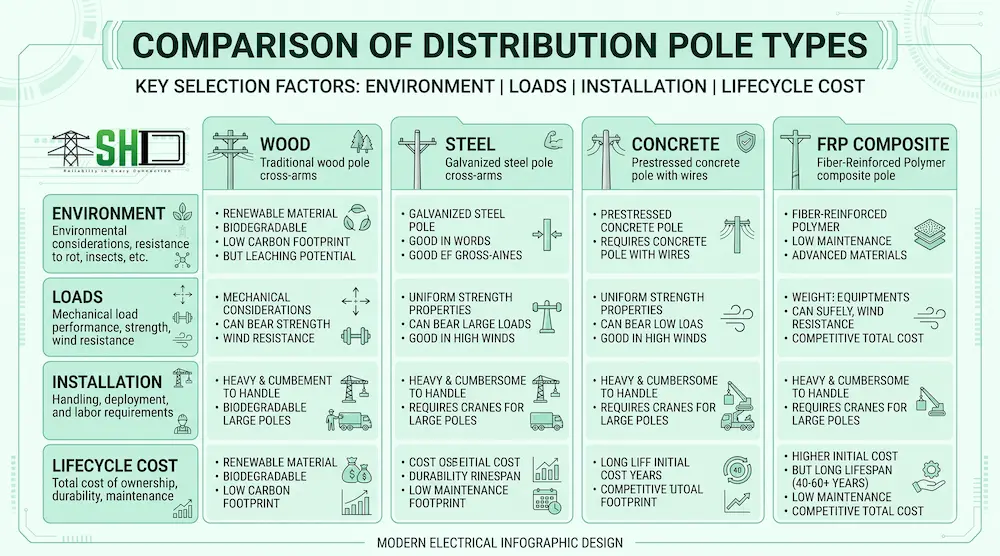
Choosing the right types of distribution pole material for 11kV to 33kV lines means weighing environment, mechanical/wind loads, installation practicality, and total lifecycle cost.
- Wood: best for dry/cold areas; avoid termites/woodpeckers/high wildfire risk.
- Steel (hot-dip galvanized): strong for fire-prone and urban use.
- Concrete: ideal for flood/swamp/seismic zones due to rot/fire resistance; hard to transport in inaccessible mountains.
- FRP/composite: best for highly corrosive coastal/industrial and harsh weather.
- Strength needs: steel/concrete handle heavy loads for angles/dead-ends/transformer platforms; wood/FRP are lighter and can meet standards.
- Installation needs: wood/FRP suit remote access; steel may be sectionalized; concrete requires heavy trucks and lifting.
- Cost trade-off: wood is the cheapest upfront but has a shorter life (~15–30 years) and requires more maintenance; steel/concrete last ~50–60+ years; FRP costs more upfront but has the lowest total cost of ownership with minimal maintenance, depending on local environmental conditions and design parameters.
Read More: Medium Voltage Surge Arrester Selection Guide.
What Do Pole Class and Load Rating Mean When Buying in Bulk?
When buying types of distribution pole or utility poles in bulk, pole class and load rating tell you whether the poles have the required strength, dimensions, and safe capacity for your project.
1- Pole Class = strength + taper dimensions
- Poles are classified (e.g., wood often follows ANSI O5.1).
- Typically Class 1 down to Class 7.
- Lower numbers (Class 1–3): thicker/larger circumferences, more rigid; used for heavy-duty electrical/high-voltage work (about 3,000–4,500+ lbs).
- Higher numbers (Class 5–7): thinner poles with lower capacity (about 1,200–1,900 lbs); for light-duty secondary/telecom.
2- Load Rating = exact force/weight limits
- Specifies how much bending force or weight the pole can safely handle (commonly in pounds/newtons).
- You must total expected loads in bulk orders: hardware weight + ice buildup + wind pressure.
- Distinguish Ultimate Load (near breaking) vs Working Load Limit (WLL) (safe capacity to operate within).
What Equipment Gets Attached to a Distribution Pole A Practical Overview?
A types of distribution pole is a shared vertical structure that organizes electrical and utility equipment by zone high voltage at the top, transformation in the middle, and services communications at the bottom—secured by grounding and reliable Overhead Power Line Hardware.
1- Top (High-Voltage Zone)
Keep in mind that the specific equipment can differ depending on operating voltage, country, type of network ( radial or looped), and its role within the electric grid.
- Primary lines (utility high-voltage conductors, often on crossarms)
- Insulators (ceramic/porcelain/polymer disks that prevent leakage)
- Lightning/surge arresters (divert voltage spikes safely to earth)
2- Middle (Transformation & Protection Zone)
- Distribution transformers (step down voltage to usable levels like 120V/240V)
- Fused cutouts (protective switches/fuses that disconnect on faults)
- Neutral & secondary lines (carry stepped-down power to neighborhoods)
3- Bottom (Communication & Service Zone)
- Service drops (hot drops) to connect homes/businesses
- Communication cables (telephone, coax TV, fiber internet lines owned by providers)
- Streetlights and related photo-sensors
4- Across the full pole (Grounding & Structural Support)
- Ground wire (connects lightning/arresters/neutral paths to grounding rods).
- Guy wires & anchors (tensioned cables anchored in earth to prevent pole tipping or failure).
Read More: Types of cut out fuse: A Complete Selection Guide.
How to Manage Storage Transport and Installation for Bulk Pole Orders?
Managing bulk pole orders safely requires strict phases from pickup and hauling to temporary storage and final foundation installation—so materials arrive undamaged and stay structurally stable.
Transport Logistics
- Confirm Oversized Load Permits matched to weight and length before transit.
- Use specialized vehicles (extendable pole trailers or crane trucks) rather than standard flatbeds.
- Secure every load with heavy-duty ratchet straps/tie-down cables at regular intervals.
Storage & Inventory Management
- Use designated pole rack storage solutions (avoid unstable horizontal heaps that increase rolling hazards).
- Keep poles off the ground if horizontal stacking is unavoidable using dry, untreated timber spacers.
- Provide elevation and airflow between levels to reduce rot/warping risk.
- Remove plastic wrapping/foil within 72 hours to prevent moisture buildup and surface corrosion.
Installation Best Practices
- Follow safety procedures for lifting massive loads near crews (use proper rigging and PPE).
- Excavate to typical engineering guidance: hole depth ≈10% of pole height plus 2 feet (e.g., a 30 ft pole → ∼5 ft below grade).
- Lift with slings from the top using a crane/hoist.
- Plumb and align the pole using magnetic levels; backfill in stages with gravel, concrete, or well-tamped soil for stability.
What Sets Sihedan Apart in Supplying Overhead Line Fittings and Protection Equipment?
Supplying Sihedan types of distribution pole and stands apart with precision-engineered overhead line fittings and reliable protection equipment, delivering safety, durability, and fast turnaround for critical utility infrastructure needs nationwide.
- Overhead Line Fittings: High-quality insulators, clamps, hardware, and accessories built for long service life
- Protection Equipment: dependable protection solutions designed to enhance network safety and reduce downtime
- Quality Assurance: tested materials and consistent manufacturing standards for performance you can trust
- Customer-Centric Supply: responsive support and efficient logistics to keep projects on schedule
- Use Across Applications: suitable for utilities, contractors, and infrastructure projects requiring robust overhead systems.
For premium bulk orders, custom specifications, or specialized overhead utility solutions, feel free to visit our Contact Us page, connect with our team directly via WhatsApp, or send your inquiry to info@sihedan.com.
FAQs
What is the difference between distribution and transmission poles?
Transmission poles support high-voltage lines that transport bulk electricity over long distances from power plants to substations. Distribution poles carry lower-voltage electricity from substations to neighborhoods, businesses, and homes.
Can different pole materials be mixed on one line?
Yes, different pole materials such as wood, steel, concrete, and fiberglass can physically be mixed on a single utility line.
What hardware is needed for surge arresters and clamps on a pole?
Hardware typically includes heavy-duty, corrosion-resistant mounting brackets, stainless steel fasteners, and specialized clamps or hot-line grips to secure the arrester to the pole and line conductor.
Leave a Reply