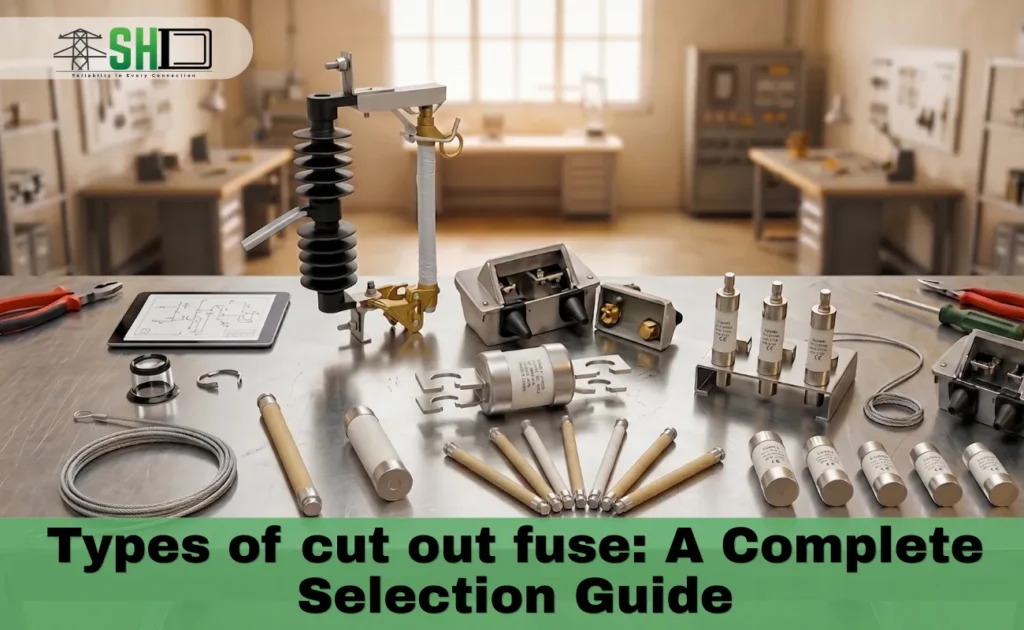
Types of cut out fuse determine how overhead distribution networks respond to faults, overloads, and transformer protection requirements, High-voltage fuse cutouts have been used by utilities for close to 100 years, per IEEE Xplore research – and selecting the correct type directly determines fault isolation speed, operator safety, and long-term network reliability.
What Are The Types of Cut Out Fuse?
A cut out fuse is a combination of a fuse and a switch installed on overhead distribution lines and pole-mounted transformers, The primary cut out fuse function is to interrupt fault current automatically while providing a visible open-circuit indication – the fuse holder drops visibly when the element melts, allowing line crews to identify the blown phase from ground level.
Every cut out fuse assembly consists of three primary components:
- Cutout body: Open frame supporting the fuse holder and insulator – electrically isolating the assembly from the mounting structure.
- Fuse holder (tube): Epoxy-impregnated glass filament wound tube with an arc-quenching inner liner.
- Fuse link: Tin or silver alloy wire that melts at rated overcurrent – available in Type K (fast) and Type T (slow) per IEEE C37.42.
Understanding the cut out fuse function in Power Systems:
Types of cut out fuse coordinate with upstream and downstream protection devices through four sequential steps:
- Normal operation: Current flows through the fuse link without exceeding the melt threshold.
- Fault detection: Fault current exceeds the rating – link melts, spring releases, fuse holder rotates open under gravity.
- Arc extinction: Expulsion tube gases de-ionize the arc at the natural current zero crossing.
- Visual indication: Open fuse holder visible from ground – crews replace the fuse link without de-energizing the feeder.
Cutouts coordinate with upstream reclosers – when a temporary fault occurs, the recloser trips and recloses before the fuse melts, preventing unnecessary outages, This coordination behavior varies across the types of cut out fuse: loadbreak designs allow manual switching under load, while standard drop-out types require de-energization.
Read More: What is an Expulsion Fuse? A Complete Technical Guide.
Primary Categories Based on Insulator Material:
The first classification of cut out fuse types is based on insulator material – the choice between porcelain and polymer affects performance in different environmental conditions:
| Parameter | Porcelain Cut Out Fuse | Polymer Cut Out Fuse |
| Material | Solid-core, birdproof porcelain | Silicone rubber over E-glass fiberglass rod |
| Weight | Heavier | Lighter – easier installation |
| Pollution resistance | Standard | Superior hydrophobic properties – self-cleans in rain |
| Coastal/industrial use | Limited in high-pollution zones | Preferred – superior tracking resistance |
| Breakage risk | Higher on impact | Lower – flexible, impact resistant |
| Standard | IEEE C37.42 / IEC 60282-2 | IEEE C37.42 / IEC 60282-2 |
Read More: Polymer vs Porcelain Insulator: Key Differences.
Operational Design and Mechanism Classifications:
Beyond insulator material, the types of fuse cutouts are further classified by operational mechanism and design:
- Standard drop-out cutout: Most common – fuse holder drops open under gravity when the element melts; mounted at 20° off vertical for reliable drop-out action.
- Loadbreak cutout: Arc-extinguishing chamber allows manual opening under live load current – used where crews require switching without de-energizing the feeder.
- Non-expulsion (current-limiting) cutout: Sand-filled element interrupts fault current within ½ cycle with no expelled gases – required in fire-prone or confined environments.
- Arrester combination cutout: Integrates a surge arrester with the cutout body – simultaneous lightning overvoltage and overcurrent protection in a single pole-mount assembly.
Standard Speed Classifications for Internal Fuse Links:
The fuse link inside all types of cut out fuse is classified by operating speed:
- Type K (Fast): Rapid fault clearing for feeder line protection – coordinates with upstream reclosers.
- Type T (Slow): Tolerates transformer inrush (8–12× rated) without nuisance blowing.
- Type E: Higher interrupting capacity for substations per IEEE C37.46.
Per IEEE C37.42, fuse links below available fault current risk catastrophic fuse tube explosion.
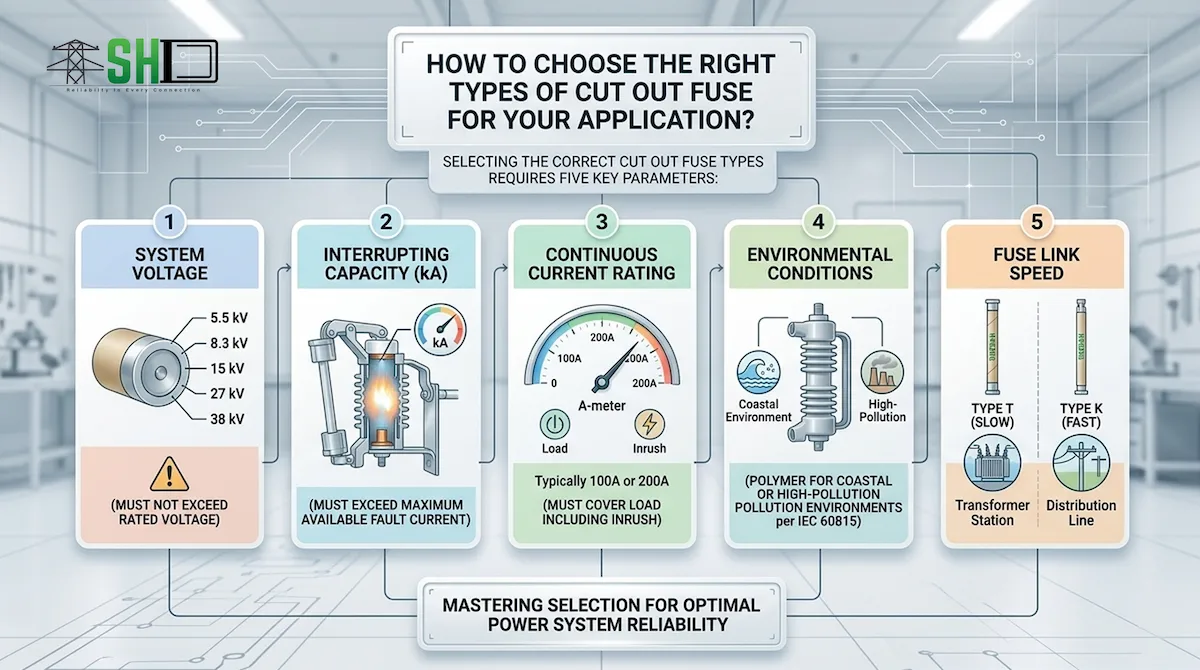
How to Choose the Right types of cut out fuse for Your Application?
Selecting the correct cut out fuse types requires five key parameters:
- System voltage: 5.5 kV, 8.3 kV, 15 kV, 27 kV, or 38 kV – must not exceed rated voltage.
- Interrupting capacity (kA): Must exceed maximum available fault current.
- Continuous current rating: Typically 100A or 200A – must cover load including inrush.
- Environmental conditions: Polymer for coastal or high-pollution environments per IEC 60815.
- Fuse link speed: Type T for transformers; Type K for feeder lines.
Read More: HV Fuses for Transformer Protection: Selection Guide.
Failure Statistics and Common Mistakes in Selecting Types of Cut-Out Fuse:
Incorrect selection of types of fuse cutouts causes premature failure and downtime:
- Under-rated interrupting capacity: Risk of catastrophic explosion during fault.
- Wrong fuse link speed: Nuisance blowing or delayed clearing – damages upstream equipment.
- Porcelain in high-pollution environments: Flashover failure – polymer required per IEC 60815.
- Skipping coordination studies: Wider outages per IEEE C37.48.
All types of cut out fuse must be verified through a coordination study before installation.
Read More: How to Calculate Fuse Size for Transformer? Step by Step.
International Safety Standards for Electrical Fusing:
High-voltage fuse cutouts have been used by utilities for close to 100 years, per IEEE Xplore research — making standards compliance a non-negotiable requirement for every installation.
- IEEE C37.42-2016: Class A distribution-class cutouts – 1 through 38 kV.
- IEC 60282-2:2008: High-voltage expulsion fuses – Europe, Asia, international projects.
- IEEE C37.41-2024: Design test procedures – 1–38 kV.
- IEC 60815: Pollution severity and creepage distance classification.
Why Sihedan Is Your Trusted Partner for Cut Out Fuse Manufacturing?
Sihedan manufactures the complete range of types of cut out fuse – certified to IEC 60282-2 and IEEE C37.42:
- Full certification: Type test documentation for utility tender submissions.
- Polymer and porcelain options: Matched to pollution severity and voltage class.
- Hot-dip galvanized hardware: ≥86μm zinc coating – superior corrosion resistance.
- Full OEM / ODM capability: Custom ratings and fuse link speed per project.
- No minimum order on first orders: Sample evaluation at freight cost.
Explore Sihedan Cut Out Fuse Products and Solutions:
Sihedan provides a complete cut out fuse portfolio for overhead distribution network protection:
- Drop Out Fuse (11–36 kV): Expulsion-type with visible drop-out indication – ideal for transformer and feeder tap protection.
- 33 kV Fuse Links K Type: EEI-NEMA Type K and T, 1–200A, compatible with 10–36 kV expulsion cutouts.
- Polymer Cutout Assemblies: Silicone rubber insulated – superior hydrophobic performance per IEC 60815.
- MC300 HDCO Heavy Duty Cutout Base: 40A–300A, 80 kA breaking capacity for secondary distribution.
For inquiries or OEM requests, contact Sihedan at info@sihedan.com, message us on WhatsApp, or visit our Contact Us page.
FAQs:
What happens when a cut out fuse blows in a distribution line?
The fuse link melts, spring releases, and fuse holder drops open visibly – isolating the faulted section while keeping the rest of the feeder energized.
Why do polymer cut out fuses perform better in coastal or polluted areas?
Silicone rubber is hydrophobic – water beads off instead of forming a conductive film, preventing pollution-induced flashover that degrades porcelain.
Is it mandatory to use IEC certified drop out fuses for new grid installations?
Most utility specifications require IEC 60282-2 or IEEE C37.42 certification – uncertified fuses create liability exposure and may void warranties.
How does investing in the right type of fuse link reduce network downtime?
Correctly selected fuse links isolate only the faulted section – preventing cascade failures and reducing outage duration.
Leave a Reply