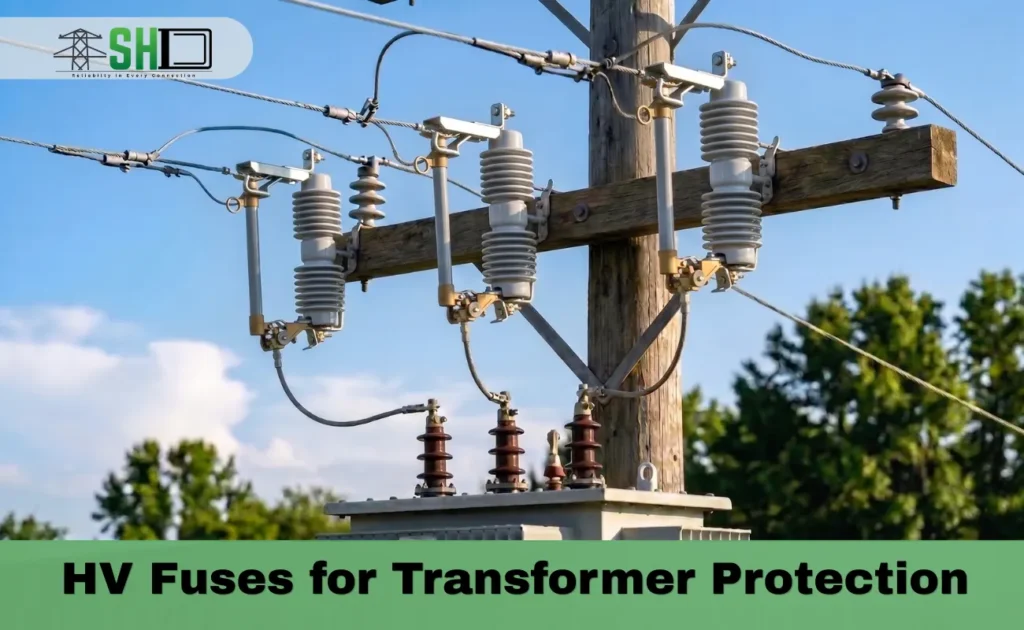
HV fuses for transformer protection are essential protective devices in medium-voltage distribution networks, helping safeguard transformers against severe overcurrents and faults. When a downstream short circuit or severe overcurrent occurs, the fuse element quickly melts to interrupt current, limiting thermal and mechanical stress on transformer windings and bushings. Proper coordination with relays and upstream switchgear improves selectivity, reduces outage time, and enhances reliability.
What are hv fuses for transformer protection?
HV fuses for transformer protection are high-voltage fuse devices to protect transformers (typically 1–40.5 kV) against short-circuit currents and severe overloads by breaking the circuit, preventing catastrophic failure. Commonly built as current-limiting or expulsion fuse types, they are installed on the primary side so that, during a fault, the transformer can be separated from the power supply.
Read More: What is an Expulsion Fuse? A Complete Technical Guide
Why it is Critical to Use High Voltage fuses for transformer protection?
High Voltage Fuses for Transformers are critical for transformer protection because they interrupt dangerous fault currents fast, limiting heat, damage, and fire risk.
- Fast Fault Isolation: Current-limiting HV fuses detect and interrupt faults quickly, reducing the time the transformer experiences severe electrical and thermal stress.
- Preventing Catastrophic Failures: High Voltage fuses for transformer protection limit fault energy and withstand high-temperature arcing conditions, helping avoid destructive transformer failures, fires, or explosions.
- Cost-Effective Protection: HV fuses provide dependable performance at a lower cost than many alternatives, with minimal maintenance requirements and high operational reliability.
- Handling High Fault Currents: With high breaking capacity, they can safely interrupt large fault currents and reduce them to safer levels before equipment damage occurs.
- Ensuring System Stability: By isolating a faulted transformer immediately, HV fuses for transformer protection limit fault propagation and reduce the risk of broader outages and system instability.
Read More: Differentiate Between Fuse and Circuit Breaker Specs in MV
How to Select the Right hv fuses for transformer protection?
Selecting the right High Voltage fuses for transformer protection ensures fast, reliable fault clearing while safely tolerating overloads and inrush. The principle for selecting the right hv fuses for transformer protection:
- Voltage rating (must match/exceed system voltage): Choose a fuse protection for transformers with a rated voltage equal to or greater than the transformer’s operating voltage to prevent harmful arcing.
- Current rating / full-load current sizing: Determine the transformer’s primary full-load current from its kVA and primary voltage, then select a fuse that can carry that current with an appropriate margin (commonly ~25–30% where applicable).
- Inrush-current withstand: Ensure the fuse type and rating can tolerate transformer magnetizing inrush current (often 8–12× full-load current) without nuisance operation, while still protecting for short circuits.
- Breaking capacity (interrupting rating): Verify the fuse’s maximum interrupting (breaking) capacity exceeds the maximum available fault current at the installation location.
- Use of backup/coordination fusing (MV/HV practice): The fuse curve should be plotted against the transformer’s “damage curve” (ANSI/IEEE points) so that the fuse operates and clears the fault before the transformer experiences irreversible thermal damage.
- Environmental derating considerations: Account for temperature and elevation effects that can change fuse thermal performance; apply manufacturer guidance/derating factors where required.
Read More: How to Calculate Fuse Size for Transformer? Step by Step
IEC Compliance and Routine Testing for HV Transformer Fuses:
hv fuses for transformer protection must meet strict IEC design and safety requirements, then pass routine testing to confirm each unit performs correctly.
IEC compliance (core standards):
- IEC 60282-1: Current-limiting fuses (most common for modern transformer protection).
- IEC 60282-2: Expulsion fuses (used for drop-out cutouts).
- IEC 62271-105: Switch-fuse combinations for high-voltage applications.
- IEC 60787: Application guidance for HV fuse-links in transformer circuits.
Routine testing (mandatory for every manufactured unit):
- Visual inspection: Check condition, markings/nameplate ratings, and workmanship.
- Dimensional verification: Confirm the fuse and construction match the holder dimensions and fit requirements.
- Cold resistance measurement: Verify fuse-link resistance is within specified limits (commonly a small % of nominal), confirming no internal element defects.
- Insulation resistance test: Verify insulation integrity of fuse bases/cartridges to detect internal defects (using the acceptance threshold defined by the standard/spec).
- Dielectric (applied voltage) tests: Apply power-frequency voltage to confirm insulation withstands the rated dielectric stress.
- Striker functionality tests (if applicable): Validate that the striker releases correctly (energy/time conditions per design).
Type testing (design verification—representative sample only):
- Breaking/interruption test: Confirms the fuse can interrupt its rated breaking current.
- Temperature rise test: Confirms safe operation without excessive heating at continuous rated current under maximum ambient conditions.
- Time–current characteristic verification: Confirms pre-arcing behavior and curve compliance.
- Impulse (lightning) withstand test: Verifies impulse withstand capability.
Transformer protection requirements to ensure correct coordination:
- Minimum breaking current / HRC coordination: The required breaking current value must be marked on back-up HRC fuses; below the specified threshold, correct operation/coordination cannot be relied upon.
- Inrush (magnetizing) withstand: The fuse must not melt during transformer energization inrush events.
- Striker reliability in switch-fuse combinations: When used with a transformer switch, the assembly must include a proper striker so that all required phases open if one fuse link operates.
Read More: Types of cut out fuse: A Complete Selection Guide
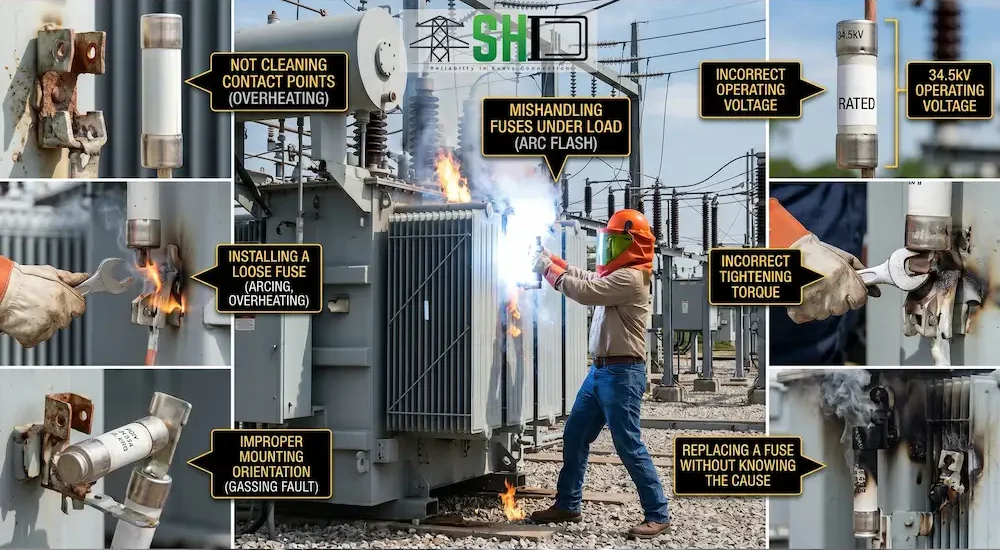
Common Installation Mistakes That Compromise HV Transformer Protection:
Installing hv fuses for transformer protection is a precise and sensitive process that requires expertise, because any mistake can damage equipment, cause explosions, or create serious safety hazards. Here are the most common errors when installing high-voltage fuses:
- Incorrect Tightening Torque: Failing to tighten connections to the manufacturer’s specifications can result in high resistance, leading to overheating and premature fuse failure.
- Improper Mounting Orientation: Installing fuses at the wrong angle or upside down can interfere with the proper venting of gases during a fault.
- Mishandling fuses under load: A serious mistake is attempting to remove or install a high-voltage fuse while the circuit is still energized (under load), which can cause a dangerous electrical arc flash.
- Installing a fuse with an incorrect operating voltage: Installing a fuse rated for a lower voltage than the network’s actual voltage means it may fail to cut off current during a short circuit.
- Not cleaning the contact points (clips/holders): Dirt or rust buildup on the fuse holder increases thermal resistance, causing the fuse to overheat and fail or burn even when the circuit fault source isn’t actually present.
- Installing a loose fuse (not securely tightened): Failing to fix the fuse properly in the clips can create arcing and severe overheating.
- Replacing a fuse without knowing the cause: Replacing a blown fuse immediately without diagnosing why it blew (for example, a short circuit) can cause the new fuse to fail as soon as power is applied.
Read More: Dropout Fuse of Transformer: Premium OEM Solutions
Why Grid Operators Trust Sihedan Transformer Fusing Solutions?
Grid operators trust Sihedan transformer fusing solutions because they’re engineered for reliability, protection selectivity, and trouble-free field performance.
- Improved fault protection: hv fuses for transformer protection help isolate transformer faults quickly, reducing damage risk.
- Reliable operation: Designed to operate consistently under real-world duty and conditions.
- Selectivity-focused design: Supports coordinated protection with upstream/downstream devices.
- Quality-built components: Built to withstand electrical stresses and long service life.
- Field-ready installation: Solutions that integrate smoothly into transformer fusing schemes.
- Reduced downtime impact: Fewer misoperations help minimize restoration time and maintenance costs.
Explore Sihedan High Voltage Fuse Products and Solutions:
Sihedan offers a range of high-voltage and low-voltage protection solutions designed for distribution networks, focusing on reliability and fault isolation. The following table summarizes their key products and primary applications:
| Product | Technical information | Applications/use cases |
| Drop Out Fuse | Dual-function fuse + switch; connects in series with transformer feeder cable for immediate overload defense. Designed for 11kV to 36kV systems with hydrophobic properties and higher creepage distance. |
|
| 33KV Fuse Links K Type | Designed to meet EEI-NEMA Type K and Type T requirements; for 10–36kV outdoor expulsion fuse cutouts with current ratings 1A to 200A. Rated voltage up to 33kV. |
|
| 11KV Fuse Links K (660mm) | K type fuse link for 1A–200A. Designed for EEI-NEMA Type K fast characteristics. Voltage range stated as 11kV–36kV. |
|
| Overhead Service Cutout | Described as a 400A Fuse Switch Disconnector suitable for NH1 and NH2 fuse links. Includes slide-fit front cover for ease of jointing and is described as easy to install. |
|
| Heavy Duty Cut Out Base MC300 HDCO (80kA) | Vandal-resistant heavy duty cutout base (MC300 HDCO). 80kA maximum breaking capacity. Current rating range 40A–300A. |
|
Need expert advice on selecting the ideal fusing solutions for your power grid? Visit our Contact Us page, reach out directly via WhatsApp, or email us at info@sihedan.com for tailored recommendations and immediate support!
FAQs:
How do magnetizing inrush currents affect outdoor transformer fuse selection?
Inrush currents can be much higher than steady-state magnetizing current for a short time, so the fuse must have a time-current characteristic that won’t nuisance-blow during startup while still interrupting true short-circuit/failed-fault conditions.
How do extreme weather conditions impact drop-out fuse performance?
High wind, ice/snow, salt fog, and temperature swings can affect mechanical operation, contact integrity, and insulating gaps. Proper fuse design (rated insulation, corrosion-resistant parts, and reliable “drop-out” mechanics) is needed to ensure the fuse clears quickly and consistently without sticking or mis-tripping.
Why are drop-out fuses the standard choice for overhead transformer protection?
They’re widely used because they provide effective, fast fault isolation for overhead systems, are easy to install and visually inspect, and allow the fuse element to physically open/“drop out” on severe faults—reducing repair time and improving network safety.
Leave a Reply