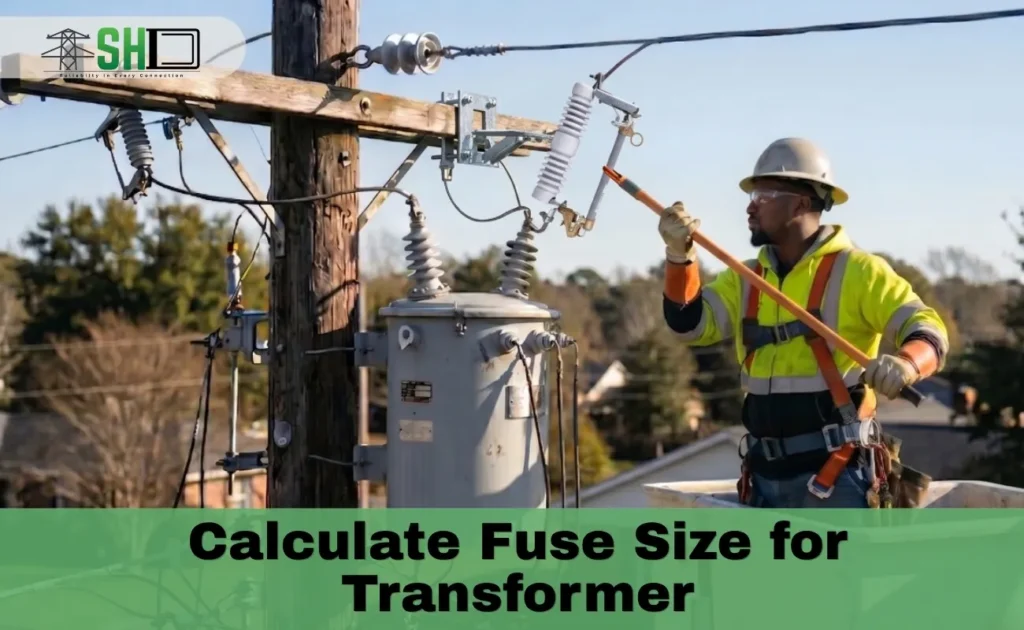
To calculate fuse size for transformer installations correctly is the difference between a protected system and a catastrophic failure, Fuse sizing must account for rated current, inrush behavior, impedance, and applicable codes, not just nameplate values, This guide covers every step of the process, from the core transformer fuse sizing formula to the standards that govern compliant transformer protection, Whether you are calculating fuse size for transformer primary or secondary circuits, following a structured approach ensures both safety and code compliance.
What is Calculation of Fuse Size for Transformer?
To calculate fuse size for transformer protection, engineers determine the minimum overcurrent rating that allows normal operation — including startup inrush — while responding to sustained faults before damage occurs.
-
Primary fuse calculation under NEC 450.3:
Primary Full-Load Current = kVA × 1000 ÷ (Voltage × √3 for three-phase)
The result is multiplied by the applicable protection factor:
- 125% — standard unsupervised installations with impedance below 6%.
- 250% — supervised locations with qualified personnel on-site.
- 300% — primary side only, when secondary fusing at 125% is also installed.
If the calculated value does not match a standard fuse rating, NEC requires rounding up to the next available standard size.
Read More: types of insulators in power system.
Why is it Important to Calculate Fuse Size for Transformer?
Knowing how to calculate fuse size for transformer systems correctly is one of the most critical steps in electrical protection design, Incorrect sizing leads to failures that extend far beyond the transformer itself.
The risks of improper fuse selection include:
- Nuisance blowing – undersized fuses trip during normal inrush, causing unnecessary downtime.
- Thermal damage – oversized fuses allow sustained overloads that degrade winding insulation over time.
- Fire hazards – a fuse that fails to interrupt a fault allows dangerous energy release inside the enclosure.
- Code violations – non-compliant protection exposes facilities to liability and failed inspections under NEC 450.3 and IEC 60076.
According to IEEE Std C37.91, improper fuse sizing is among the leading causes of transformer protection failures, particularly when inrush behavior is not factored into the selection process.
Read More: Function of Insulator in Transmission Line: Types, Specs & Selection.
Key Components in Transformer Protection Systems:
Before calculating fuse size, engineers must identify every element in the protection chain, as each component directly affects fuse selection and coordination:
- Primary fuses: Protect against internal faults; sized above full-load current to ride through inrush.
- Secondary fuses / circuit breakers: Protect downstream conductors; sized by conductor ampacity and load.
- Current transformers (CTs): Monitor current levels and feed protective relays in larger installations.
- Time-delay fuses: Standard choice for transformer protection; tolerate inrush while clearing sustained faults.
- Current-limiting fuses: Interrupt fault current rapidly; used where fault damage limitation is critical.
- Temperature sensors / protective relays: Supplement fuse protection with thermal overload monitoring in large transformers.
Read More: Insulators Used in Transmission Lines Explained.
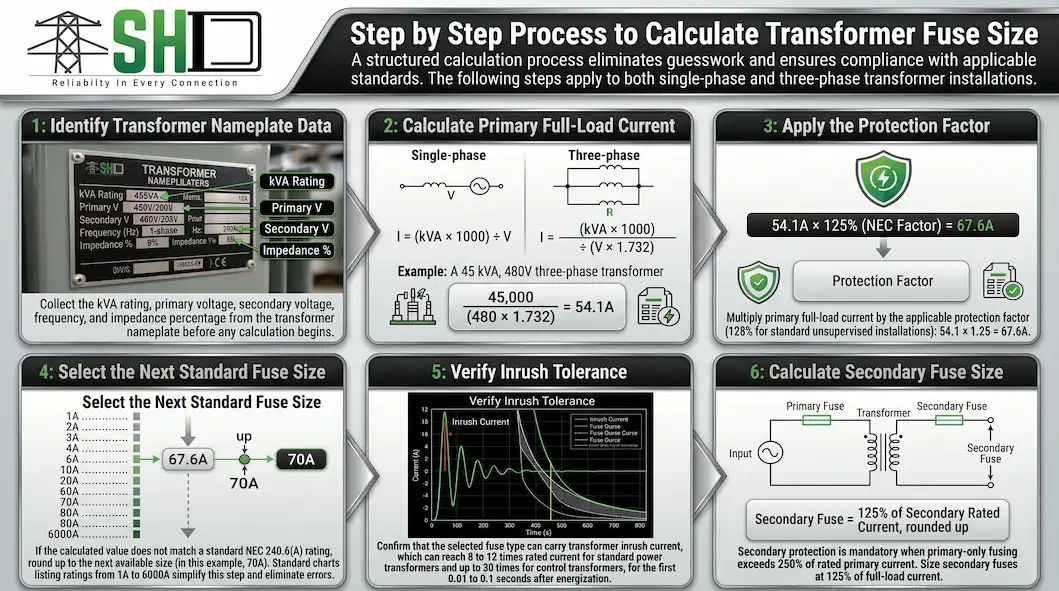
Step by Step Process to Calculate Fuse Size for Transformer:
A structured calculation process eliminates guesswork and ensures compliance with applicable standards, The following steps apply to both single-phase and three-phase transformer installations.
-
Step 1: Identify Transformer Nameplate Data:
Collect the kVA rating, primary voltage, secondary voltage, frequency, and impedance percentage from the transformer nameplate before any calculation begins.
-
Step 2: Calculate Primary Full-Load Current:
The transformer fuse sizing formula varies by phase:
- Single-phase: I = (kVA × 1000) ÷ V
- Three-phase: I = (kVA × 1000) ÷ (V × 1.732)
Example: A 45 kVA, 480V three-phase transformer → I = 45,000 ÷ (480 × 1.732) = 54.1A
-
Step 3: Apply the Protection Factor:
Multiply primary full-load current by the applicable NEC factor:
125% for standard unsupervised installations: 54.1 × 1.25 = 67.6A
-
Step 4: Select the Next Standard Fuse Size:
If the calculated value does not match a standard NEC 240.6(A) rating, round up to the next available size – in this example, 70A. A transformer fuse sizing chart listing standard ratings from 1A to 6000A simplifies this step and eliminates manual interpolation errors.
-
Step 5: Verify Inrush Tolerance:
Confirm that the selected fuse type can carry transformer inrush current, which can reach 8 to 12 times rated current for standard power transformers and up to 30 times for control transformers, for the first 0.01 to 0.1 seconds after energization.
-
Step 6: Calculate Secondary Fuse Size (if required):
Secondary fuses are sized at 125% of secondary full-load current, then rounded up to the next standard size, Secondary protection is mandatory when primary-only fusing exceeds 250% of rated primary current.
Read More: HV Fuses for Transformer Protection: Selection Guide.
Codes and Standards for Calculating Transformer Fuse Size:
Every decision to calculate fuse size for transformer circuits must align with the governing standard for the installation jurisdiction, Compliance is not optional – it determines whether the protection system is legally recognized and insurable.
The primary applicable standards are:
| Standard | Jurisdiction | Key Requirement |
|---|---|---|
| NEC 450.3 | North America | Primary fuse ≤ 125% (unsupervised) or ≤ 250% (supervised) |
| NEC 240.6(A) | North America | Standard fuse ampere ratings for selection |
| IEC 60076 | International | Transformer protection and overcurrent coordination |
| IEC 62271 | International | High-voltage switchgear and protection device requirements |
| GB/T 11022 | China | Common technical requirements for high-voltage switchgear |
When working across multiple jurisdictions, always verify which standard takes precedence with the local Authority Having Jurisdiction (AHJ) before finalizing protection design.
Read More: Pin Insulator vs Post Insulator Comparison.
Failure Statistics & Common Mistakes in Fuse Selection:
The most common errors when calculating fuse size for transformer protection occur at predictable points – identifying them in advance prevents costly rework and compliance failures:
- Sizing on full-load current alone: Ignores inrush characteristics, resulting in nuisance blowing or inadequate fault protection
- Using fast-acting fuses on primary: Cannot tolerate inrush – will blow during normal energization
- Failing to coordinate primary and secondary protection: Upstream fuses clear faults that should be handled downstream, causing wider outages
- Ignoring changes in available fault current: System upgrades increasing fault current can render existing selections non-compliant
- Assuming primary fuses provide full overload protection: Primary fuses are backup devices; thermal overload requires supplemental sensors or relays
- Skipping secondary fusing above 250% primary sizing: A direct NEC code violation
As outlined in IEC 60076, these recurring errors account for a significant proportion of transformer protection failures in industrial facilities – most of which are preventable with a structured sizing process.
Read More: Polymer vs Porcelain Insulator: Key Differences.
Why Sihedan Is Your Trusted Partner for Transformer Protection?
Selecting the right fuse is only one part of transformer protection – the manufacturer behind it determines real-world performance. Sihedan is a Baoding-based high-tech enterprise specializing in fuses and electrical protection components for domestic and international projects:
- Proven manufacturing expertise: Specialized workshops for machinery, forging, welding, and stamping ensure consistent quality across every batch
- Full OEM / ODM capability: Custom fuse solutions matched to specific transformer ratings, voltage classes, and installation environments
- International market reach: Supplied to the USA, Malaysia, Bolivia, England, Kenya, Uganda, and more – with full tender documentation
- ISO-certified quality system: ISO 9001, ISO 14001, and ISO 18001 covering quality, environmental, and occupational health standards
- No minimum order on first orders: Validate product performance before committing to volume
- Free samples available: Freight-only cost for sample evaluation, reducing qualification risk
For transformer protection projects requiring reliable fuse solutions, Sihedan provides the product range, documentation, and technical support to meet project specifications and code compliance requirements.
Explore Sihedan Transformer Protection Products and Solutions:
Sihedan offers a complete range of fuse products for low and medium-voltage transformer protection, built to international standards and tested for reliable field performance:
- Drop Out Fuse (11-36kV): Combines switching and overcurrent protection – fuse link melts, holder drops vertically for immediate visual fault confirmation on overhead feeder lines
- 33KV Fuse Links K Type: EEI-NEMA Type K and T rated, 1–200A, compatible with 10-36kV expulsion cutouts – direct-fit for medium-voltage transformer protection
- GG GL Cylindrical Fuse Link 30×58 – 100KA 500V: Pure metal element in ceramic cartridge, rated 100KA at 500V AC/DC, IEC 0269 compliant – ideal for low-voltage secondary current-limiting protection
- MC300 HDCO Heavy Duty Cutout Base: Rated 40A–300A, 415/500/550VAC, 80kA breaking capacity – covers full NEC 240.6(A) ratings for single and three-phase installations
For product inquiries, technical specifications, or OEM requests, connect with Sihedan directly:
- WhatsApp: +8613968767426.
- Email: info@sihedan.com.
- Support: Visit our Contact Us page.
FAQs:
What does calculating fuse size mean for transformers?
Calculating fuse size means determining the correct overcurrent protection rating using the transformer’s kVA, voltage, and NEC 450.3 or IEC 60076 factors – ensuring normal operation while clearing sustained faults before damage occurs.
Why do transformers experience high inrush currents during startup?
At energization, the transformer core draws 8–30 times full-load current depending on core material and energization point. Time-delay fuses are required because fast-acting fuses would trip on inrush as a fault.
Is upgrading to a standardized drop out fuse a cost effective decision?
Yes – drop-out fuses combine visible isolation, automatic fault clearing, and field-replaceable elements, offsetting upfront cost through reduced downtime and eliminating separate isolation switches in most medium-voltage installations.
Leave a Reply