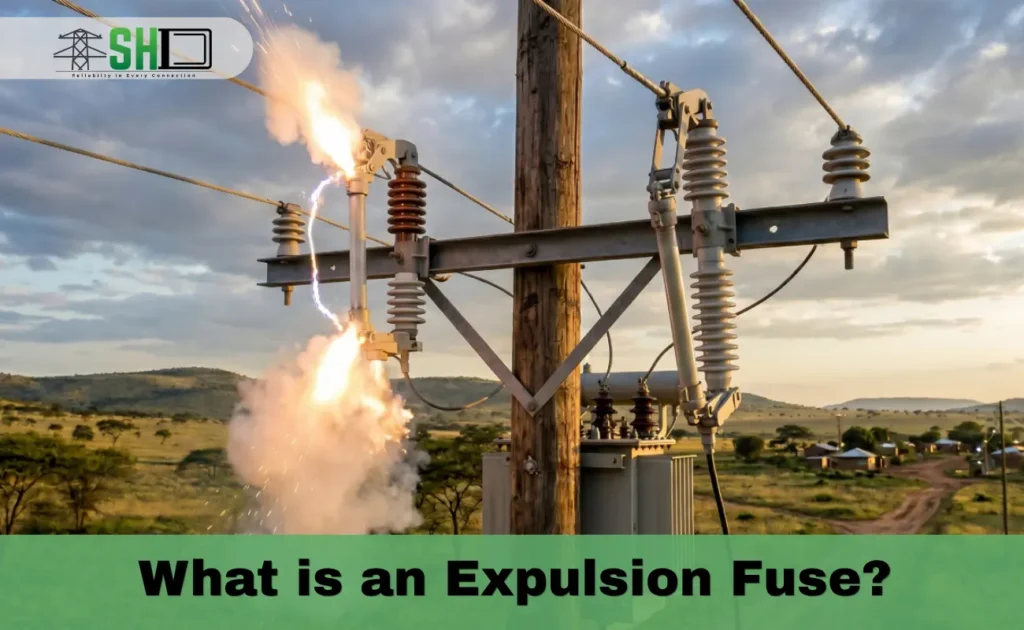
What is an expulsion fuse is a question every distribution engineer in Africa must answer correctly, Understanding what is an expulsion fuse starts with this: a high-voltage protective device interrupting fault current by expelling arc gases through a vented tube at 2.8–38 kV, with immediate visual fault indication, According to IEA (2024), 600 million people in Africa still lack reliable electricity access.
What is an expulsion fuse?
Knowing what is an expulsion fuse means understanding a zero-current-awaiting device that clears faults at the natural current zero, expelling ionized gases, Per IEEE C37.42-2016, it is classified as:
- Class A (Distribution): 1–38 kV – overhead feeders, pole-mounted transformers, tap lines.
- Class B (Power): 1–170 kV – substation and transmission protection.
The expulsion fuse transformer configuration is the most common deployment in African overhead networks, protecting pole-mounted transformers on rural feeders.
The Physics and Internal Components of Expulsion Fuses:
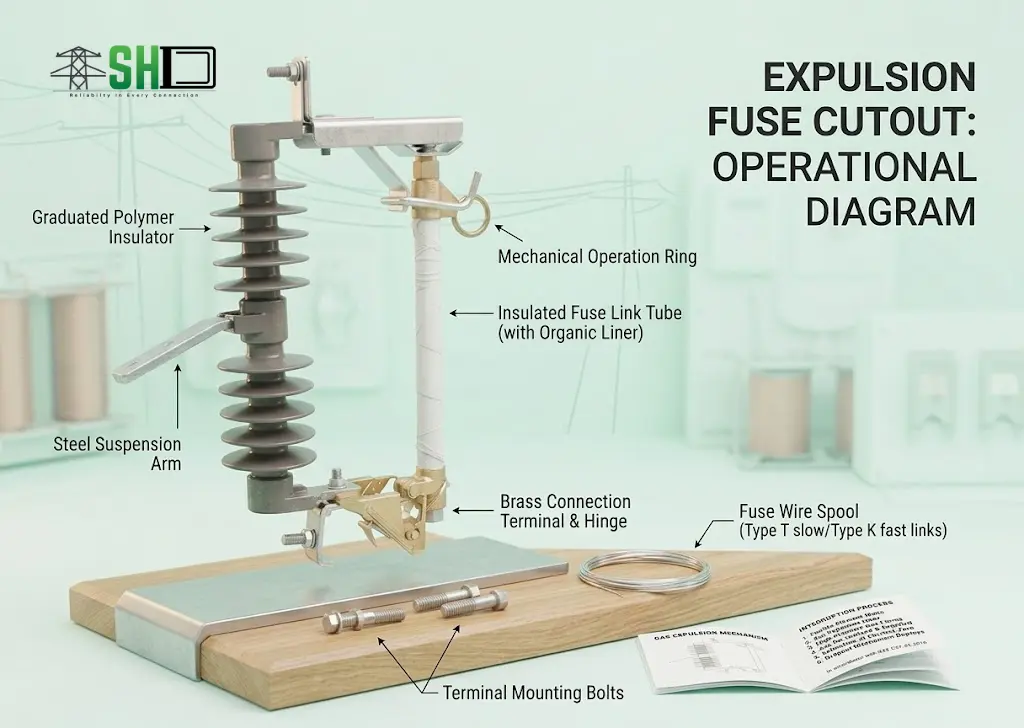
The fault interruption process depends on four components working together:
- Fusible element: Tinned copper wire with flexible braid – melts under fault and initiates arcing.
- Gas-generating liner: Organic tube that vaporizes under arc impingement, producing a gas blast that de-ionizes and expels the arc.
- Frangible diaphragm: Ruptures under high fault current for double-end venting.
- Spring tension assembly: Releases on element melt, dropping the carrier by gravity for visible isolation.
The expulsion fuse diagram shows components arranged vertically – upper contact fixed, lower as hinge, carrier drops outward giving line crews immediate visual fault indication from ground level.
How the gas-emitting material works?
During expulsion fuse blowing, arc energy vaporizes the liner, creating high-pressure gas that de-ionizes and expels the arc through the tube, Extinction occurs at current zero, stopping fault current flow.
How Expulsion Technology Differs from Current Limiting Fuses?
The key technical differences between both fuse technologies are:
| Parameter | Expulsion Fuse | Current-Limiting Fuse |
| Interruption method | Zero-current-awaiting; arc expelled through tube | Interrupts within ½ cycle; arc quenched in sand |
| Visual indication | Yes – carrier drops visibly | No external indication |
| Environment | Outdoor only; produces noise and gases | Indoor or outdoor; silent |
| Voltage range | 1–38 kV (A) / 1–170 kV (B) | 1–38 kV |
| Cost | Lower upfront cost | Higher upfront cost |
Primary Criteria and Ratings for Expulsion Fuses:
Selecting the correct what is expulsion type fuse rating requires evaluating these parameters per IEEE C37.42-2016:
- Continuous current rating: 1–200A for distribution class.
- Voltage rating: Standard ratings: 5.5, 8.3, 15, 27, 38 kV.
- Fuse link type: Type K (fast) for feeders; Type T (slow) for transformers and capacitors.
- X/R ratio: ≤ 15 per IEEE C37.42-2016.
Read More: types of insulators in power system.
Field Applications to Understand What is an expulsion fuse:
Field deployment is the clearest way to understand what is an expulsion fuse and why it remains the dominant protection choice for overhead networks across Africa:
- Transformer protection: The expulsion fuse transformer cutout protects 5–500 kVA pole-mounted transformers with visible fault indication for line crews.
- Feeder tap protection: Limits fault zones at branch points, reducing outage impact on rural communities.
- Capacitor bank protection: Type T links tolerate inrush while clearing internal faults.
- Substation feeder exits: Class B fuses protect exits at 33 kV+ where current-limiting is not required.
Read More: Function of Insulator in Transmission Line: Types, Specs & Selection.
Routine Inspection and Maintenance for Overhead Network Protection:
A structured program for every installation where what is an expulsion fuse matters extends service life and maintains fault interruption performance:
- Contacts: Inspect for corrosion or deposits – clean or replace if resistance is elevated.
- Fuse carrier tube: Check for cracks or moisture – replace before re-energization if damaged.
- Fuse link: Verify correct type (K or T) and rating – never substitute a higher-rated link.
- Hinge and spring: Confirm free operation and clean drop-out.
- Mounting hardware: Check for corrosion – critical in coastal and high-humidity environments.
Interval: 12 months (normal) / 6 months (coastal, high-dust) per IEC 60815.
Failure Statistics and Common Mistakes in Expulsion Mechanisms:
Most failures in the field – for anyone asking what is an expulsion fuse and why it failed – result from incorrect selection or inadequate maintenance, not the device itself, Common causes of premature expulsion fuse blowing include:
- Wrong link type: Type K on transformers causes nuisance blowing on 8–12× inrush.
- Oversized link: Thermal stress and poor upstream coordination.
- Cracked tube: Failed interruption and potential rupture.
- X/R > 15: Exceeds interrupting rating and risks catastrophic failure.
- No coordination study: Must coordinate with reclosers via TCC curves per IEEE C37.42-2016.
Per IEEE Std, 1366-2012, most customer interruptions originate at the distribution layer – properly specified expulsion fuses are the first line of defense.
Read More: HV Fuses for Transformer Protection: Selection Guide.
International Safety Standards for Expulsion Fuses:
Every project where what is an expulsion fuse is specified must comply with applicable international standards:
- IEEE C37.42-2016: Class A (1–38 kV) and Class B (1–170 kV) construction, testing, and rating requirements.
- IEEE C37.48-2005: Application, coordination, and maintenance guide.
- IEC 60282-1: E-rated fuse selection – widely referenced in African utility specifications.
- IEC 60815: Pollution severity for coastal, desert, and industrial environments.
Request IEC 60282-1 and IEEE C37.42-2016 certificates at procurement stage, For dry and fire-prone areas, IEEE C37.48 requires 1.8m ground clearance below the vent – understanding what is expulsion type fuse compliance is critical in Southern and Eastern African savanna networks.
Why Sihedan Is Your Trusted Partner for Protection Solutions?
The manufacturer determines real-world performance wherever what is an expulsion fuse is deployed under African field conditions, Sihedan is a Baoding-based enterprise specializing in fuses and protection components for international projects:
- IEEE C37.42 and IEC 60282-1 certified: Full documentation for African utility tender submissions.
- Africa-optimized design: Engineered for high-temperature, high-humidity, and high-pollution environments per IEC 60815.
- Full OEM / ODM capability: Custom ratings and configurations per project specifications.
- ISO 9001, 14001, 18001 certified: Quality, environmental, and occupational health systems.
- No minimum order on first orders: Sample evaluation at freight cost only.
Explore Sihedan Expulsion Fuse Products and Components:
Sihedan offers a complete range for overhead network protection:
- Drop Out Fuse (11–36kV): Carrier drops vertically for immediate visual fault confirmation on overhead feeder lines.
- 33KV Fuse Links K Type: EEI-NEMA Type K and T, 1–200A, compatible with 10–36kV cutouts.
- 11KV Fuse Link K 660mm: Designed for 10–36kV cutouts, meeting EEI-NEMA Type K/T requirements (1–200A) to safely handle overloads and cold load pick-up.
- MC300 HDCO Heavy Duty Cut out Base: Rated 40A–300A, 80kA, full NEC 240.6(A) ratings.
Ready to secure your distribution network with reliable solutions? For inquiries, OEM requests, and technical details, contact info@sihedan.com or visit the Sihedan website. Contact us via WhatsApp and Email for a customized quote immediately.
FAQs:
How does the gas emitting material inside the fuse actually work?
The arc vaporizes the organic liner, generating high-pressure gas that de-ionizes the arc and expels it through the tube at the natural current zero crossing.
What causes the outer tube of the fuse to crack or explode during a fault?
Unintended cracking results from a degraded tube, exceeding the maximum interrupting rating, or X/R > 15. High fault currents intentionally rupture the frangible diaphragm for double-end venting.
Are there specific environmental compliance codes for using these fuses in dry areas?
Yes – IEEE C37.48 requires minimum 1.8m ground clearance, Exhaust control devices or current-limiting alternatives are recommended in fire-prone areas where clearance cannot be met.
How does utilizing a properly rated expulsion fuse reduce grid downtime costs?
A correctly rated fuse isolates only the faulted section, preserving supply elsewhere, The visible drop-out indicator allows rapid fault location and replacement, minimizing restoration time.
Sources:
- IEA – Access to Electricity in Africa 2024.
- ScienceDirect – Fuse Operation, Transmission and Distribution Electrical Engineering.
Leave a Reply