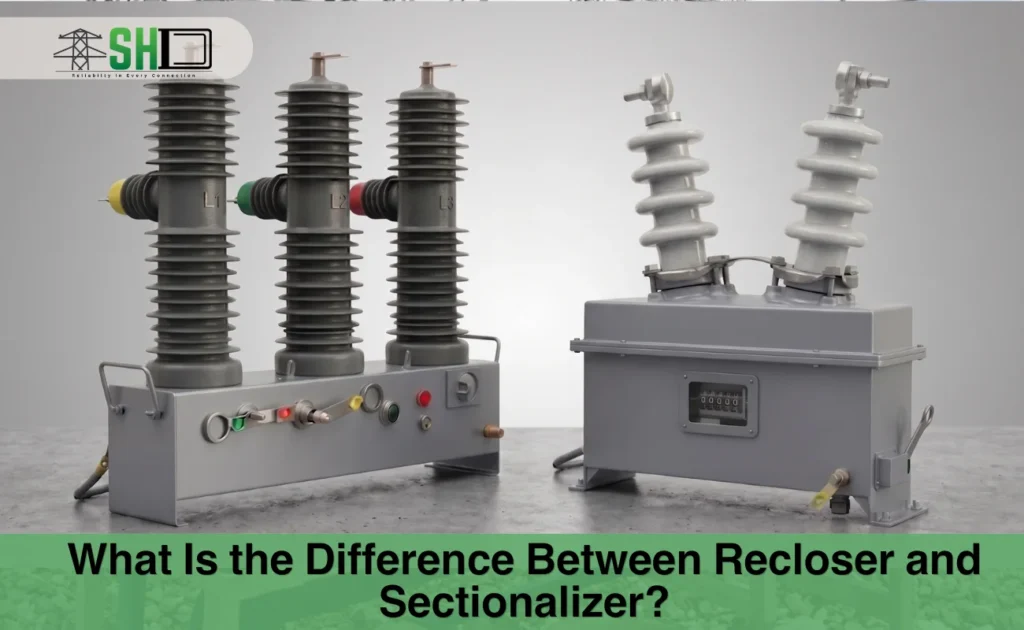
The difference between recloser and sectionalizer lies primarily in their fault-interrupting capabilities and operational logic. A recloser is an automated overcurrent device that interrupts a fault, pauses, and then attempts multiple reclosing operations to restore service. A sectionalizer isolates a faulted section once, using sensing and tripping to protect downstream equipment. In most designs, the difference between sectionalizer and recloser, a recloser includes coordinated timing and reclose intervals, while a sectionalizer focuses on fast, permanent separation. As a result, reclosers can clear temporary faults without permanently changing the network configuration.
What Is an Auto Recloser?
An Auto Recloser is a smart high-voltage switch used in electrical distribution networks that automatically cuts off power during a temporary fault and turns it back on moments later. It senses current, opens, waits, and reclose-attempts (for example, if the fault was temporary like a lightning flash or brief contact).
The difference between auto recloser and sectionalizer If the fault persists, the recloser will lock out to prevent repeated damage and allow crews to identify and repair the problem.
Read More: Circuit Breaker in Transmission Line: Best Choice Criteria.
What Is a Sectionalizer?
A sectionalizer is an electrical protective switching device used on distribution lines to automatically isolate a faulted section of the network, limiting the interruption to only the area where the fault occurs, Working alongside an upstream recloser.
The difference between recloser and sectionalizer, a sectionalizer is typically designed for fewer operations, often aimed at permanent separation rather than repeated reclosure attempts.
The Key Difference Between Recloser and Sectionalizer
The difference between recloser and sectionalizer in distribution networks, a recloser detects and actively clears faults, while a sectionalizer cooperates with it by isolating the faulted zone after de-energizing for safety.
| Feature | Recloser | Sectionalizer |
| Main purpose | Reclose after a fault to restore service | Isolate (section off) the faulted portion |
| Operation style | Opens and then attempts one or more reclose cycles | Opens once to separate the faulted section (typically less emphasis on repeated reclose) |
| “Fault type” commonly addressed | Often temporary faults (lightning, brief contact) | Faults that require isolating a specific downstream section (often closer to permanent separation) |
| Service continuity | Can restore power quickly without changing network topology | Limits outages to a smaller section of the feeder |
| Coordination with other devices | Coordinates with relays/reclosers using timing and counts | Coordinates with reclosers to minimize customer impact |
| Lockout behavior | Locks out after programmed unsuccessful trips/reclose attempts | Trips to isolate and generally remain open until remote or manually reset (system-dependent) |
| Typical placement | Mid-feeder or locations where repeated restoration attempts are useful | Downstream locations where fault isolation is needed to protect remaining load and equipment |
| Customer impact | May momentarily interrupt service during opening/reclose attempts | Interrupts only the customers on the faulted section, keeping the rest energized |
| Typical Placement | Installed upstream on main lines to act as a “first responder”. | Installed downstream of a recloser on branches or specific zones to isolate trouble. |
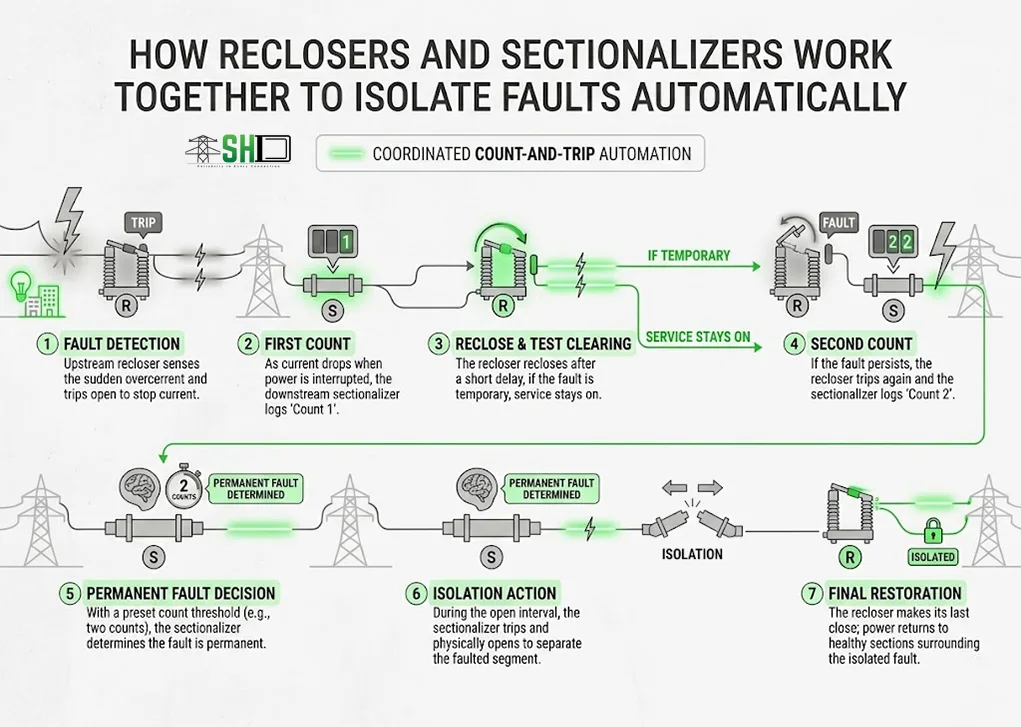
How Reclosers and Sectionalizers Work Together to Isolate Faults Automatically
To understand the difference between recloser and sectionalizer, you need to know how reclosers and sectionalizers work. Auto recloser and sectionalizer coordinate a “count-and-trip” automation that detects faults and retries service.
- Fault detection: The upstream recloser senses the sudden overcurrent and trips open to stop current.
- First count: As current drops when power is interrupted, the downstream sectionalizer logs “Count 1.”
- Reclose & test clearing: The recloser recloses after a short delay; if the fault is temporary, service stays on.
- Second count: If the fault persists, the recloser trips again and the sectionalizer logs “Count 2.”
- Permanent fault decision: With a preset count threshold (e.g., two counts), the sectionalizer determines the fault is permanent.
- Isolation action: During the open interval, the sectionalizer trips and physically opens to separate the faulted segment.
- Final restoration: The recloser makes its last close; power returns to healthy sections surrounding the isolated fault.
Read More: Differentiate Between Fuse and Circuit Breaker Specs in MV
How to Choose Between a Recloser and a Sectionalizer for Medium Voltage Networks?
Choose between a Recloser and a Sectionalizer by matching your medium-voltage network’s fault-clearing needs, budget, and protection coordination goals, difference between recloser and sectionalizer then selecting the device that fits those constraints.
- Identify fault-clearing needs: Use a recloser where active detection and fault interruption are required (e.g., key line points or substations).
- Use sectionalizers for segmentation: Use a sectionalizer to isolate a permanent fault after the upstream recloser has cleared the initial surge.
- Compare cost & complexity: difference between recloser and sectionalizer, Sectionalizers are typically cheaper and simpler because they don’t break fault current; they open while the line is de-energized.
- Consider independent control: Difference between recloser and sectionalizer, a recloser costs more but provides autonomous fault interruption and “test and reclose” behavior for transient faults.
- Evaluate coordination & timing: Coordinating multiple reclosers on long/rural feeders can be timing-intensive; sectionalizers often simplify coordination via preset count logic (e.g., open after the 2nd or 3rd recloser trip).
Why Sihedan Company Provides Reliable Auto Reclosers for Medium Voltage Networks?
Sihedan provides reliable auto reclosers for medium-voltage networks by combining vacuum-break interruption technology, robust outdoor design, and engineering controls that support demanding switching duty cycles, such as the 33kV Auto Recloser and its key features:
- Reliable fault switching: Uses a low-resistance vacuum interrupter for rapid, clean circuit breaking with minimal degradation over time.
- Built for frequent operation: Incorporates a modular spring operating mechanism optimized for repetitive switching and quick response.
- Wide voltage compatibility: Works across 30 kV / 33 kV / up to max 36 kV systems (supports classes from 11 kV to 38 kV).
- Strong current handling: Supports an 800 A continuous rating with rated current options up to 1250 A / 1600 A for heavier industrial loads.
- Outdoor resilience: Designed for harsh conditions, operating from -40°C to +40°C, up to 2000 m altitude, and wind resistance up to 34 m/s.
- Long service life & low maintenance: Simple, cost-effective structure intended to reduce maintenance needs while sustaining weather exposure.
- Quality & EPC readiness: Supported by ISO-based quality controls (ISO 9001/14001/18001) and offers B2B & EPC-ready documentation for procurement.
- Customizable for projects: OEM/customization available based on project requirements.
Need expert engineering support to select the right MV protection equipment? Reach out to Sihedan via our Contact Us page, chat with our technical team on WhatsApp, or email us at info@sihedan.com to secure your project today.
FAQs:
Can a sectionalizer operate without an upstream recloser?
No. Sectionalizers cannot interrupt fault current. They must work alongside an upstream device (like a recloser) that clears the fault. The sectionalizer relies on the upstream device to temporarily cut the power so it can safely open while the line is dead.
How many reclose attempts does a typical recloser make before lockout?
A standard recloser typically makes 3 to 4 attempts to re-energize the circuit (sometimes referred to as “shots”) before locking out. The sequence usually involves rapid trips and recloses, finishing with a final open operation if the fault persists.
What happens if a recloser closes on a permanent fault?
If the fault is permanent, the recloser will continue to cycle through its programmed trip-and-reclose sequence. If the fault remains at the end of these cycles, the recloser stays open (lockout), permanently isolating that section of the grid until maintenance crews manually resolve the issue.
Leave a Reply