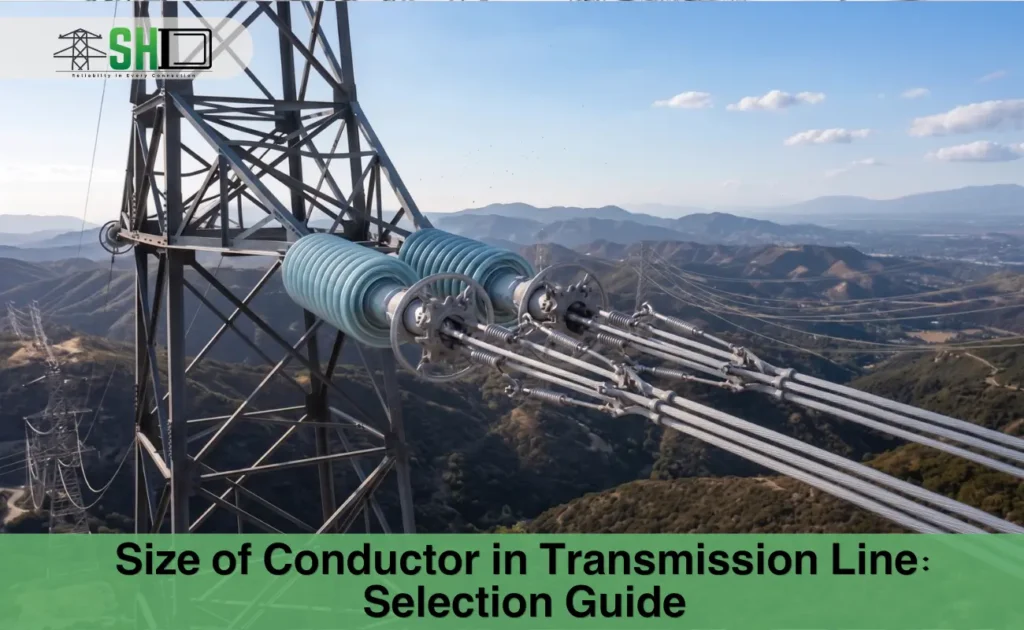
Selecting the correct size of conductor in transmission line is one of the most critical decisions in power system design, as it directly determines current capacity, energy losses, mechanical sag, and the overall safety of the overhead network
What is the Size of Conductor in Transmission Line?
The size of conductor in transmission line refers to the cross-sectional area of the conductive material — measured in mm², AWG, or kcmil — that determines how much current the conductor can carry without exceeding the allowable thermal limit for standard ACSR conductors per IEC 61089.
Why Conductor Size Matters?
The size of a conductor is not merely a physical dimension – it governs three interconnected performance factors that define the reliability and economy of the entire transmission system:
- Current capacity (ampacity) – a larger cross-section carries more current without overheating.
- Resistance and I²R losses – smaller conductors have higher resistance, leading to greater energy waste as heat.
- Mechanical behaviour – conductor size affects weight per metre, which directly controls sag, tension, and tower spacing.
Read More: Types of Overhead Line Conductors: Comparison & Specs Guide.
What Determines the Size of Conductor in Transmission Line and Why It Matters?
The selection of conductor size in transmission line depends on electrical, mechanical, and environmental parameters evaluated together, and per IEEE Std 738-2023, the current-temperature relationship varies with ambient temperature, wind speed, and solar radiation:
- Maximum load current — the conductor must sustain peak demand without exceeding its rated temperature.
- Voltage level — higher voltages require larger conductors to reduce resistive losses.
- Span length and tower spacing — longer spans demand higher tensile strength, often requiring a steel-reinforced core.
- Ambient temperature — higher ambient temperatures reduce heat dissipation, effectively lowering the safe current rating.
- Corona discharge — at voltages above 33 kV, minimum diameter requirements apply to prevent corona losses.
How Conductor Size is Measured Using mm², AWG and kcmil?
Three measurement systems are used globally for conductor sizing, and understanding each is essential for cross-referencing manufacturer data sheets and international project specifications:
| Unit | Region | Key Feature |
| mm² | International (IEC) | Direct cross-sectional area – most intuitive |
| AWG | North America | Inverse scale – smaller number = larger wire |
| kcmil | North America (large cables) | Used above 4/0 AWG; 1 kcmil = 0.5067 mm² |
Quick Conversion Reference:
A few widely used conductor sizes across both systems for quick field reference:
- 50 mm² ≈ 1/0 AWG ≈ 98.7 kcmil – common for 11kV distribution lines.
- 120 mm² ≈ 4/0 AWG ≈ 211 kcmil – standard for 33kV feeders.
- 240 mm² ≈ 477 kcmil – typical for primary 33kV transmission.
- 400 mm² ≈ 795 kcmil (ACSR Drake) – widely used in 132kV and above.
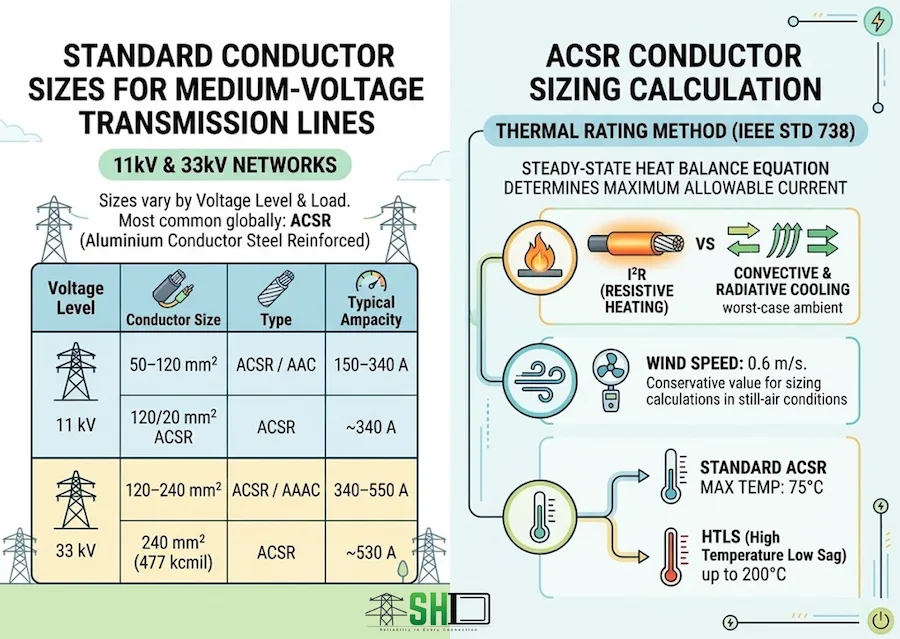
Standard Conductor Sizes for 11kV and 33kV Transmission Lines:
Standard conductor sizes vary by voltage level and load requirement, and the most common conductor type globally is ACSR (Aluminium Conductor Steel Reinforced), which ranges from #6 AWG to 2167 kcmil, with the following sizes being standard for medium-voltage networks:
| Voltage Level | Conductor Size | Type | Typical Ampacity |
| 11 kV | 50–120 mm² | ACSR / AAC | 150–340 A |
| 11 kV | 120/20 mm² ACSR | ACSR | ~340 A |
| 33 kV | 120–240 mm² | ACSR / AAAC | 340–550 A |
| 33 kV | 240 mm² (477 kcmil) | ACSR | ~530 A |
ACSR Conductor Sizing Calculation:
The ACSR conductor sizing calculation follows the thermal rating method defined in IEEE Std 738, where the steady-state heat balance equation determines the maximum allowable current:
- I²R (resistive heating) must be balanced against convective and radiative cooling under worst-case ambient conditions.
- Wind speed is typically set at 0.6 m/s as a conservative value for sizing calculations in still-air conditions.
- Maximum conductor temperature is 75°C for standard ACSR and up to 200°C for HTLS (High Temperature Low Sag) conductors.
How Conductor Size Affects Sag, Tension and Tower Spacing?
Conductor size directly impacts the mechanical behaviour of transmission lines — per IEEE Xplore — Sag and Tension Calculation, sag and tension vary with temperature, wind load, and ice accumulation:
- Larger conductors are heavier per metre, increasing sag and requiring taller towers or shorter spans to maintain ground clearance.
- Higher tension reduces sag but increases mechanical load on towers, foundations, and the supporting Overhead Power Line Hardware.
- Smaller conductors allow longer spans but carry less current and have higher resistive losses.
- Thermal sag rises under emergency loading — driving adoption of real-time thermal rating (RTTR) systems.
The sag formula: S = wL² / 8T — where S is sag (m), w is weight per unit length (N/m), L is span (m), and T is tension (N).
Read More: Dead End Clamp Function: Applications & Selection Guide.
How to Choose the Right Size of Conductor in Transmission Line for Your Project?
Choosing the correct size of conductor in transmission line requires a structured engineering approach that balances four competing requirements — ampacity, losses, mechanical performance, and cost — and the following step-by-step process is aligned with IEC and IEEE best practices:
- Determine maximum load current — calculate peak demand current including future load growth over the design life (typically 25–30 years).
- Apply thermal rating — use IEEE Std 738 or IEC 61089 to compute the required cross-section that keeps the conductor below 75°C under worst-case ambient conditions.
- Check voltage drop — verify that resistive losses do not cause end-of-line voltage to fall below the permissible 5–10% of nominal voltage.
- Calculate sag and tension — confirm that the chosen conductor meets ground clearance requirements under maximum operating temperature and ice/wind loading per IEC 60826:2017.
- Verify corona limits — at 33 kV and above, conductor surface gradient must remain within acceptable values to prevent corona discharge.
- Optimise for lifecycle cost — a slightly larger conductor costs more upfront but saves significantly more in I²R energy losses over a 30-year service life.
Read More: Insulators Used in Transmission Lines Explained.
How Sihedan Delivers the Exact Conductor Size You Need?
For any project requiring precise selection of conductor size in transmission line, Sihedan delivers ACSR, AAAC, and ACSS conductors across mm², AWG, and kcmil sizes — backed by IEC 61089 and acsr conductor sizing calculation support per IEEE Std 738-2023 to meet every electrical and mechanical requirement.
Need expert assistance in choosing the ideal conductor size for your project? Reach out via our Contact Us page, message us directly on WhatsApp, or email us at info@sihedan.com for customized engineering solutions.
FAQs:
Why can’t we just use the thickest conductor available for transmission lines?
Thicker conductors are heavier, increasing sag and tower costs; they also require larger, more expensive structures, making oversizing economically and mechanically impractical for most projects.
How does high ambient temperature affect the calculated size of a conductor?
Higher ambient temperature reduces the conductor’s ability to dissipate heat, lowering its safe ampacity – so a larger cross-section is required to carry the same current without exceeding the 75°C limit.
What is the difference between stranded conductor size and overall diameter?
Stranded conductor size refers to the aluminium cross-sectional area in mm², while overall diameter includes the steel core and all aluminium strands – making overall diameter always larger than the conductor size alone.
Leave a Reply