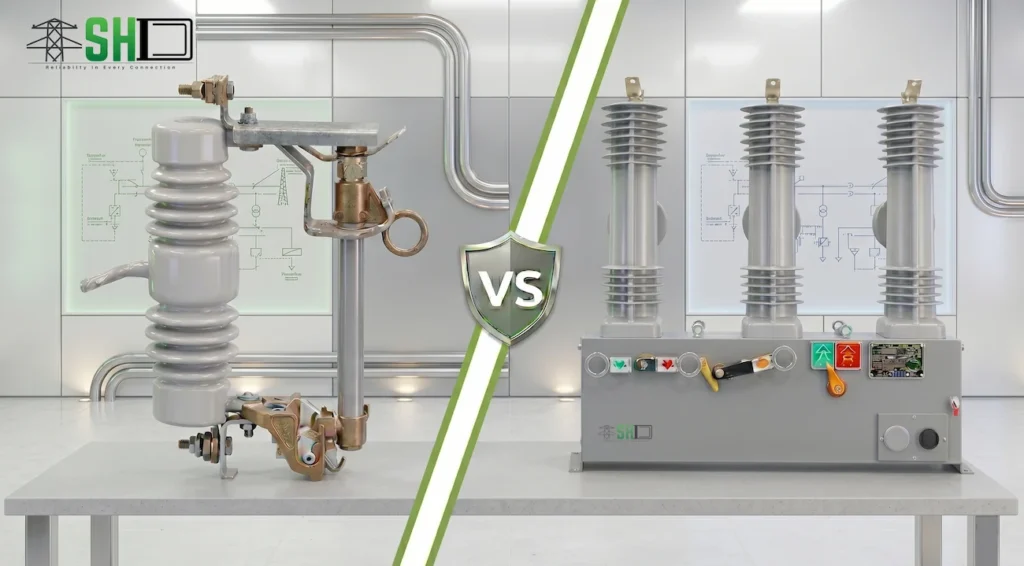
To differentiate between fuse and circuit breaker, Sihedan recommends understanding how each device protects electrical systems. A fuse contains a thin metal element that melts when current exceeds a safe level, interrupting the circuit permanently until replaced. In contrast, a circuit breaker automatically trips when it detects overcurrent or faults, then can often be reset after the issue is resolved. Knowing these differences helps homeowners and technicians select appropriate protection, improving safety and reducing downtime from repeated trips or replacements.
What is a circuit breaker and how does it work?
A circuit breaker is a safety switch that stops electricity when there is an overload or a short circuit. When turned on, it lets power flow normally to the wiring it protects. If the current becomes too high or a fault happens, the breaker “trips” and automatically turns the power off.
Circuit breakers are often installed to protect critical infrastructure, and are typically installed in medium voltage switchgear and motor control centers. They use internal mechanisms—such as thermal or electromagnetic parts—that detect dangerous current levels and trigger the trip. Each breaker also has a current rating, where smaller ratings protect smaller circuits and larger ratings protect bigger sections industrial plant feeders.
Read More: What is an Expulsion Fuse? A Complete Technical Guide.
What is a fuse and how does it work?
A fuse is a simple protection device placed in the electrical circuit to guard a device or wiring line. It contains a thin strip of metal that carries current safely under normal conditions. If too much current flows due to overload or a short circuit, the metal strip melts, breaking the circuit and cutting off the power.
Fuses are made for specific current and voltage ratings in industrial power systems (e.g., 10A, 20A, 50A, 100A for medium voltage) and must match the device’s requirements. Once a fuse blows, it cannot be reused and must be replaced with the correct-rated fuse. Using the wrong fuse rating—such as one with a higher current—can cause overheating, fault clearing failure, and may lead to fire or equipment damage.
What is the Function of Fuses and Circuit Breakers?
Fuses and circuit breakers are protective devices that safeguard electrical systems. To differentiate between fuse and circuit breaker functions, note that a fuse breaks the circuit by melting once a fault occurs, while a circuit breaker can be reset after it trips.
- Overcurrent protection: They cut off power when current rises beyond safe limits to prevent damage.
- Short-circuit protection: They interrupt the circuit immediately when a fault is detected, limiting heat and risk.
- Overload prevention: They help ensure devices and wiring do not draw more power than they are designed to handle.
- Safety and isolation: They protect both people and equipment by disconnecting electricity during a problem.
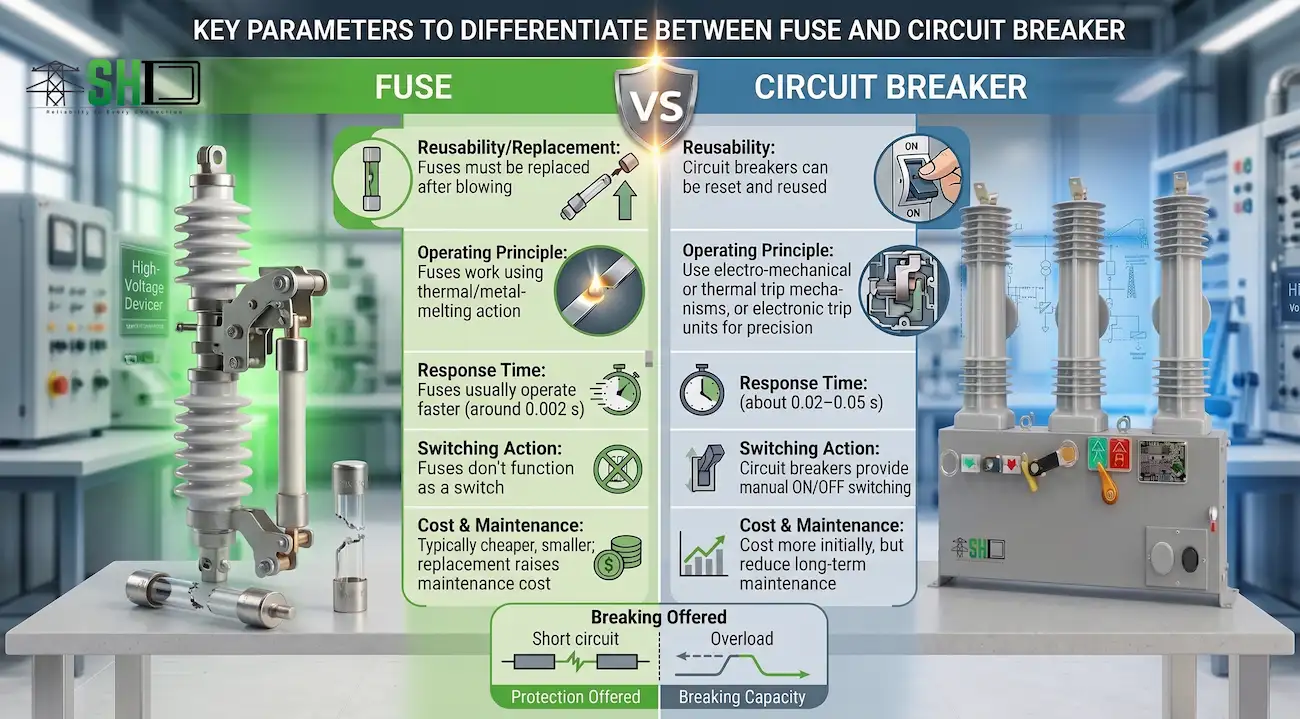
Key Parameters to Differentiate Between Fuse and Circuit Breaker:
The fuse and circuit breaker difference in many ways, but both are used to control how much electrical power a system can handle. Fuse technology mainly focuses on permitting a certain maximum current to flow to a protected device. Difference between fuse and circuit breaker:
- Reusability/Replacement: Fuses must be replaced after blowing; circuit breakers can be reset and reused.
- Operating Principle: Fuses work using thermal/metal-melting action; circuit breakers use electro-mechanical or thermal trip mechanisms, or electronic trip units for precision.
- Response Time: Fuses usually operate faster (around 0.002 s) than circuit breakers (about 0.02–0.05 s).
- Protection Offered: A fuse is generally faster for short circuits than a Circuit Breaker, but for overloads, the speed depends on the specific time-current curve of each device. A circuit breaker is designed for overloads and also handles short circuits.
- Switching Action: Fuses don’t function as a switch; circuit breakers can provide manual ON/OFF switching for isolation or infrequent operation.
- Cost & Maintenance: Fuses are typically cheaper and smaller, but replacement raises maintenance cost; circuit breakers cost more initially but reduce long-term maintenance.
- Breaking Capacity: Both devices can safely interrupt without sustaining damage from fault currents up to a specified maximum value, known as their breaking capacity.
Summary fuse and circuit breaker comparison in table:
| Feature | Fuse | Circuit Breaker |
| Reusability | Cannot be reused | Reusable |
| Response Time | Fast (0.002s) for short circuits | Slower (0.02-0.05s) for short circuits |
| Operation | Thermal (Melting) | Electromagnetic/Thermal/ or electronic |
| Resetting | Replacement needed | Manual/Automatic switch |
| Protection | Overload (only gG type) & Short Circuit | Overload & Short Circuit |
| Breaking Capacity for same size | Very high (up to 100kA+ at low cost) | Moderate (higher cost for high ratings) |
| Cost | Low Initial Cost | High Initial Cost |
| Maintenance | High (replacement cost) | Low (reset) |
Advantages and Limitations of Fuses and Circuit Breakers:
Fuses and circuit breakers are critical components for protecting electrical systems from overcurrents, but differentiate between fuse and circuit breaker in cost, speed, and long-term utility.
Fuses:
Advantages:
- Very fast response to sudden overcurrents, helping protect sensitive equipment.
- Low initial cost and simple design.
- High reliability due to no moving parts.
- Compact saving space in panels.
Limitations:
- Single-use blown fuse must be replaced, causing downtime and requiring spare stock.
- Safety risks during replacement including the chance of using the wrong fuse rating.
Circuit Breakers:
Advantages:
- Resettable and reusable, reducing downtime after a trip.
- Safer operation since terminals are enclosed and fault status is easier to identify.
- More versatile control including acting as an infrequent ON/OFF switch for isolation and handling complex power systems well.
Limitations:
- Higher upfront cost than fuses.
- Slower to respond to extreme surges, which can be a concern for very sensitive loads.
- May need maintenance, since mechanical components can wear and require testing.
Read More: Dropout Fuse of Transformer: Premium OEM Solutions.
Field Applications that differentiate between fuse and circuit breaker:
To effectively differentiate between fuse and circuit breaker in field applications, note that fuses are commonly used where fast protection for a specific load is needed, such as in electronics, control circuits, and motor branch protection, because they isolate faults quickly but must be replaced after a trip.
Circuit breakers are typically used on main distribution and larger power circuits since they provide overload and short-circuit protection and can be reset and reused, making them more practical for frequent fault handling and system switching.
Maintenance Requirements and Lifespan of Fuses vs Circuit Breakers:
When you differentiate between fuse and circuit breaker maintenance requirements, you will find that fuses generally have minimal maintenance because they have no moving parts, but their lifespan is effectively limited by the fact that once a fault occurs and the fuse blows, it must be replaced.
Circuit breakers require periodic inspection and testing since their mechanical components can wear and their trip mechanisms must remain accurate over time, but they typically offer a longer service life and can be reset and reused many times, reducing the need for frequent replacements.
Read More: How to Calculate Fuse Size for Transformer? Step by Step.
Common Mistakes When Selecting Fuses and Circuit Breakers:
When you differentiate between fuse and circuit breaker types, selecting the wrong protective device can lead to nuisance trips, overheating, fire risk, or inadequate protection. Common mistakes include:
- Using the wrong current rating for the load.
- Choosing an incorrect fuse/breaker type (slow-blow vs fast-acting, thermal vs magnetic).
- Ignoring voltage and interrupting/breaking capacity requirements.
- Selecting without checking short-circuit withstand needs.
- Replacing with mismatched ratings after a fault.
- Poor coordination between upstream and downstream protection devices.
Read More: HV Fuses for Transformer Protection: Selection Guide.
Why Sihedan Fuses and Breakers Are Trusted for Grid Safety?
When differentiate between fuse and circuit breaker in Sihedan are trusted for grid safety because they deliver dependable overcurrent and short-circuit protection, consistent performance under demanding conditions, and build quality engineered for long-term reliability. Their advanced protection features help minimize downtime, improve system stability, and enhance safety for critical power infrastructure.
Read More: Types of cut out fuse: A Complete Selection Guide.
Explore Sihedan Medium Voltage Circuit Breakers and Drop Out Fuses:
Explore Sihedan Medium Voltage Circuit Breakers and Drop-Out Fuses, designed to strengthen grid reliability and protect distribution networks. These solutions help isolate faults quickly, limit damage to equipment, and maintain stable power flow making them ideal for utilities and industrial power systems.
For expert guidance on selecting the right protection devices for your power systems, reach out to our support team. Connect with us via our Contact Us page, email at info@sihedan.com, or send us a message on WhatsApp for instant assistance.
FAQs:
Can a circuit breaker directly replace a fuse in an existing system?
Yes, a circuit breaker can often replace a fuse, but the differences in speed, type of protection, and panel compatibility mean this should be treated as an upgrade requiring proper, often professional, installation to ensure safety.
Are fuses faster than circuit breakers in clearing short circuit faults?
Yes, fuses are generally faster than circuit breakers at clearing short-circuit faults. Because they rely on the physical melting of a metal element.
Which protective device is better for medium voltage industrial applications?
For most modern medium voltage (MV) industrial applications (5kV to 38kV), Vacuum Circuit Breakers (VCBs), combined with intelligent protection relays, are the preferred choice when the ability to reset and advanced protection features are required; however, fuses remain competitive where fast clearing and low cost are priorities.
Leave a Reply