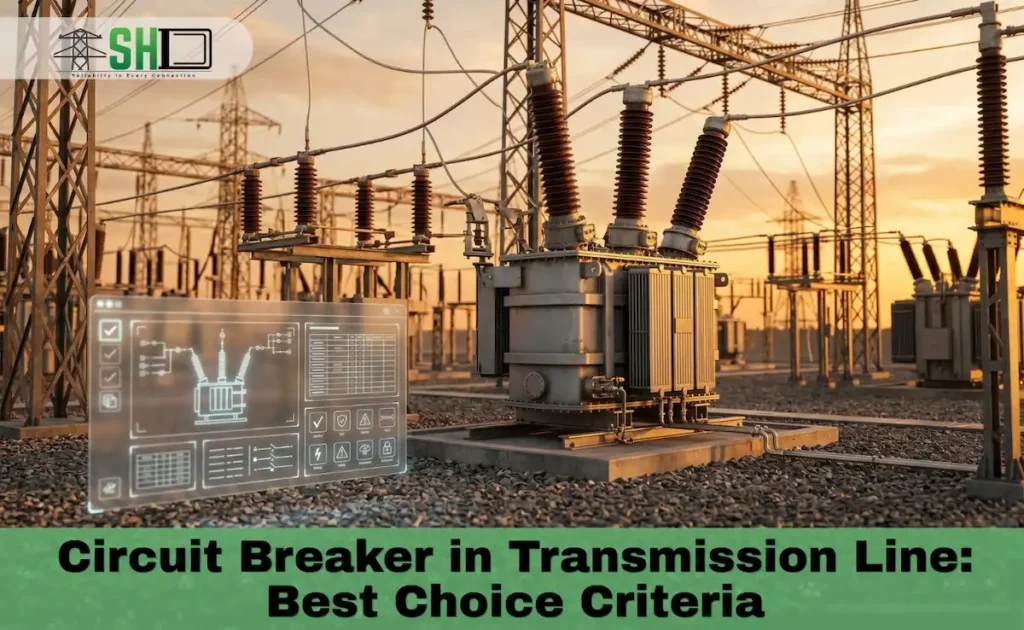
Circuit breaker in transmission line protects high-voltage power systems by interrupting fault currents quickly and reliably. In transmission networks, faults such as lightning strikes, equipment failures, or insulation breakdown can create dangerous overcurrents and voltage dips. Circuit breakers detect these abnormal conditions and separate the affected section, limiting damage and improving safety. By restoring service efficiently and reducing outage duration, they support grid stability and maintain continuous electricity supply for communities and industries.
What is a circuit breaker in transmission line?
A circuit breaker in a transmission line is an automated, high-voltage safety device that detects abnormal fault conditions and rapidly interrupts dangerous short-circuit currents. Unlike regular switches for normal load, it uses relays and protective systems to stop current flow.
Because transmission lines operate at very high voltages, these breakers use specialized insulating media, such as SF6 gas, vacuum, or oil, to quench the arc and isolate the faulty section, helping maintain overall system stability and preventing widespread blackouts.
Read More: Differentiate Between Fuse and Circuit Breaker Specs in MV.
The Main Function and Importance of Circuit Breakers in Power Networks
The main function of a circuit breaker in transmission line is to protect power networks by detecting short circuits, and faults, quickly interrupting current, and improving safety, reliability, and maintenance efficiency.
- Short-Circuit Protection: Sudden, intense surges (direct faults) trigger magnetic mechanisms that trip the breaker within milliseconds, preventing severe equipment damage.
- Manual Switching and Isolation: Breakers support safe disconnection and reconnection of power to specific circuits for repair and maintenance (including “racking out/in”), improving operational safety.
- Arc Extinguishing Capabilities: When the breaker contacts separate under high voltage, a powerful plasma arc is formed. The breaker uses specialized mediums such as Sulfur Hexafluoride (SF6) gas, oil, or a vacuum to rapidly cool and extinguish this arc, ensuring the current is truly stopped without damaging the switch itself.
- Personal Safety: Circuit breaker in transmission line reduce the risk of electric shock and electrocution by removing power from faulted sections.
- System Reliability and Efficiency: Unlike fuses (which must be replaced), circuit breakers can often be reset, reducing downtime and restoring service faster.
- Fault Isolation: In larger networks, breakers act as selective protective devices, isolating only the faulty portion while keeping the rest of the grid operating.
Read More: Function of Insulator in Transmission Line: Types, Specs & Selection
Core Components of a Circuit Breaker in Transmission Line
Circuit breakers in transmission lines depend on specialized, fast-acting components to extinguish intense electrical arcs. The core components of a transmission line circuit breaker include:
1- The Arc Chamber / Interrupter (Where faults are stopped)
- Separates contacts fast during a fault to break the current.
- Uses arc-quenching to cool and de-ionize the arc rapidly.
- Common quenching media:
- SF6 gas (very high-voltage (72.5 kV – 1100 kV), strong insulation).
- Vacuum (increasing use up to around 145 kV).
- Compressed air (used in air-blast designs).
2- The Operating Mechanism (The instant power to move)
- Provides millisecond switching force using stored energy (compressed spring or pneumatic pressure).
- Links the control system to the moving contacts via precision linkages.
3- The Trip Unit / Protection System (The “brain”)
-
- Sensors (Current Transformers) detect abnormal conditions like:
- Short-circuit/faults.
- Sudden surges.
- Uses current transformers (CTs) + relays/electronic trip units to command the breaker to open.
- Sensors (Current Transformers) detect abnormal conditions like:
4- The Insulation & Support Structure (Safety at high voltage)
- Insulators/porcelain housings keep the interrupter isolated from ground.
- Frame/tank protects internal components and maintains mechanical integrity.
5- The Operating Control Circuit (Who commands and monitors the breaker)
- Control panel handles:
- Open/close commands.
- Status monitoring.
- Remote control.
- Monitoring critical conditions like SF6 gas pressure.
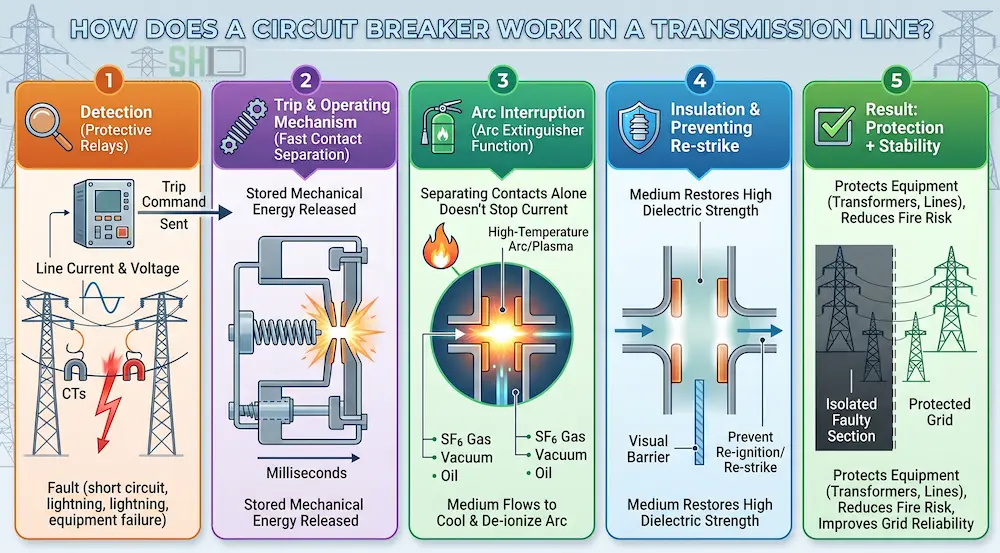
How does a circuit breaker work in transmission line?
A circuit breaker in transmission line functions as an automatic, high-speed switch that detects faults and breaks the circuit to prevent equipment damage. It uses sensors to detect abnormal currents and separates contacts within an insulating medium like (SF6).
1- Detection (Protective Relays):
Transmission breakers rely on sensors + relays (often current transformers) that continuously monitor the line current and voltage.
When a fault occurs (short circuit, lightning strike, equipment failure, etc.), the relay sends a trip command to the breaker.
2- Trip & Operating Mechanism (Fast Contact Separation):
Once the trip signal is received, the breaker releases stored mechanical energy—such as springs, hydraulic, or pneumatic pressure—to rapidly separate moving and fixed contacts in milliseconds for the protection of transmission line.
3- Arc Interruption (Arc Extinguisher Function):
Separating contacts alone doesn’t instantly stop the current, because the fault produces a high-temperature arc/plasma.
The circuit breaker power line uses a special interruption medium to cool, de-ionize, and extinguish the arc:
- SF6.
- gas (very common for high-voltage).
- Vacuum (common in vacuum circuit breakers).
- Oil (oil circuit breakers in some designs).
4- Insulation & Preventing Re-strike:
After the arc is extinguished, the medium rapidly restores dielectric strength, helping ensure the breaker does not re-ignite the arc once the contacts are open.
5- Result: Protection + Stability
By isolating the faulty section quickly, circuit breakers:
- protect equipment (e.g., transformers and lines).
- reduce fire risk from overheating.
- improve grid reliability by preventing faults from spreading.
Types of Breakers Used in Power Transmission
A circuit breaker power line can handle high current, extinguish strong arcs, and keep the grid stable. Breakers are mainly grouped by the arc-quenching medium/technology they use. Types of circuit breaker in transmission line:
1- SF6 Circuit Breakers (Sulfur Hexafluoride)
- Most common for high and extra-high voltage transmission (often above ~72.5 kV).
- SF6 quickly absorbs free electrons, helping extinguish arcs fast.
- Typically compact, efficient, and comparatively low maintenance.
2- Vacuum Circuit Breakers (VCB)
- Common in medium voltage and used in some high-voltage applications.
- Contacts sit inside a vacuum chamber.
- Vacuum has extremely strong insulating properties, enabling compact size and long service life.
3- Air-Blast Circuit Breakers (ABCB)
- Use high-pressure compressed air to blow out the arc.
- Were once widely used outdoors for high-voltage substations.
- Largely replaced by SF6 designs due to noise and the need for complex air-compressor systems.
4- Oil Circuit Breakers (OCB)
- Contacts are immersed in insulating oil.
- Arc heat generates gas pressure that helps cool and extinguish the arc.
- Still found in older grid infrastructure, but involves fire risk and more oil-quality monitoring.
5- Hybrid Circuit Breakers
- Combine switching methods with solid-state power electronics.
- Important in HVDC systems, where interrupting current can be more challenging than in AC systems.
| Type | Quenching Medium | Common Voltage Range | Key Advantage |
| SF6 | Sulfur Hexafluoride Gas | 72.5 kV to 800+ kV | Excellent arc quenching & compact |
| Vacuum | Vacuum | 11 kV to 38 kV (typical) | Low maintenance & long life |
| Air Blast | Compressed Air | 132 kV to 400 kV | Very fast operation |
| Oil | Insulating Mineral Oil | 11 kV to 220 kV | Self-insulating & simple design |
Circuit Breaker Safety and Application Scenarios in Transmission Lines
Circuit breakers in transmission networks (from ~11 kV up to 500 kV+) are essential “safety switches” that automatically interrupt fault current, isolate damaged sections, and allow maintenance—helping keep the grid stable and preventing fires or equipment damage.
1- Application Scenarios:
- High-voltage transmission networks: Used as the main switching devices to connect/disconnect lines and keep power flowing reliably.
- Substations: Isolate key equipment (e.g., transformers, capacitor banks, reactors) for maintenance and fault protection.
- Power generation plants: Protect generators by tripping instantly during faults to avoid large-scale grid failures.
- Industrial high-voltage systems (factories/mines): Maintain stability during heavy-load conditions and abnormal events.
- Railway electrification: Protect the high-voltage supply lines feeding railway infrastructure.
2- Safety & Protection
- Fault detection & isolation: Detect abnormal conditions (like overcurrent/overheating) and isolate faults to prevent equipment damage and fires.
- Designed to handle extreme fault conditions: Must withstand high magnetic forces during faults and still open quickly.
- Arc/energy control to stop dangerous current flow: Breakers interrupt load/fault current to keep the system from escalating.
- Remote monitoring (modern systems): Many breakers support remote status + fault identification, improving response time and efficiency.
- Maintenance safety: Safe procedures like LOTO (Lockout/Tagout) and proper PPE are critical before working on high-voltage equipment.
How to choose the right circuit breaker in transmission line?
Choosing the circuit breaker in transmission line involves matching the breaker’s ratings to the maximum system voltage, load current, and potential fault levels. The primary goal is to ensure the breaker can safely interrupt high fault currents without damage. Transmission Line Circuit Breaker Selection Factors:
| Selection Factor | Description | Requirement |
| Rated Voltage (Ur ) | Highest operating voltage of the transmission system. | (Ur ) ⩾ System Highest Voltage |
| Rated Current (Ir ) | Maximum continuous load current, considering overloading and future growth. | (Ir ) ⩾ Max Load Current |
| Breaking Capacity ( Isc) | The maximum short-circuit current the breaker can safely interrupt. | ( Isc) ⩾ System Fault Current |
| Making Capacity | Ability to close onto a fault (usually (2.5 * ( Isc) for 50Hz). | Peak Making Current |
| Operating Time | Time taken from relay signal to contact separation (fast speed required). | Typically 2–3 cycles |
| Insulation Level | Ability to withstand impulse and switching surges. | Rated BIL (Basic Insulation Level) |
| Arc Quenching Medium | Technology used to extinguish the arc (SF6 is standard for HV). | High Voltage: SF6 |
| Environment | Site altitude, ambient temperature, and pollution levels. | Temperature/Altitude derating |
Read More: Insulators Used in Transmission Lines Explained.
How Sihedan Engineers Advanced Protection for Transmission Networks?
Sihedan engineers advanced protection for transmission networks by focusing on high-tensile, durable, and reliable physical hardware designed to withstand extreme electrical and environmental stresses, including:
- Over 25 years of experience producing crucial components for HV and EHV overhead lines.
- Advanced silicone rubber, glass, and porcelain insulators that ensure long-term insulation performance and prevent leakage.
- High-performance tensioning products for secure conductor management, such as strain clamps and suspension clamps.
- Essential safety mechanisms like surge arresters for surge protection and switchgear for controlled system management.
- A comprehensive manufacturing approach that maintains structural integrity, grounding, and operational safety of transmission lines in over 50 countries.
For high-performance overhead line solutions or expert advice on your grid’s protection setup, reach out via our Contact Us page, message our engineers on WhatsApp, or email us directly at info@sihedan.com.
FAQs
Which is better for transmission lines SF6 or vacuum circuit breakers?
For high-voltage transmission lines (>72.5kV), SF6 breakers are superior due to excellent dielectric strength and compact, reliable performance. However, vacuum breakers (VCB) are better for the environment and are preferred for medium-voltage (<72.5kV).
How does the auto reclosing feature work in transmission line breakers?
Auto reclosing automatically triggers circuit breakers to re-close after tripping due to transient faults, restoring power without human intervention by allowing time for arc extinguishing, thus improving transmission system stability
What happens if a transmission line circuit breaker fails to open?
An uncleared fault causes severe equipment damage, overheating, and potential fire.
Leave a Reply