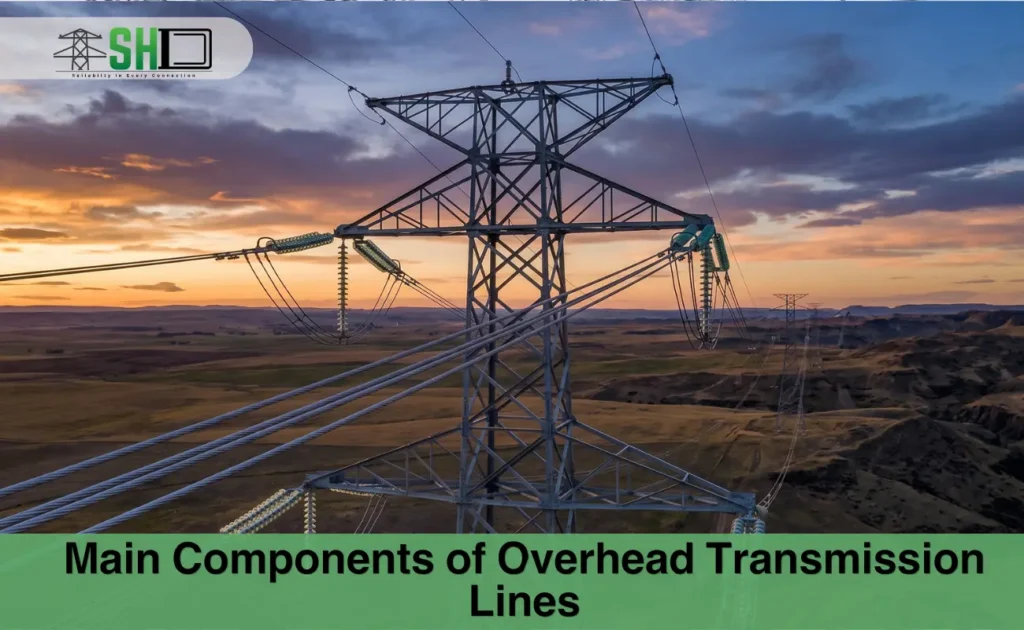
Main components of overhead transmission lines include conductors, insulators, support structures, and ground wires. Conductors facilitate efficient electrical power flow across vast distances. Insulators prevent dangerous current leakage to the supporting structures, which are typically robust steel towers. Finally, ground wires shield the system from lightning strikes, ensuring reliable, uninterrupted electricity distribution over varied terrain and harsh weather conditions.
What Are the Main Components of Overhead Transmission Lines?
The main components of overhead transmission lines carry electricity over long distances using conductors, tower/pole structures, insulators, cross-arms, and ground (shield) wires, plus specialized hardware.
- Conductors: one of the main components of overhead transmission lines, carry electrical energy from power plants to substations (often ACSR—Aluminum Conductor Steel Reinforced—for strength and conductivity).
- Supporting Structures (Poles and Towers): Keep conductors elevated at safe, mandated clearances (wood for lower voltage; steel lattice towers for high/extra-high voltage).
- Insulators: Prevent current from leaking from live conductors into supporting structures (porcelain, toughened glass, or composite polymers).
- Cross-Arms and Clamps: overhead transmission line components are Cross-Arms and Clamps that hold insulators in place and maintain proper spacing between live conductors (typically steel or treated wood).
- Overhead Ground/Shield Wires: Positioned at the top to intercept lightning strikes and route surges safely into the earth—providing lightning protection.
Read More: Types of Overhead Line Conductors: Comparison & Specs Guide.
How Each Component Works at High Voltage to Maintain Reliable Power Flow?
Components of overhead line transmission work reliably because each suspended component protects current, spacing, and structure, preventing leakage, flashovers, and lightning-caused outages across long distances.
- Conductors: the main components of overhead transmission lines, they carry electrical current from generating stations to substations. Often use (ACSR) to balance conductivity with mechanical strength.
- Supporting Structures (Poles and Towers): Hold conductors at safe heights above ground and obstacles. Steel lattice towers or wood/concrete poles withstand the large weight and tension. Their height and width increase with voltage to maintain.
- Insulators: Separate and support live conductors so current does not travel into the supporting structure. Made of porcelain, toughened glass, or composite polymers. They’re assembled into long strings that provide enough insulation to prevent flashovers.
- Cross-Arms and Clamps: Provide brackets to position conductors outward and safely attach them to towers. Cross-arms keep energized cables separated from the grounded tower body.
- Overhead Ground/Shield Wires: Protect the power lines from lightning and sudden surges. Run along the top of transmission structures as grounded lightning rods.
- Transformers: Strategically placed in substations, step-up transformers increase the voltage for transmission, while step-down transformers reduce it to safe, usable levels for homes and businesses.
Read More: Dead End Clamp Function: Applications & Selection Guide.
Key Selection Criteria for Overhead Transmission Line Components
Selectingmain components of overhead transmission lines requires balancing electrical efficiency, mechanical durability, and environmental resilience, ensuring reliable long-distance power transfer under stress.
1- Conductors:
- Electrical conductivity: the main components of overhead lines that maximize to reduce I²R losses (e.g., aluminum types like ACSR/AAAC).
- Mechanical strength: high tensile capacity to resist wind/ice tension and prevent excessive sag.
- Thermal rating: withstand high operating temperatures without permanent deformation.
2- Supporting Structures (Poles and Towers):
- Mechanical loading: withstand dead loads, live loads, and environmental loads (wind, ice, seismic).
- Material durability: steel for high-voltage strength; wood/concrete (RCC) for medium-to-low voltage distribution.
- Height and span optimization: balance longer spans (more clearance) against increased wind load and foundation count.
3- Insulators:
- Dielectric strength: prevents flashover/puncture at maximum voltages and switching surges.
- Mechanical strength: supports conductor weight and dynamic tension without cracking/shattering.
- Environmental resistance: resist pollution, salt spray, and temperature cycling (porcelain/glass/composites).
4- Overhead Ground Wires / OPGW:
- Fault current capacity: electrical transmission line components that handle prospective short-circuit levels safely without damage.
- Mechanical tension: Use materials like high-tensile steel or aluminum-clad steel (ACS) to match conductor sag-tension.
- Communication capabilities: OPGW embeds fiber optics for teleprotection and grid monitoring while shielding lightning.
Read More: Size of Conductor in Transmission Line: Selection Guide.
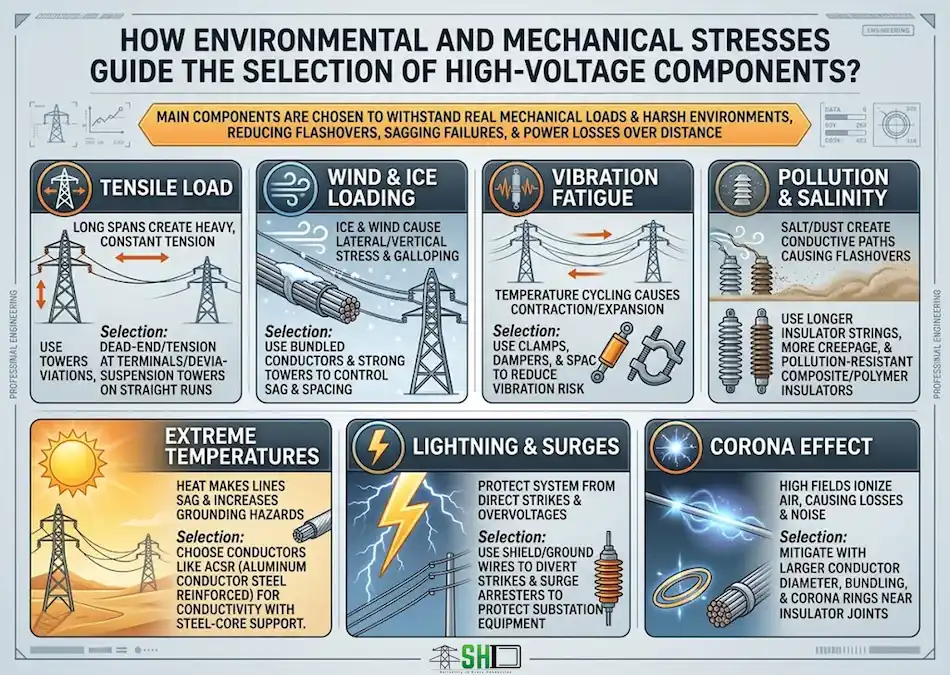
How Environmental and Mechanical Stresses Guide the Selection of High-Voltage Components?
The main components of overhead transmission lines are chosen to withstand real mechanical loads and harsh environments, reducing flashovers, sagging failures, and power losses over distance.
- Tensile load: Long spans create heavy, constant tension; use dead-end/tension towers at terminals/deviations and suspension towers on straight runs.
- Wind & ice loading: Ice and wind cause lateral/vertical stress and galloping; use bundled conductors and strong towers to control sag and spacing.
- Vibration fatigue: Temperature cycling causes contraction/expansion; use clamps, dampers, and spacers to reduce vibration and snapping risk.
- Pollution & salinity: Salt/dust create conductive paths causing flashovers; use longer insulator strings, more creepage, and pollution-resistant composite/polymer insulators.
- Extreme temperatures: Heat makes lines sag and increases grounding hazards; choose conductors like ACSR for conductivity with steel-core mechanical support.
- Lightning & surges: Use shield/ground wires to divert strikes and surge arresters to protect substation equipment.
- Corona effect: High fields ionize air, causing losses and noise; mitigate with larger conductor diameter, bundling, and corona rings near insulator joints.
Read More: Function of Insulator in Transmission Line: Types, Specs & Selection.
Maintenance and Replacement Strategies for Overhead Line Components:
Effective maintenance and replacement keep the main components of overhead transmission lines safe and reliable using inspections, condition monitoring, and targeted component swaps.
- Conductors & Shield Wires: Thermography, drones, and live-line robots detect damage; replace when degradation is critical, and upgrade shield wires to OPGW when needed.
- Insulators: Visual patrols, corona cameras, and ultrasonic testing find micro-cracks; wash for pollution, and replace immediately if damaged/contaminated.
- Support Structures (Towers & Poles): Repair corrosion/rot and foundations (coatings, bolt tightening, tower-base work); decommission and replace severely fatigued structures.
- Hardware & ROW: Keep right-of-way clear by trimming/herbicide; inspect and service dampers/clamps; upgrade hardware during conductor/insulator replacements.
Read More: Polymer vs Porcelain Insulator: Key Differences.
Sihedan Company Your Trusted Single Source for High-Grade Overhead Transmission Line Components:
Sihedan Company delivers high-grade main components of overhead transmission lines with dependable performance, safety-focused engineering, and consistent supply to utilities, contractors, and energy projects nationwide.
- Reliable single-source sourcing: One supplier for key overhead line components to simplify procurement.
- High-grade component quality: Built for long-term durability under high voltage and harsh field conditions.
- Safety-first design focus: Supports electrical isolation, structural integrity, and fault protection.
- Engineering-aligned solutions: electrical power line components selected to meet performance requirements for power transfer and resilience.
- Consistent availability: Stable supply planning to support project timelines and maintenance cycles.
- Support for utility needs: Suitable for new builds, upgrades, and replacement programs across transmission networks.
Ready to equip your next project with reliable, high-grade components? Reach out to us through our Contact Us page, message us directly on WhatsApp, or send an email to info@sihedan.com for expert technical support and orders.
FAQs:
What HV overhead line component standards apply to bulk procurement?
Bulk procurements are universally governed by IEC (International Electrotechnical Commission) and IEEE standards.
How do you calculate conductor size for distance and load at high voltage?
Conductor sizing is based on thermal ampacity (load), electrical resistance, and acceptable voltage drop. While sophisticated Overhead Transmission Line Design Handbooks are used for full sag-tension limits,
Can you mix HV components from different manufacturers on the same line?
Yes, but with strict conditions. You can mix components like insulators, dampers, and clamps from different manufacturers, provided they are built to the same standardized specifications and are fully compatible dimensionally and mechanically (e.g., matching bolt sizes and ball-and-socket couplings per IEC 61284).
Leave a Reply