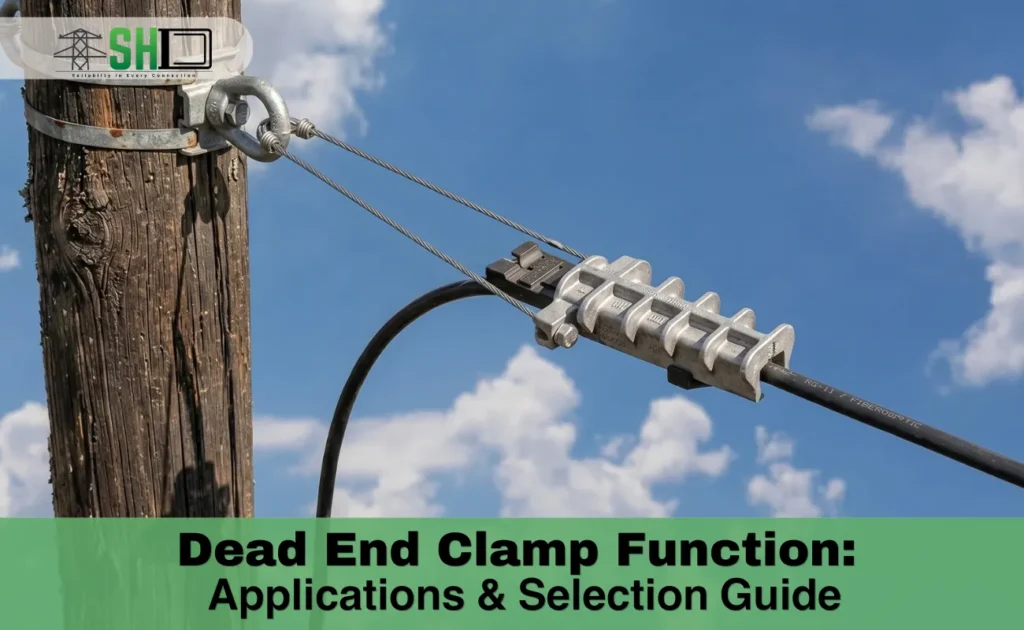
Dead end clamp function is primarily to provide a secure, high-tension mechanical connection for overhead power and telecommunications lines. These essential components anchor conductors to terminal poles or strain towers, effectively absorbing the axial load and preventing cable slippage. As a result, it is designed to securely grip, anchor, and terminate conductors or cables at specific points, such as line ends, corner poles, or long-span crossings. A dead end clamp use to ensure structural integrity and safety in electrical, telecommunication, and fiber optic cable systems.
What Is Dead End Clamp Function?
A dead-end clamp, also called a strain clamp or anchor clamp, is a mechanical fitting used in overhead power lines and telecommunications.
A dead end clamp function acts as a specialized tensioning hardware that anchors and secures electrical conductors, fiber optic cables, or utility wires to poles and towers. It takes the full mechanical strain of the line, helping prevent sagging or breakage at span ends, corners, or sharp turns.
How Do Dead End Clamps Work?
A dead end clamp function is to securely hold the end cables in overhead lines. The clamp squeezes the cable tightly, keeping it in place when a line stops, reaches an endpoint, or turns around poles or towers.
The main characteristics that make dead end clamp work effectively are:
- Dead end clamps are designed to handle harsh conditions like strong winds, ice, and mechanical oscillation.
- Their shape helps spread the pulling force along the cable, reducing stress on weak spots that could otherwise lead to failure.
- They also fit many cable sizes and types, making them useful for many applications such as overhead power lines, factories, green energy systems, and phone lines.
What Are the Main Parts and Materials of a Dead End Clamp?
Dead end clamps are essential for anchoring overhead power lines and aerial bundled cables (ABC). A typical dead end clamp has a body, a wedge (or inserts), and a flexible bail hook, along with hardware like bolts and nuts to secure the assembly in place.
Main Parts
- Clamp body: Main housing that transfers tensile load (typically aluminum alloy or reinforced thermoplastic).
- Wedge/insert(s): Insulating, self-locking inserts (often a pair) that grip the cable without damage.
- Bail loop/hook: Flexible bail hook (often stainless steel) for attaching to pole hardware.
- Bolts and nuts (as needed): Fasteners for bolt-type/compression models with high corrosion resistance.
Read More: Function of Insulator in Transmission Line: Types, Specs & Selection.
Dead End Clamps in Different Applications with Real Examples
Dead end clamp function secures overhead conductors at endpoints, utility poles, towers, and buildings for maintaining tension, reducing sag, and enabling routing changes.
Electrical distribution lines (LV-ABC):
low-voltage aerial bundled conductor (LV-ABC) systems to anchor lines at poles, particularly where the line starts or ends.
- Example: Wedge-type dead end clamps anchor insulated messenger wire (or multiple ABC conductors) on a pole-mounted bracket in urban or suburban neighborhoods.
High-voltage transmission lines:
Must use dead end clamp overhead line to handle massive tension and extreme weather conditions.
- Example: Compression or bolted quadrant dead-end clamps terminate ACSR conductors at transmission towers, connecting to insulator strings under heavy tension.
Fiber optic networks (ADSS/OPGW):
Telecommunication lines, especially Fiber-to-the-Home (FTTH) setups, use special tension clamps to hold fiber cables without damaging the delicate fibers inside
- Example: Preformed helical dead-end clamps anchor ADSS cables to distribution poles by wrapping and distributing tension without damaging fibers.
Railway catenary systems:
Railway electrification relies on a specialized dead end clamp overhead line to hold the overhead contact wire in place under high tension
- Example: Mechanical wedge dead-end clamps terminate and anchor the overhead contact wire to pylons at railway stations to keep pantographs aligned.
Guy wire applications:
Dead end clamp function are crucial for securing anchor or guy wires that provide support for utility poles or transmission towers.
- Example: Preformed dead-end grips attach a guy wire to a utility pole and to a ground anchor rod, preventing pole tilt under tension.
Read More: Insulators Used in Transmission Lines Explained.
How to Choose the Right Dead End Clamp?
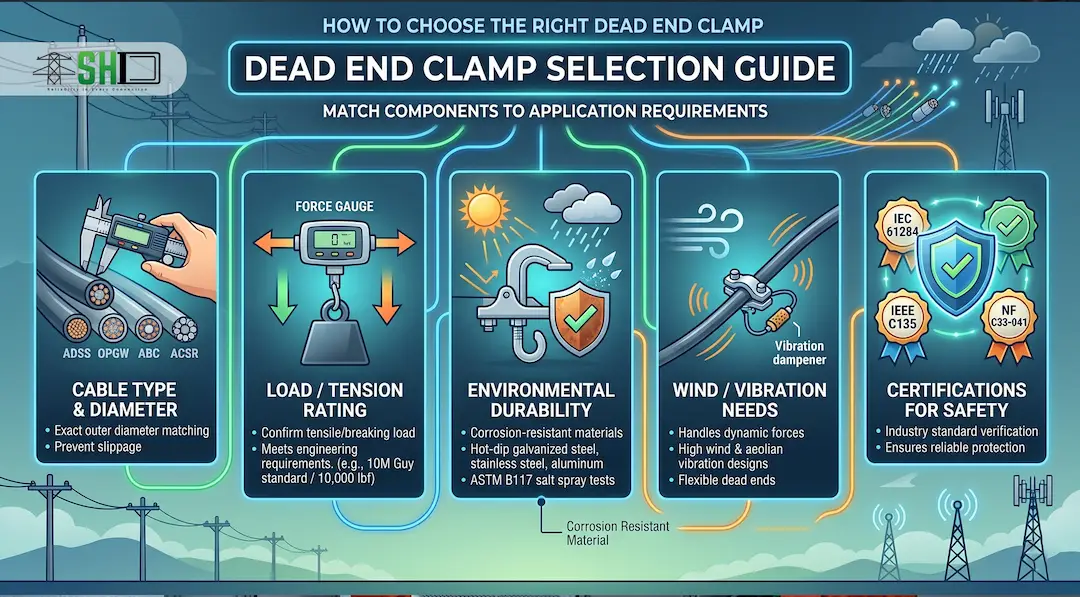
Choosing the right Dead end clamp function means matching cable size, type, required tension, and environment while selecting the correct clamp design and compatible materials.
- Cable type & diameter: Select a clamp sized to the exact outer diameter (e.g., ADSS/OPGW/ABC/ACSR) to prevent slippage
- Load/tension rating: Confirm the clamp’s tensile/breaking load meets your engineering requirements (especially for high-tension lines—for example, meeting the 10M Guy standard (minimum breaking strength of 10,000 lbf or 44,480 N.)
- Environmental durability: Use corrosion-resistant materials for harsh areas (e.g., hot-dip galvanized steel, stainless steel, aluminum for coastal conditions). Preference is given to clamps that have passed the ASTM B117 salt spray tests.)
- Wind/vibration needs: Consider designs that handle high wind and vibration (e.g., vibration-dampening or flexible dead ends).
- Certifications for safety: Look for badges like IEC 61284, IEEE C135, and NF C33-041; they help ensure you’re protected from unwanted incidents.
Installation and Maintenance of Dead End Clamps Step by Step
Installing and maintaining the dead end clamp function correctly helps them perform stably, preserves electrical contact, and extends service life. Follow these steps for safe, reliable performance:
- Preparation – Gather equipment and confirm clamp size/specifications.
- Prepare the tension clamp – Arrange its structure to receive the conductor.
- Insert the cable – Place the conductor into the designated position of the dead end clamp (do not fully secure yet).
- Apply tension – Tighten the conductor using a winch or come-along to reach the required tension.
- Secure the clamp – Use the appropriate tool (hydraulic crimper, wedge driver, or torque wrench) to permanently fasten the clamp onto the conductor.
- Release and check – Slowly release the winch and verify that the clamp holds the tension without slippage.
Inspection and maintenance – Check that the mechanical and electrical contact between the wire and clamp is good, and regularly inspect for wear, corrosion, or damage, replacing worn clamps in time to ensure system reliability and safety.
How Sihedan Ensures Higher Reliability for Dead End Clamps in B2B Projects?
Sihedan ensures higher reliability for dead end clamps in B2B projects by:
- Combining strict quality control, engineered compatibility, and durable materials.
- Building every clamp for stable long-term performance: consistent grip, reduced loosening risk, and dependable operation.
- Applying proven manufacturing standards and full traceability to help procurement and engineering teams simplify maintenance and deliver projects with confidence.
- Testing according to recognized industry standards (ASTM, IEC, IEEE).
Looking for reliable solutions for your projects or need expert technical advice on selecting the right clamps? Contact our team via our Contact Us page, message us on WhatsApp, or email us at info@sihedan.com for customized support and competitive quotes.
FAQs
What problems can you avoid by using dead end clamps?
Using high-quality dead end clamps effectively prevents catastrophic overhead line failures by ensuring secure anchoring and constant tension, avoiding problems such as conductor slippage, excessive sagging, or snapping during strong winds and ice loading.
What cables can you use with a dead end clamp?
Dead end clamp function is highly versatile, accommodating various cable types, including ACSR (Aluminum Conductor Steel Reinforced), AAAC (All Aluminum Alloy Conductor), AAC (All Aluminum Conductor), and telephone and fiber-optic cables such as ADSS (All-Dielectric Self-Supporting).
Can dead end clamps handle bad weather?
Yes, dead end clamps are engineered to handle harsh weather—including strong winds, heavy ice, and intense heat—by utilizing high-strength, corrosion-resistant materials like galvanized steel and aluminum alloys.
Leave a Reply