
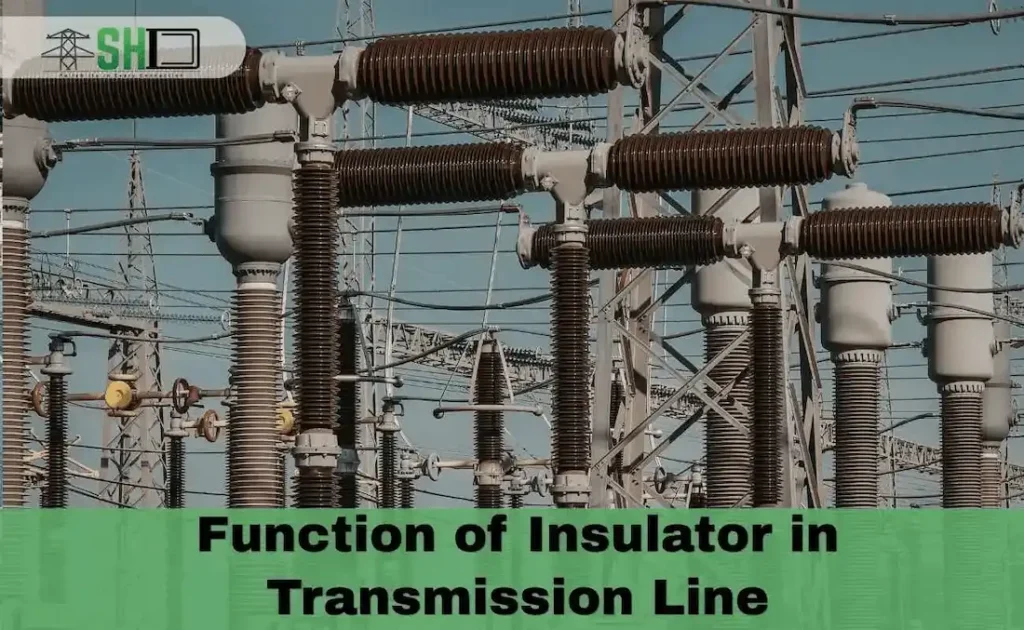
Function of Insulator in Transmission Line is important in delivering power in a safe and dependable manner over great distances. They also provide the needed mechanical support for hanging conductors and for the weight and tension of the conductors. For equipment protection and for the maintenance of voltage and stability of the system at high voltage and in a changing environment, insulators ensure safety to the system and personnel and the surround and provide protection against leakage currents and flashovers.
What Is an Insulator in a Transmission Line?
An insulator on a transmission line is a crucial electrical component that helps keep energized conductors separate from grounded structures like poles and towers. Insulators keep current from flowing to the ground, all while keeping everything stable under the weight of the conductors, as well as the wind and tension on the line. Insulators help keep the lines safe by withstanding their electrical and mechanical load and helping the lines deal with the environment.
What Is the Function of Insulator in Transmission Line?
- Electrical Isolation Between Conductor and Tower: A key purpose of insulators on transmission lines is to maintain electrical isolation between the conductor and the supporting tower. Insulators prevent the direct electrical connection between the energized conductor and the grounded supporting structure, and thereby, prohibit the flow of electric current to ground.
- Preventing Leakage Current and Flashover: Insulators are engineered to resist leakage current and flashovers due to voltage stress, pollution, moisture, and dust. The right specifications of insulation and sufficient creepage will limit surface current flow and electrical arcs between the conductor and the supporting tower.
- Supporting Mechanical Load of Conductors: Insulators do more than electrically insulate. They also provide mechanical support for the conductors on the transmission lines. They support the conductor’s weight and endure the mechanical stresses from wind and ice loads and tension forces
- Ensuring System Safety and Reliability: System safety and reliability also lie in the hands of the insulators. Insulators provide the electrical clearance and mechanical support to protect equipment, personnel, and structures downstream from electrical arcs.
Read More: Insulators Used in Transmission Lines Explained
Why Insulators Are Critical in High Voltage Transmission Lines?
Function of Insulator in Transmission Line provides a crucial purpose in high voltage power line transmission, as they bear extreme internal electric and mechanical pressures, and, in addition, physically support the line and keep it separated from the grounded support towers. Insulators also help to eliminate line leakage current and to prevent line flashovers and other high voltage electrical problems, as well as environmental problems. Insulators maintain electrical clearances and mechanical stability, protect transmission line apparatus, help provide safety to personnel, help prevent electrical outages, and help provide reliable continuous service over long distances.
How Does an Insulator Work in a Transmission Line?
- Dielectric strength: it is known as the maximum electric field that an insulating material can withstand without breaking down. To withstand the voltage stress without conducting current, the material used in the design of the insulator is one that exhibits high dielectric strength. Materials with high dielectric strength ensure that the conductors will continue to have the required electric field isolation from the towers during normal and fault conditions.
- Creepage distance: it is the insulating surface distance between the live part and the grounded part. A long creepage distance is useful in reducing the surface leakage current, particularly in polluted, humid, or dusty environments. Suitable creepage ensures that insulators are less affected by contamination and that insulation performance is maintained.
- Preventing flashover: it is one of the most important tasks of insulators on transmission lines due to the high voltage stress. Using controlled design, insulators can be able to achieve the required electric field distribution in order to avoid tracks from being formed on the surface of the insulators. Insulators are able to withstand flashover during rain or pollution to ensure that the transmission lines do not suffer faults, outages, or damage to the system and other avoids the damage to the system and other components.
Read More: Types of Insulators In Power System.
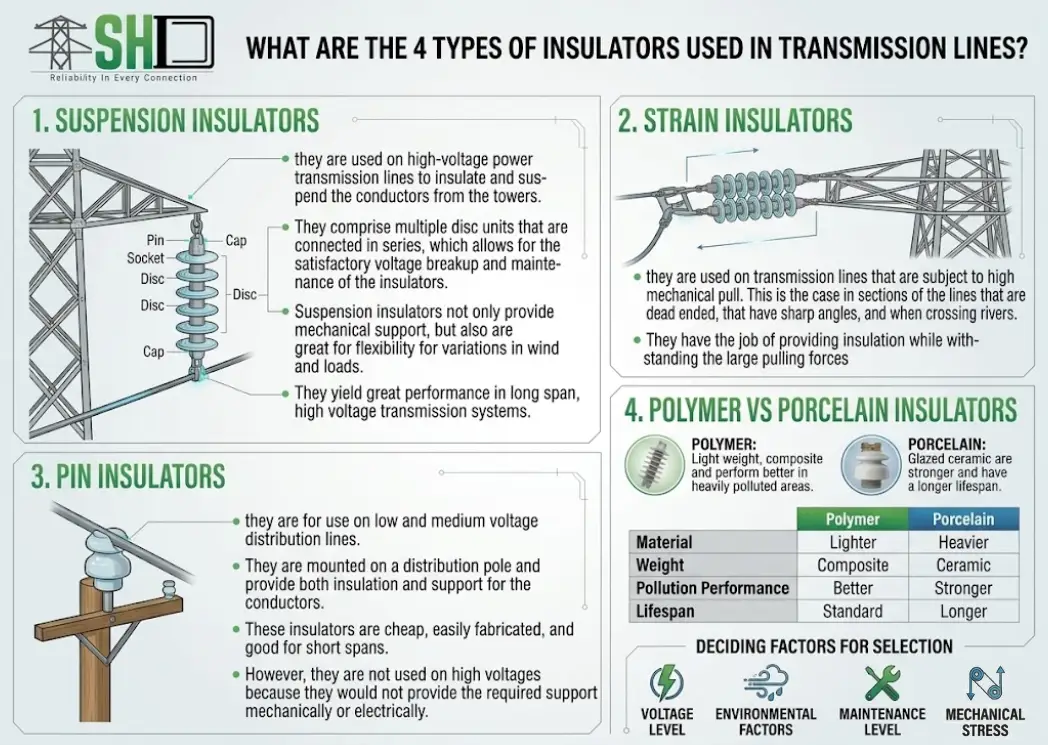
What Are the 4 Types of Insulators Used in Transmission Lines?
- Suspension insulators: they are used on high-voltage power transmission lines to insulate and suspend the conductors from the towers. They comprise multiple disc units that are connected in series, which allows for the satisfactory voltage breakup and maintenance of the insulators. Suspension insulators not only provide mechanical support, but also are great for flexibility for variations in wind and loads. They yield great performance in long span, high voltage transmission systems.
- Strain insulators: they are used on transmission lines that are subject to high mechanical pull. This is the case in sections of the lines that are dead ended, that have sharp angles, and when crossing rivers. They have the job of providing insulation while withstanding the large pulling forces
- Pin insulators: they are for use on low and medium voltage distribution lines. They are mounted on a distribution pole and provide both insulation and support for the conductors. These insulators are cheap, easily fabricated, and good for short spans. However, they are not used on high voltages because they would not provide the required support mechanically or electrically.
- Polymer vs Porcelain Insulators : the main differences between two types are in their materials, weight, and their performance characteristics. Although polymer insulators are lightweight and perform better in heavily polluted areas, porcelain insulators are stronger and have a longer lifespan. For transmission line systems, the deciding factors regarding choice of insulators are The voltage level, environmental factors, the level of maintenance required, and the level of mechanical stress on the system.
Read More: Pin Insulator vs Post Insulator Comparison
Common Problems in Transmission Line Insulators:
To benefit from function of insulator in transmission line, it is necessary to understand the common problems of them. Insulators on transmission lines are integral to the reliability and security of the entire power system. The mechanical, thermal, and electrical impact on the insulators overtime are the primary cause of insulator failure. For example, moisture, environmental abrasion, and the aging of materials may cause leak currents, and subsequently, insulator flashover and failures. Regular inspection and maintenance has the benefits of identifying these problems before outages occur, reducing the cost of repairs, and ensuring safe and uninterrupted transmission of power.
How to Choose the Right Insulator for Transmission Line?
The consideration of insulation materials must be studied closely, taking into account the level of voltage, the level of mechanical strength, and also the condition of the environment. Pollution, humidity, temperature, and wind are all part of the consideration. Careful consideration of the construction of the hardware and the compliance to all of the international standards guarantees the transmission system will be efficient, effective, and will perform continually over a long period of time.
Read More: Polymer vs Porcelain Insulator: Key Differences
Partnering for Grid Reliability with Sihedan:
At Sihedan, we understand that transmission network stability begins with selecting the right components. We support your high-voltage infrastructure projects by providing:
- Comprehensive Equipment Supply: Supplying premium insulators, switchgears, and distribution boards tailored for new overhead lines and grid upgrades.
- Engineering Consultations: Assisting your technical team in matching specific specs—such as creepage distances and mechanical loads—to your project’s exact environmental conditions.
- Operational Safety Focus: Ensuring all delivered components maximize system reliability, minimize flashover risks, and comply with strict safety standards.
To discuss your project specifications or request a custom quotation, connect with our team instantly via WhatsApp or through our Contact Us page.
Conclusion:
Insulators, without a doubt, are a must for an effective and safe transmission of electricity. Function of Insulator in Transmission Line will offer the necessary electrical isolation and mechanical support as well as offer the needed protection from environmental and electrical stressors. When insulators are properly selected, placed, and maintained, then an uninterrupted flow of electricity will be maintained.
FAQ:
What is the difference between an isolator and an insulator?
An insulator is a static material (porcelain or polymer) that physically supports conductors and prevents current flow to grounded towers. Conversely, an isolator is a mechanical switch operated under no-load conditions to manually disconnect a specific circuit section for safe maintenance.
How does environmental pollution impact transmission line insulators?
Industrial dust and coastal salt form conductive layers on the insulator’s surface. When combined with moisture, this reduces the effective creepage distance, causing surface leakage currents and high-voltage flashovers. Silicone polymer insulators resist this better due to their natural hydrophobic (water-repelling) properties.
What is the expected lifespan of high-voltage insulators?
Porcelain and toughened glass insulators typically operate for 40 to 50 years due to their superior resistance to mechanical degradation. Polymer composite insulators average 15 to 25 years but offer the advantage of being up to 90% lighter, significantly reducing the mechanical stress on transmission towers.