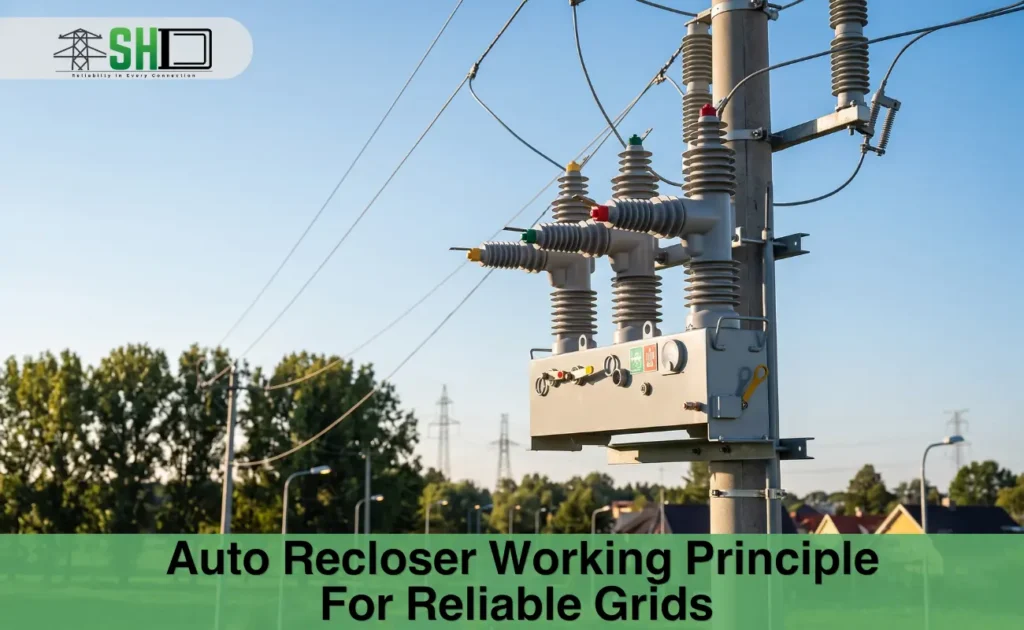
Understanding the auto recloser working principle is essential for anyone specifying protection equipment for overhead distribution lines, since reclosers determine how quickly a network recovers from a transient fault without dispatching a field crew. Most overhead line faults are momentary rather than permanent, caused by lightning, wind-blown debris, or brief animal or vegetation contact, and a recloser is the device that decides, automatically and within milliseconds, whether the line can be safely restored. This guide covers what auto reclosers do, how their reclosing sequence works, why they matter for grid reliability, the main recloser types, and how to select and mount the right unit for an overhead line project.
What Is an Auto Recloser in Power Systems?
An auto recloser is a self-controlled switching device that automatically interrupts and restores power on an overhead line after detecting a fault, without requiring manual intervention at the site.
- It combines a circuit interrupter, current sensing, and a control relay in a single unit, following the auto recloser relay working principle used across modern distribution protection schemes.
- Most transient faults on overhead lines, such as those caused by wind-blown debris or brief tree contact, clear themselves within a fraction of a second, which is exactly the window a recloser is designed to exploit.
- Unlike a simple circuit breaker, which trips and stays open until a technician resets it, before conceding that a fault is permanent, which is the core of the auto recloser working principle.
- Modern units also log fault current, timing, and event history, giving utilities visibility into recurring problem sections of a feeder without a site visit.
Read More: Differentiate Between Fuse and Circuit Breaker Specs in MV.
Auto Recloser Working Principle and Reclosing Sequence
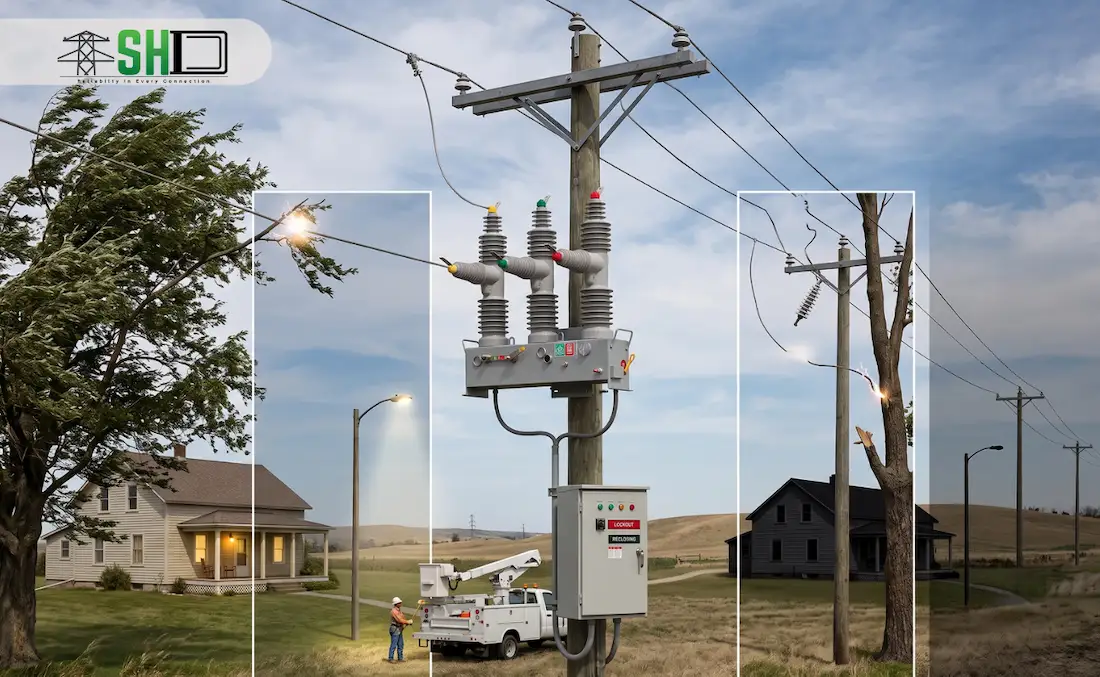
The auto recloser working principle rests on a simple idea, that a brief interruption is far less disruptive than a sustained outage, so the device trips fast, waits briefly, and tries again before giving up.
- Fault detection: the recloser’s relay senses an overcurrent condition on the protected line, comparing measured current against a preset time-current curve.
- Instantaneous trip: the interrupter opens within a few cycles to clear the fault before it can escalate or damage connected equipment.
- Reclosing attempts: the unit recloses after a short dead time, typically starting under one second and lengthening with each subsequent attempt to allow ionized air around the fault point to dissipate.
- Progressive time-current curves: many controllers shift from a fast curve on the first trip to a slower, more selective curve on later attempts, improving coordination with downstream fuses.
- Lockout: if the fault persists through the final programmed attempt, the recloser locks out and holds the line open until a crew investigates and clears the permanent fault.
This function of auto recloser operation allows temporary faults to clear on their own while isolating permanent faults after a limited number of tries, protecting downstream equipment and customers from repeated fault current.
Read More: What Is the Difference Between Recloser and Sectionalizer?
Why Auto Reclosers Are Essential for Distribution Grids
Auto reclosers reduce the duration and frequency of customer outages by resolving the majority of overhead line faults automatically, without waiting for a manual switching operation, a direct outcome of the auto recloser working principle in action.
- Utilities rely on an auto recloser in power system design to meet reliability targets such as SAIDI and SAIFI, since most recorded interruptions on overhead networks are transient rather than permanent.
- Coordinated reclosing also protects transformers, cables, and customer equipment by clearing faults before thermal and mechanical stress can accumulate across repeated fault cycles.
- Because reclosers isolate only the faulted section when paired with sectionalizers, they help contain outages to the smallest possible part of the network rather than tripping an entire feeder.
- Fewer sustained outages also reduce the number of emergency crew dispatches needed after storms, freeing field teams to focus on genuine permanent faults.
Types of Auto Reclosers for Overhead Lines
Selecting the right technology depends on interrupting medium, control type, and the specific auto reclose function required for the line in question.
- Hydraulically controlled reclosers, the traditional recloser design, use oil-based mechanisms for interruption and timing, offering simple, self-contained operation without external control power, which suits remote sites with limited infrastructure.
- Electronically controlled reclosers pair a microprocessor relay with vacuum or SF6 interruption, enabling programmable time-current curves, multiple reclosing attempts, and remote communication with a control center.
- Single-phase and three-phase reclosers serve different feeder configurations, with single-phase units isolating only the affected phase to limit the scope of an outage on rural or lightly loaded lines.
- Pole-top and substation-frame designs differ mainly in mounting arrangement and current rating, with substation-frame units typically built for higher fault levels and heavier duty cycles.
Both interrupting technologies and control types are covered by IEC 62271-111, the jointly developed international standard for automatic circuit reclosers up to 38 kV, also published as IEEE C37.60, which formalizes the auto recloser working principle across international markets.
Read More: Circuit Breaker in Transmission Line: Best Choice Criteria
Auto Recloser Selection Guide for Overhead Lines
Choosing an auto recloser starts with matching electrical ratings to the feeder, then fits the utility’s protection philosophy, since a mismatched setting undermines the auto recloser working principle rather than supporting it.
- Confirm rated voltage, continuous current, and short-circuit interrupting capacity against the feeder’s actual loading and fault levels, allowing margin for future load growth.
- Set the number of reclosing attempts and the dead-time sequence to match the utility’s standard protection practice before lockout.
- Verify communication compatibility with SCADA or distribution automation systems if remote monitoring and control are required for the site.
- Confirm the mounting arrangement, pole-top, platform, or substation frame, suits the physical layout and clearance available on the line.
- Check environmental ratings, including temperature range and pollution level, against the site’s climate before finalizing a specification.
Recommended Solution: 33kV Auto Recloser 800A-1250A Max. 36kV for Overhead Lines.
Why Sihedan Provides Reliable Auto Recloser Solutions?
Sihedan supplies electronically controlled auto reclosers engineered around the auto recloser working principle that utilities already rely on. Designed to integrate seamlessly with your existing Overhead Power Line Hardware, these units offer programmable protection settings for a wide range of network configurations.
- Every unit is factory tested for interrupting performance, timing accuracy, and mechanical endurance before shipment, with test reports available for review.
- Sihedan supports single-phase and three-phase configurations across common distribution voltage classes, with documentation prepared for customs and installation.
- Technical teams assist buyers in setting reclosing attempts, dead times, and coordination settings to match existing protection schemes and fuse curves.
- Export packaging and logistics support are included for bulk orders, reducing the coordination burden on utilities and EPC contractors.
Ready to upgrade your overhead line protection or need a custom solution? Visit our Contact Us page, reach out directly via WhatsApp, or email us at info@sihedan.com to connect with our technical experts today.
Frequently Asked Questions
How many reclosing attempts should an auto recloser have?
Most distribution reclosers are set for two to four reclosing attempts before lockout, balancing fault clearance against unnecessary stress on equipment.
What voltage levels are auto reclosers available for?
Auto reclosers are available for distribution voltages up to 38 kV, covering common overhead line classes from 11 kV through 36 kV.
What are the mounting requirements for overhead line reclosers?
Reclosers are typically pole-mounted or platform-mounted, requiring adequate clearance, a stable support structure, and access for control cabinet maintenance.
Leave a Reply