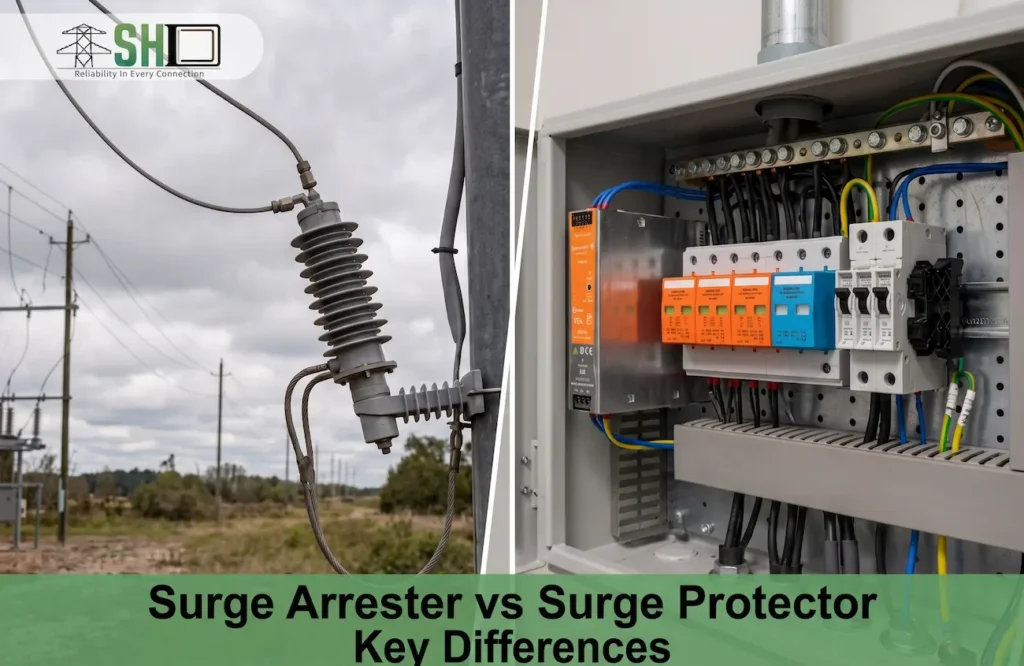
Understanding the distinction between a surge arrester vs surge protector is vital for designing essential electrical safeguards for any project. While both devices are engineered to mitigate damage from unexpected voltage spikes, they are built for different scales. A surge arrester acts as a heavy-duty, large-scale barrier installed near the external power grid to deflect massive anomalies like lightning strikes. Conversely, a surge protector operates closer to home, protecting sensitive domestic electronics from internal voltage fluctuations. Together, a surge protector vs surge arrester combination creates a comprehensive defense system for your infrastructure.
What is a surge arrester?
A surge arrester is a protective electrical device that safeguards power systems and equipment by protecting against voltage surges—caused by lightning or internal switching—and safely diverting the excess current to the ground. Difference between lightning arrester and surge arrester:
- A lightning arrester protects external structures and power lines from direct lightning strikes.
- A surge arrester protects indoor electrical panels and sensitive devices from internal and external voltage spikes (such as switching surges or grid faults).
What is a surge protector?
A surge protector (also called a surge suppressor or SPD) is a device designed to voltage protection level up for electrical appliances and sensitive electronics from sudden, high-voltage spikes or power surges in an electrical circuit.
Read More: Ground Rod Sizing and NEC Code Requirements
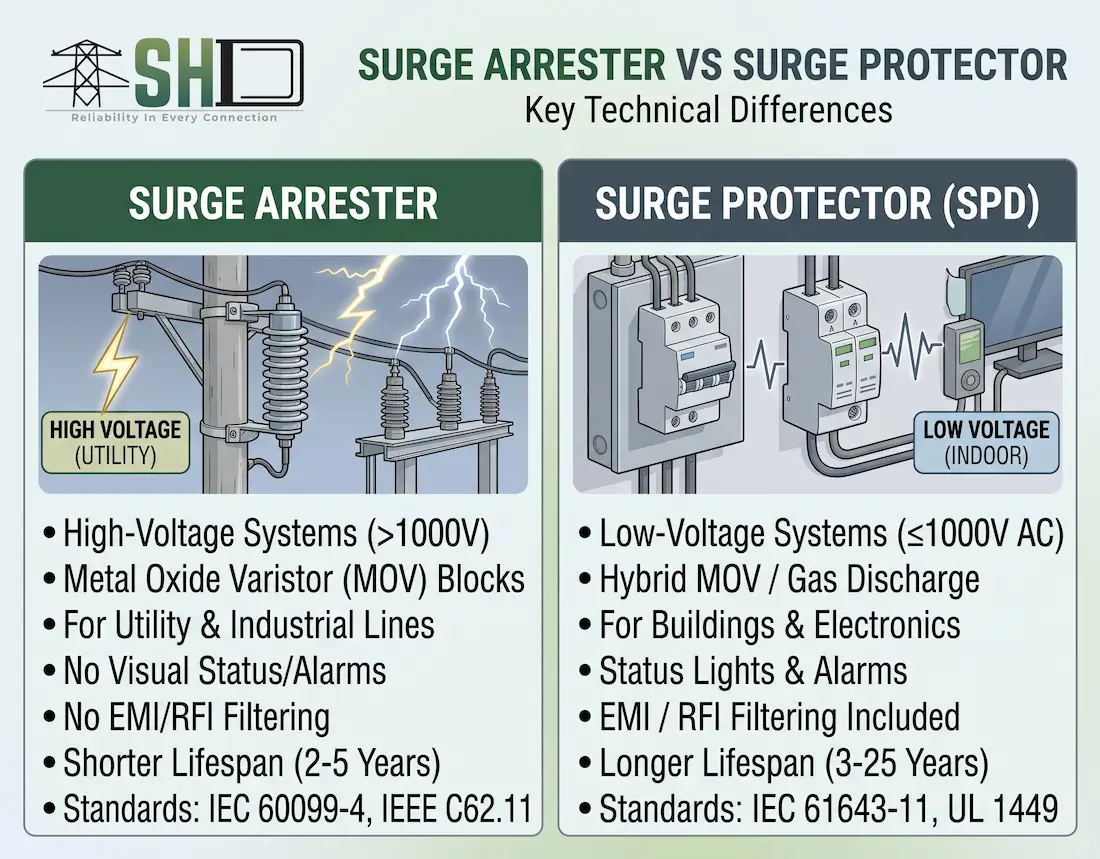
Surge arrester vs surge protector key technical differences
The main technical difference between a surge arrester vs surge protector is that a surge arrester protects high-voltage, primary electrical systems (such as utility substations, transformers, and industrial distribution lines), while a surge protector protects low-voltage, secondary electrical systems (such as building panel boards, data centers, and consumer electronics).
Key Technical difference between surge arrester and surge protector:
| Feature | Surge Arrester | Surge Protector (SPD) |
| System Voltage | High-voltage / Primary systems (Medium to High Voltage, IEC 60099-4) | Low-voltage / Secondary systems (typically ≤ 1000V AC or 1500V DC, IEC 61643-11) |
| Core Technology | Metal Oxide Varistor technology (MOV) design in heavy-duty metal blocks depending on the arrester type | Hybrid MOV or Gas Discharge Arrester (GDA/GDR) design |
| Power Interruption | Often, some devices include internal protection that can interrupt or cut power flow during a severe fault | Does not interrupt normal power flow; it diverts excess energy while keeping the circuit active |
| Monitoring & Alarms | Lacks built-in status lights, digital displays, or audible alarm capabilities | Features visual indicator lights, remote alarms, or diagnostic monitoring |
| EMI / RFI Filtering | Not available | Frequently includes electromagnetic and radio frequency interference filtering |
| Internal Fusing | None integrated inside the device | Built-in internal fusing to protect against overcurrent conditions |
| Expected Lifespan | Typically 2 to 5 years (shorter under frequent heavy surges) | Up to 3 to 25 years depending on class and surge frequency |
| Standards | IEC 60099-4, IEEE C62.11 | IEC 61643-11, UL 1449, GB/T 18802.1 |
How surge arresters and surge protectors work together
Surge arrester vs surge protector devices (SPDs) work together as a multi-layered defense system to absorb, weaken, and divert massive high-voltage surges before they can reach sensitive electronics.
- First line of defense (Surge Arresters): Installed at the main service entry or high-voltage side (such as substations or main distribution panels), the arrester absorbs and diverts massive, high-energy hits like direct lightning strikes or heavy grid switching.
- Voltage reduction (Step-down handoff): The surge arrester clamps and shears off the bulk of the dangerous high-voltage energy, dumping the majority safely into the earth grounding system.
- Second line of defense (Surge Protectors / SPDs): Installed closer to indoor or secondary distribution panels, the SPD intercepts the remaining lower-energy spikes and residual voltage that slipped past the primary arrester.
Read More: Earth Rod Resistance Test Procedures Guide
Steps to choose between a surge arrester and a surge protector
To choose between a lightning arrester vs surge protector, you must evaluate your electrical system’s voltage level, location, and the equipment you want to protect. Follow these steps to choose between a surge arrester vs surge protector:
- Identify the installation location: Choose a surge arrester depending on exposure to surges, system voltage, and required protection level.
- Determine the voltage level: Select a surge arrester for high-voltage utility lines (above 1,000V) and a surge protector for low-voltage household appliances (120V to 240V).
- Assess the threat source: Use a surge arrester to defend against external lightning strikes and utility switching, but use a surge protector to block internal spikes from household appliances.
- Check the required response speed: Pick a surge protector for sensitive electronics because it responds instantly (nanoseconds) compared to the slightly slower surge arrester.
- Evaluate discharge capacity: Opt for a surge arrester if you need to divert massive kilo-ampere (kA) currents to the ground before they enter your building’s wiring.
Common installation mistakes for surge protection equipment
Common installation mistakes for surge protection devices (SPDs) reduce their effectiveness and leave electrical systems vulnerable to damage.
- Excessive lead length: Using long or looped connection wires adds inductance, increasing the let-through voltage and reducing protection.
- Poor earthing and bonding: Using undersized, long, or high-impedance ground conductors prevents surge current from safely dissipating.
- Double tapping: Incorrectly daisy-chaining or double-tapping line-side Type 1 devices violates safety codes like the NEC and risks electrical hazards.
- Improper device coordination: Mismatching or skipping classes (such as failing to cascade Type 1, Type 2, and Type 3 devices) leaves downstream equipment vulnerable.
- Ignoring terminal torque specifications: Hand-tightening terminals instead of using a torque wrench leads to loose connections, high resistance, and thermal failure.
- Omission of backup protection: Installing an SPD without a dedicated fuse or backup protector can cause a short-circuited unit to take down the entire distribution board.
- Poor environmental placement: Mounting units inside sealed, unventilated panels or in direct sunlight causes overheating and premature metal-oxide varistor (MOV) degradation.
Why choose Sihedan as your trusted surge protection partner?
Choose Sihedan as your trusted surge protection partner. We deliver premium Overhead Power Line Hardware and cutting-edge surge arrester products such as the 33kv surge arrester, 11kv surge arrester, and Lightning Arrester to secure your electrical grids and guarantee long-term power stability.
- Comprehensive Product Portfolio: Offering a full suite of surge protection devices alongside robust overhead power line hardware to meet all grid infrastructural needs.
- Uncompromising Quality Control: Manufacturing under rigorous international standards to deliver highly durable equipment that withstands extreme environmental conditions.
- Advanced Technical Expertise: Powered by an experienced engineering team providing tailored solutions, precision designs, and reliable protection for complex power systems.
- Proven Field Reliability: Trusted by global utilities and industries for high-performance products that minimize downtime and prevent costly grid failures.
Safeguard your high-voltage infrastructure with our globally certified surge arresters. For bulk B2B orders, custom engineering, and direct factory pricing, visit our Contact Us page, reach out via WhatsApp, or email info@sihedan.com.
FAQs
Can an industrial surge arrester replace a surge protector?
No, an industrial surge arrester cannot replace a surge protector. Surge arresters are designed for high-voltage exterior protection against lightning, while surge protectors handle low-voltage interior transients for sensitive equipment.
Do commercial facilities need both surge arresters and protectors?
Yes, commercial facilities need both surge arresters and protectors. They form a dual-layered defense system, where arresters block massive exterior power surges and protectors regulate smaller, internal voltage spikes.
What happens if you install a surge protector on high voltage lines?
Installing a surge protector on high-voltage lines causes catastrophic failure. The device cannot handle the excessive voltage, leading to immediate melting, short-circuiting, fires, or dangerous electrical explosions.
How do surge arresters and protectors differ in response time?
Surge protectors generally feature faster response times than surge arresters. Protectors react in nanoseconds to safeguard sensitive electronics, whereas heavy-duty arresters take slightly longer to suppress massive lightning strikes.
Leave a Reply