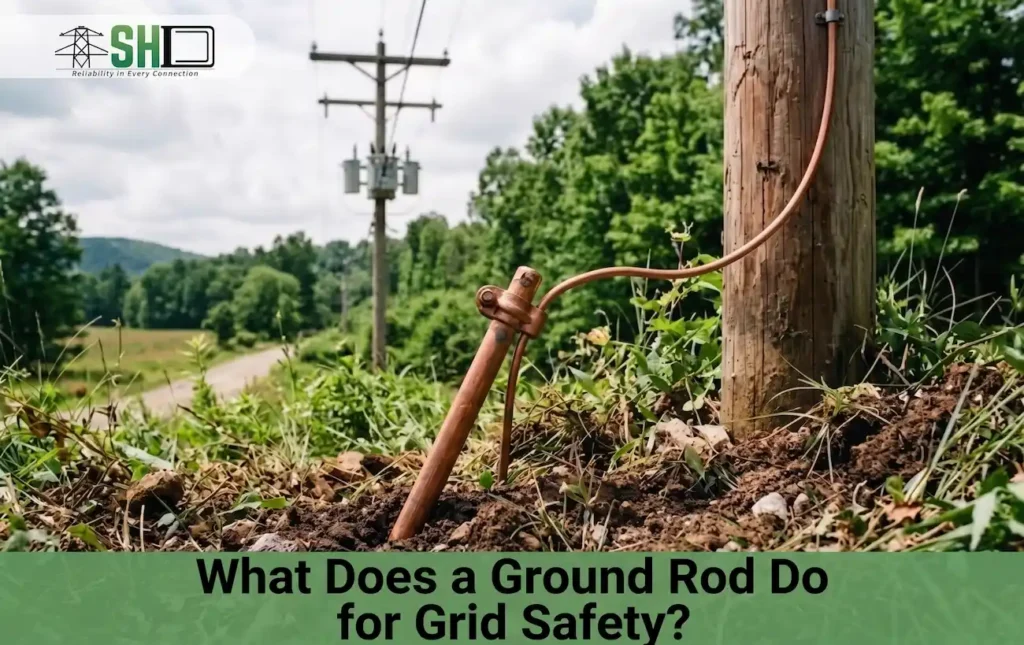
What does a ground rod do? This metal stake plays a vital role in keeping your electrical system safe. Driven deep into the earth, it gives dangerous stray electricity an easy path to travel away from your home. When lightning strikes or a power surge hits, the rod safely channels that massive current into the ground. This process protects your valuable appliances from frying and reduces the risk of electrical fires or severe shocks. Ultimately, the purpose of ground rod is to serve as a reference or a grounding anchor and ensure your household remains completely safe.
What Is a Ground Rod?
What is earthing rod is a metal rod driven deep into the earth to create a safe, physical connection between a building’s electrical system and the general mass of the Earth.
What Does a Ground Rod Do?
What does an earth rod do? It stabilizes electrical voltage and safely diverts high-voltage energy from lightning or utility surges into the earth.
What is an earth rod used for:
- Stabilizes the electrical system: what are ground rods provide a common reference point (zero potential) for your electrical system, which stabilizes electrical performance.
- Surge and Lightning Dissipation: It safely absorbs and redirects high-voltage energy spikes, such as nearby lightning strikes or utility surges, away from your fragile electronics and into the ground.
- Static Discharge: It bleeds off static electricity that builds up on lines or equipment housings.
What does a ground rod do not trip standard circuit breakers during a normal short circuit or ground fault; that is the job of the indoor equipment grounding wire running back to your panel.
Read More: Main Components of Overhead Transmission Lines
How Ground Rods Work During an Electrical Fault?
During an electrical fault, current tries to return through the path with the least impedance. Ground rods connect equipment to earth, allowing fault current to flow and helping protection trip quickly, rather than clearing standard indoor short-circuit faults. so, what does a ground rod do:
- Fault occurs: A live conductor contacts metalwork/ground or another phase, creating an abnormal current path.
- Current finds a return path: Current flows from the fault into the bonded grounding conductors connected to the grounding electrode system.
- Ground rods provide earth connection: The rod conducts the current from the grounding conductor into the surrounding soil.
- Soil resistance limits current: Earth is not perfectly conductive, so current is reduced by soil and electrode resistance.
- Voltage rises locally: As current spreads into soil, a voltage rise (ground potential rise) occurs near the rods.
- Protective devices operate: With sufficient fault current/impedance, breakers trip or fuses blow, clearing the fault.
- Safety depends on grounding quality: Poor bonding, inadequate number/depth/spacing of rods, or high soil resistance can increase shock risk from step/touch potentials.
- Current spreads outward: The fault current disperses away from the rod through the ground’s volume, not just “into” the rod.
The Role Of Material Conductivity In Ground Rod Performance
Ground rod performance during grounding depends on how well the rod material conducts current and how effectively it contacts soil. Conductivity affects resistance, corrosion durability, and fault current dispersion. So, what does a ground rod do depending on Material Conductivity:
- Higher conductivity lowers electrode resistance: A more conductive metal helps carry fault current from the grounding conductor into the rod and into the soil.
- Material affects current distribution: Good conductivity helps current spread along the rod surface rather than concentrating at a small point, improving effectiveness.
- Surface condition controls contact: Oxides, coatings, and soil moisture determine how well current transfers at the rod/soil interface.
- Temperature and environment influence durability: Grounding installations exposed to wet/dry cycles or chemicals can degrade weaker materials faster, increasing resistance.
- Common practices: Install rods with proper length, bonding, and multiple electrodes where needed, regardless of conductivity, to achieve the required resistance.
Read More: Pole Clamp Types Selection Criteria
Essential Ground Rod Clamps and Connections
Ground rod clamps and connections are critical because they provide a reliable, corrosion-resistant link between ground rods and grounding conductors. Poor connections increase resistance and failure risk.
- Clamp ensures secure mechanical contact: It grips the rod and conductor firmly so the connection doesn’t loosen over time.
- Low-resistance electrical path: A good clamp reduces contact resistance, helping the grounding system carry fault/strike current effectively.
- Correct material matching: Clamps are selected to work with the rod and conductor metals to avoid galvanic corrosion (for example, copper-to-steel compatibility issues).
- Proper installation torque/fastening: Using the correct tightening method prevents loose joints, which can heat up and degrade the connection.
- Bonding continuity matters: Ground rod connections must be electrically continuous with the rest of the grounding system (main bonding/EGC where required).
- Weather/soil exposure requirements: Outdoor clamps must be rated for direct burial and harsh soil conditions, not indoor-only hardware.
- Typical connection types: Common designs include listed exothermic weld (where applicable), listed compression fittings, or listed mechanical clamps/bridges.
- Inspection and maintenance: Regular checks help confirm the clamp hasn’t corroded, loosened, or developed high resistance.
Warning Signs of a Failing Ground Rod System
A failing ground rod system causes strange electrical behavior, mild shocks, and frequent circuit breaker trips because stray electricity cannot safely escape into the earth.
- Tingling or mild shocks: Feeling a slight zap when you touch metal kitchen appliances, washer bodies, or plumbing pipes means the enclosure is energized.
- Flickering or dimming lights: Lights may brighten or dim unexpectedly when heavy appliances turn on, signaling a floating neutral or poor earth path.
- Frequent breaker trips: Circuit breakers or safety switches (GFCI/RCD) shut off repeatedly under normal loads due to unrouted leakage current.
- Burn marks or warm outlets: Discoloration, a melting plastic smell, or warm wall plates around plugs indicate stray current trying to find an alternate route.
- Premature electronics failure: Computers, TVs, and smart devices break down early or reset randomly due to voltage instability and unabsorbed power surges.
How Sihedan Manufactures Grounding Systems To Handle HV Faults?
Sihedan engineers premium grounding systems to safely dissipate high-voltage faults, ensuring complete grid resilience. Our robust Overhead Power Line Hardware and specialized Construction Hardware deliver unmatched protection against severe system overloads.
- Rapid Fault Dissipation: Engineered to channel heavy short-circuit and lightning currents safely into the earth, preventing arc flashes and protecting expensive substation infrastructure.
- High Corrosion Resistance: Manufactured with premium copper-bonded steel and hot-dip galvanized components, ensuring long-term underground stability even in highly corrosive soil conditions.
- Optimized Safety Metrics: Designed specifically to reduce hazardous step and touch potentials, keeping maintenance personnel safe during high-voltage electrical disruptions.
- Strict Quality Compliance: Produced under rigorous precision manufacturing protocols that align with global utility standards, ensuring consistent electrical connectivity and mechanical strength.
Ensure the ultimate safety of your utility grids with our globally certified grounding hardware. For custom engineering, bulk OEM orders, and direct factory pricing, visit our Contact Us page, connect with our experts on WhatsApp, or email us at info@sihedan.com.
FAQs
How to test if a ground rod is working?
To test if a ground rod is working, use a ground resistance tester via the fall-of-potential method. Alternatively, clip a clamp-on ground meter around the electrode to measure its resistance safely without disconnecting the system.
What happens if a ground rod goes bad?
If a ground rod goes bad, the electrical system loses its safe path to the earth. This leads to electrical risks, increases the risk of electrical fires, and creates severe shock hazards for occupants.
Can a ground rod be installed in rocky soil?
Yes, ground rods can be installed in rocky soil, but it requires specialized techniques. You can drive them at an angle up to 45 degrees, bury them horizontally in a trench, or use chemical grounding rods.
How long does a ground rod last underground?
A standard galvanized ground rod lasts about 15 years underground. However, high-quality copper-bonded ground rods are much more durable and can effectively protect a system for 30 to 50 years depending on soil conditions.
Leave a Reply