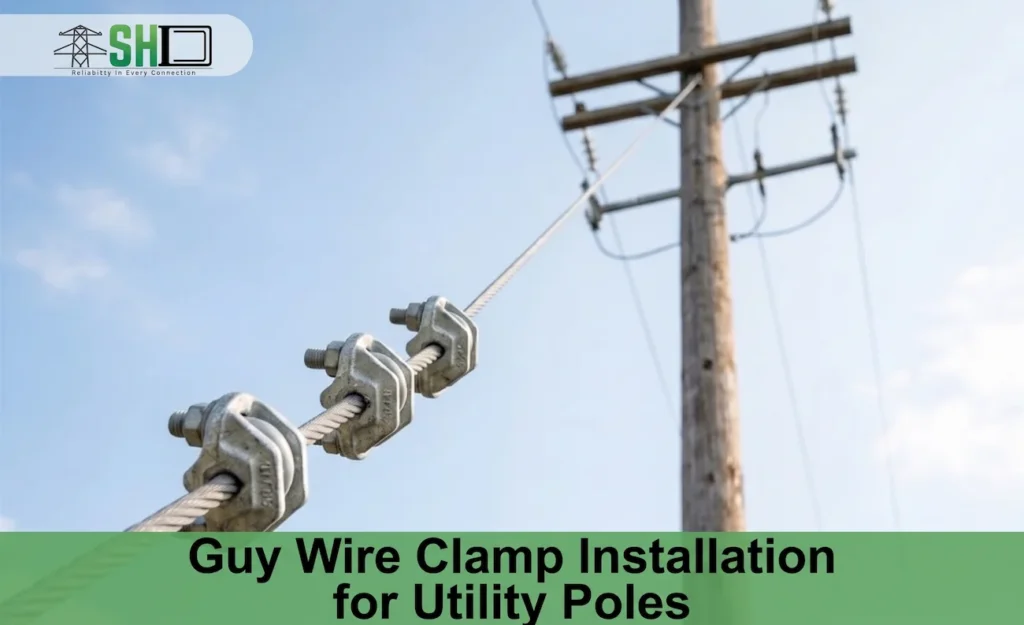
Guy wire clamp installation is vital for securing utility poles, antennas, and large masts against high winds and structural loads. The critical engineering standards, specialized equipment, and safety regulations are required to ensure a secure, reliable hold. Adherence to precise placement and specified torque requirements prevents hardware failure, safeguarding both the structure and the public. Mastery of these professional techniques, alongside strict compliance with local building codes and the use of proper personal protective equipment, ensures long-lasting stability and structural integrity.
What is a Guy Wire?
A guy wire is a tensioned cable attached to a tall, thin structure and anchored to the ground to add lateral stability and prevent it from falling over. One end connects high up on the structure while the other is fixed firmly in the earth.
What is guy wire used for?
- Utility pole guy wire anchor to offset the pull of power lines.
- Radio and television towers to keep tall masts upright.
- Wind turbines to withstand heavy side winds.
- Tents to hold poles secure in stormy weather.
Read More: Types of Distribution Pole: Complete Selection Guide
What Is a Guy Wire Clamp?
A guy wire clamp is a piece of hardware used to secure, grip, and tension guy wires or cables. Guy wire clamp installation fastens the loose end of a guy wire back onto the main cable to lock a supporting loop or eye in place, keeping utility poles, towers, and masts stable.
Read More: Dead End Clamp Function: Applications & Selection Guide.
Guy Wire Clamp Installation Hardware Types
Guy wire clamp installation relies on premium Guy Wire Accessories and specific hardware types to secure, tension, and anchor utility poles, towers, and masts safely. The utility pole guy wire requirements include parallel groove guy clamps, wire rope clips, thimbles, and turnbuckles, all hot-dip galvanized for weather protection.
Core Guy Clamp Types
- Bolt Guy Clamps: Light-duty plates with a single parallel groove and bolt, used for small loads or temporary lines.
- Bolt Guy Clamps: Medium-duty variant providing extra holding friction for standard utility or telecom pole runs.
- Bolt Guy Clamps: Heavy-duty standard for utility poles and power lines; features parallel grooves across two matching plates secured by three shoulder bolts to maximize grip strength without crushing the strand.
Essential Supporting Hardware
- Wire Rope Clips (U-Bolts): Used to clamp the dead-end loop back onto the main cable body.
- Thimbles: Placed inside the wire rope eye loop to prevent sharp bending, wear, crushing, and fatigue.
- Turnbuckles: Screw-threaded tensioners attached to the anchor point to adjust cable tightness.
- Shackles (Anchor Shackles): Guy wire anchor rods are heavy-duty connecting links used to join the wire rope assembly to eye bolts, dead-ends, or ground anchors.
- Guy Grips (Preformed Dead-Ends): Helical wire sets that wrap directly onto the cable as an alternative or supplement to traditional bolted clamps.
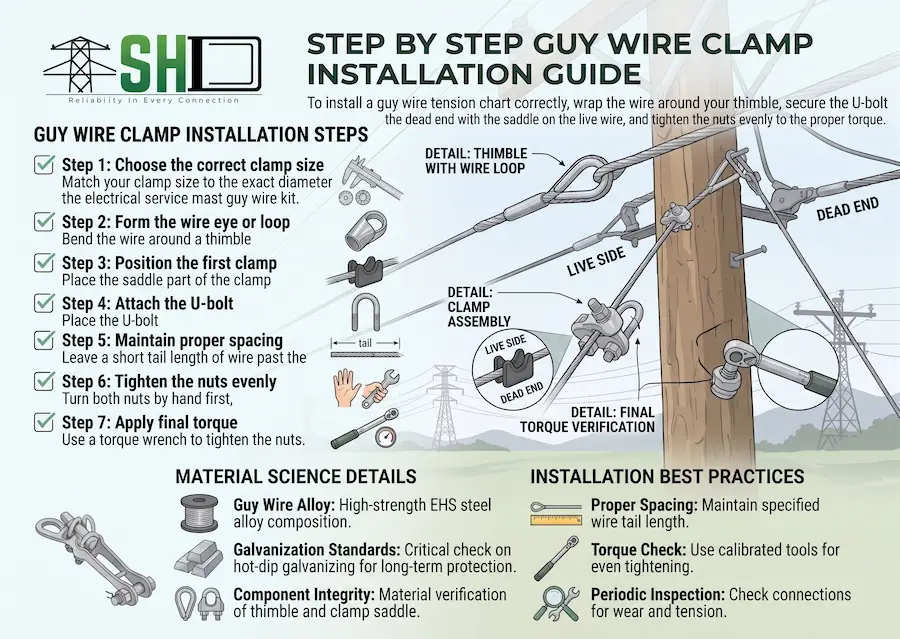
Step by Step Guy Wire Clamp Installation Guide
To install a guy wire tension chart correctly, wrap the wire around your thimble, secure the U-bolt over the dead end with the saddle on the live wire, and tighten the nuts evenly to the proper torque. Guy wire clamp installation Steps:
Step 1: Choose the correct clamp size:
Match your clamp size to the exact diameter of the electrical service mast guy wire kit.
Step 2: Form the wire eye or loop
Bend the wire around a thimble to form a smooth loop and protect the wire from wear.
Step 3: Position the first clamp
Place the saddle part of the clamp on the live (main) side of the wire.
Step 4: Attach the U-bolt
Place the U-bolt part of the clamp over the dead (tail) end of the wire.
Step 5: Maintain proper spacing
Leave a short tail length of wire past the clamp according to the length specified by the manufacturer.
Step 6: Tighten the nuts evenly
Turn both nuts by hand first, then use a wrench to tighten them equally back and forth.
Step 7: Apply final torque
Use a torque wrench to tighten the nuts to the manufacturer’s recommended tightness (typically between 15 and 30 ft-lbs depending on the clip size).
Key Safety Tips for Guy Wire Clamp Installation
For safe guy wire clamp installation, always remember the golden rule: “Never saddle a dead horse.” Always place the saddle part of the clip on the live (main) wire and the U-bolt on the dead (tail) end. Correct spacing, right clamp counts, and proper gear prevent dangerous slips.
- Positioning: Put the saddle on the live wire end. Put the U-bolt on the dead wire end.
- Spacing: Keep space between clamps equal to six times the wire rope width.
- Quantity: Use three clamps for 8–10 mm wire. Use four clamps for 12–16 mm wire.
- Check: Retighten all nuts with a torque wrench after the first load.
- Gear: Wear a hard hat, heavy work gloves, and non-slip boots.
- Inspection: Check the wire for rust, kinks, or broken strands before you start.
- Reuse: Never reuse old clamps. They lose strength after first use.
Why Sihedan is the Best Choice for Guy Wire Clamp Installation Hardware?
Sihedan is the best choice for guy wire clamp installation hardware and complete Overhead Power Line Hardware, trusted for dependable performance, clean installation, and long-term stability. When precision matters, Sihedan delivers strength you can count on.
- Secure, reliable clamping: Designed to firmly grip guy wires, helping maintain proper tension and alignment over time.
- Built for durability: Made to resist wear and withstand harsh outdoor conditions for long service life.
- Accurate installation fit: Hardware geometry and fitment are engineered to support smooth, consistent installs, reducing rework.
- Strong corrosion resistance: Helps protect critical contact points, supporting stable performance in demanding environments.
- Tight, stable connections: Reduces slippage risk at the clamp interface to support safer, steadier wind/load handling.
- Work-efficient design: Supports faster setup with practical handling features, helping crews install with confidence.
- Quality you can standardize: A consistent product approach makes it easier to maintain uniformity across projects and sites.
- Suitable for real-world use: Ideal for towers, masts, and structural guying where secure anchoring is essential.
For bulk orders, technical specifications, or immediate expert support on your guy wire hardware needs, visit our Contact Us page, message us directly on WhatsApp, or email our team at info@sihedan.com.
FAQs
What is the correct torque for guy wire clamp bolts?
The correct torque for guy wire clamp or clip bolts varies by size, such as 15 ft-lbs for 1/4-inch or 30 ft-lbs for 5/16-inch rope, so always follow the exact manufacturer specification.
Can guy wire clamps be reused after installation?
Guy wire clips should generally not be reused in safety-critical applications because the threads, bolts, and saddles suffer stress, distortion, and potential wear during the initial installation and loading phase.
How long do galvanized steel guy wire clamps typically last?
Galvanized steel guy wire clamps typically last between 15 and 30 years outdoors, though their exact lifespan depends heavily on local environmental factors like humidity, pollution, coastal salt air, and regular maintenance.
How do you properly secure a utility pole guy wire anchor?
To properly secure a utility pole guy wire anchor, drive or screw an approved earth anchor depending on soil type and anchor type, attach the strand securely, and tension it properly using a turnbuckle.
How Many Clamps Are Required per Guy Wire Application?
You typically need a minimum of two to three clamps or more, depending on the load and clip specifications, the clamp size, and the clip’s design, spaced evenly apart to properly distribute the load and hold the strand securely.
Leave a Reply