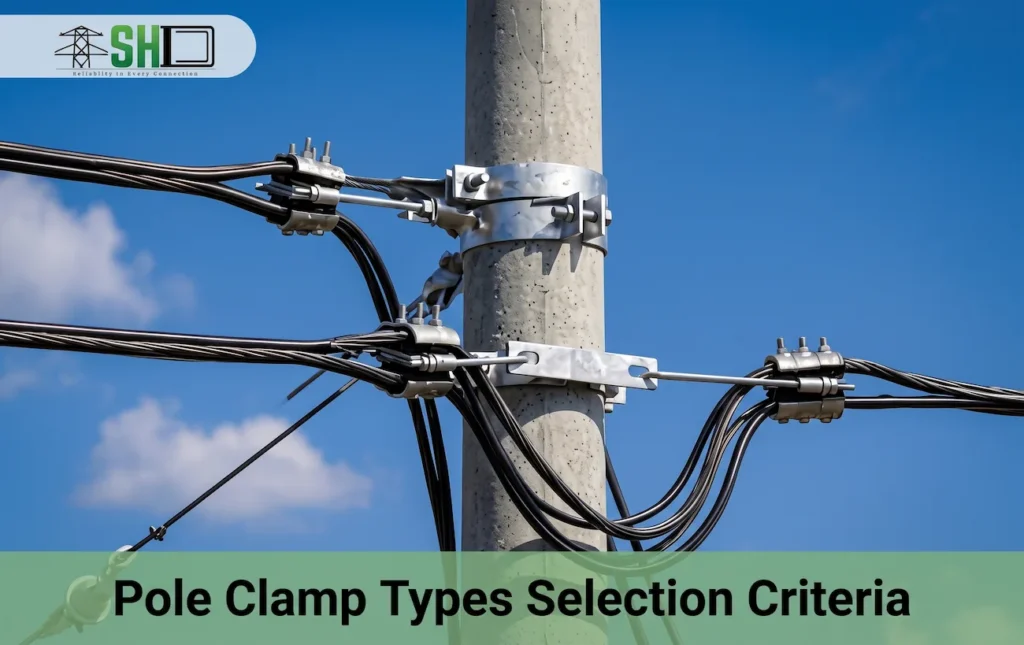
Pole clamp types play an essential role in securing hardware, cables, and crossarms safely to utility poles within electrical distribution networks. These durable brackets hold equipment firmly against strong winds, heavy ice, and everyday mechanical stress. Different designs serve unique purposes, such as supporting dead-end assemblies, suspending messenger wires, or anchoring guy lines. Electricians choose specific clamps based on pole size, load requirements, and environmental conditions. Understanding these options helps engineers design resilient power grids that deliver reliable electricity to homes and businesses every single day of the entire year.
What Is a Pole Clamp?
A pole clamp is a metal fastening device that wraps around a utility or communication pole to provide a secure mounting point for external hardware. It is also known as a pole band or pole fastener.
- Pole clamp types place the sections around the pole and tighten them using heavy-duty bolts and nuts.
- Tightening the bolts creates inward pressure, locking the clamp tightly against the wood, concrete, or metal pole without sliding.
- ground clamp definition is a metal device used to securely attach an electrical wire to a grounding source like a water pipe or a metal rod.
Read More: Main Components of Overhead Transmission Lines
Main Pole Clamp Types for Overhead Lines
The main utility pole clamp types for overhead lines are categorized by their specific mechanical and electrical functions in supporting, anchoring, and connecting conductors.
1- Suspension Clamps
- Support and hang conductors on straight sections of overhead lines from insulator strings.
- Allows smooth movement or cradling; some use rubber or neoprene inserts to absorb vibration and reduce wear.
- Standard bolted, armor-grip, and preformed variants for fiber/ADSS lines.
2- Dead-End (Tension / Anchor) Clamps
- Anchor and secure conductors at termination points, dead-ends, corners, or sharp turns where full mechanical line tension must be handled.
- Grips the cable firmly to prevent slipping or snapping under high stress.
- Bolted strain clamps, wedge-type clamps, and compression dead-ends.
3- Parallel Groove (PG) Clamps
- pg clamp full form connect parallel-axis conductors to form continuous electrical paths or tap connections (jumpers).
- Uses parallel-groove bolting configurations to ensure solid electrical contact without crushing the wire.
- Aluminum, bimetallic (for aluminum-to-copper), and bronze/brass.
4-Pole Band Clamps
- Wrap securely around the utility pole body to mount hardware, crossarms, or guy attachments, particularly on concrete or steel poles.
- Adjustable heavy steel bands fastened with high-strength bolts.
Key Differences Between Pole Clamp and Pole Band
A pole clamp directly grips and anchors cables, wires, or hardware lines, while a pole band wraps entirely around the circumference of a utility pole to provide a stable mounting bracket for attachments.
| Feature | Pole Clamp | Pole Band (Pole Band Clamp) |
| Primary Function | Grips, suspends, or dead-ends conductors, fiber optic cables, or messenger wires. | Acts as a collar/bracket base to mount enclosures, transformers, crossarms, or antennas. |
| Load Handling | Transfers line tension, ice, and wind loads from the cable directly into the pole structure. | Supports static and mechanical fixture weights, offset loads, and bracket attachments without drilling. |
| Common Types | Suspension clamps, dead-end/tension clamps, and drop wire clamps. | Single offset, double offset, adjustable bands, and link-style pole bands. |
| Typical Application | Aerial FTTH and power line cable routing and span management. | Cellular booster mounting, street furniture, and utility distribution hardware installation. |
Pole Clamp Technical Specifications and Material Standards
Pole clamp types for utility, telecom, and solar applications are typically fabricated from structural carbon steel or stainless steel designed to meet rigorous mechanical load and corrosion-resistance standards.
- Standard Carbon Steel: Q235 or equivalent structural flat steel providing high tensile strength and ductility; tensile strength ratings up to 560 N/mm².
- Stainless Steel: Type 304 or 316 for high-corrosion or marine environments.
- Aluminum Alloys: Alternative lightweight brackets used selectively for specialized cable anchoring (e.g., ADSS lines).
- Hot-Dip Galvanization: Preferred corrosion protection conforming to ISO 1461 or ASTM A153 / A123 for exterior and subterranean durability.
- Alternative Finishes: Electro-plated zinc (ZN) or specialized powder coatings depending on utility specifications.
- Pole Diameters: Ranging generally from 150 mm to 280 mm for standard utility applications, calculated based on the offset height and top diameter of the pole.
- Load Ratings: Stay tension strengths are typically 29 kN or higher, according to the design, application, and depending on the configuration (single offset, double offset, or link-style brackets).
Read More: Types of Distribution Pole: Complete Selection Guide
How to Choose the Right Pole Clamp Type for Your Project?
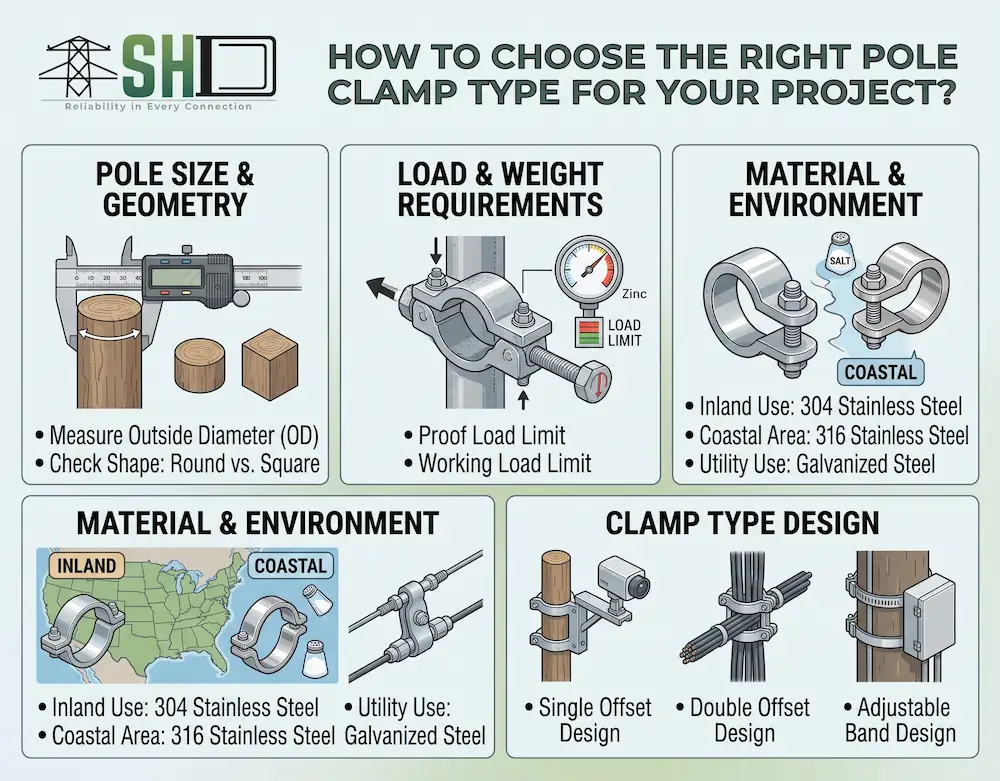
Choosing the right pole clamp types requires matching the outer diameter and shape of the pole, evaluating load limits, and selecting a corrosion-resistant material suited for the environment.
- Pole Size and Geometry: Measure the outside diameter (OD) and check the shape (round versus square). Ensure the clamp’s size range fits tightly without stretching its limits.
- Load and Weight Requirements: Review the proof load (where permanent deformation begins) and working load limit to guarantee safety under tension or heavy equipment weight.
- Material and Environment: Use 304 stainless steel for normal inland use, and upgrade to 316 stainless steel for coastal areas with high salt exposure to prevent rapid rusting. Galvanized steel works well for heavy pressure on utility lines.
- Clamp Type Design: Pick single offset, double offset, or adjustable Pole Band Clamps Guide depending on whether you are mounting brackets, communication cables, or heavy electrical hardware.
Common Pole Clamp Installation Mistakes to Avoid
Avoiding the wrong size, improper tightening, and surface neglect ensures a secure and lasting pole clamp installation.
- Using the wrong size: Selecting a clamp that does not match the exact outer diameter of the pole results in a weak grip or excessive crushing pressure.
- Improper tightening: Over-tightening can warp or damage the pole and strip the threads, while under-tightening allows the clamp to slip or slide out of position.
- Failing to clean the surface: Leaving grease, dirt, rust, or moisture on the pole prevents a tight, friction-based hold and causes the clamp to creep.
- Misaligning the clamp: Mounting the clamp at an uneven angle or off-center creates unbalanced stress and reduces holding strength.
- Ignoring environmental factors: Using non-corrosive or weak materials outdoors leads to rapid rust and failure when exposed to moisture and temperature shifts.
Why Sihedan is a Trusted Pole Clamp Direct OEM Factory?
Sihedan is a premier manufacturing leader delivering exceptional Overhead Power Line Hardware, specializing in durable, precision-engineered pole line hardware designed for global utility and modern telecommunication infrastructure applications.
- Direct Factory Pricing: Eliminates middleman markups to provide cost-effective hardware without sacrificing raw material quality or engineering precision.
- Custom OEM Solutions: Tailors pole clamp dimensions, finishes, and steel grades directly to specific utility project specifications and regional standards.
- Rigorous Quality Control: Utilizes advanced pressure casting and hot-dip galvanization techniques to ensure maximum rust resistance and high holding strength.
- Global Trust & Experience: Backed by decades of manufacturing expertise, supplying reliable grid components to partners across numerous international markets.
Build resilient and modern utility grids with our globally certified pole line hardware. For custom engineering, bulk OEM orders, and direct factory pricing, visit our Contact Us page, connect with our engineers on WhatsApp, or email us at info@sihedan.com.
FAQs
How long do hot-dip galvanized pole clamps last?
Hot-dip galvanized pole clamps typically last between 30 to 50 years in standard inland environments. However, their service lifespan can decrease to 20 to 30 years in highly corrosive marine or coastal areas, depending on factors such as salt exposure, industrial pollution, moisture, and maintenance.
Can you reuse adjustable pole clamps after use?
Reusing them is generally not recommended because the initial tightening causes mechanical stress, material fatigue, and thread wear. Reusing compromised clamps risks structural slipping, deformation, or unexpected failure under load.
Are standard pole clamps compatible with ADSS/OPGW?
No, standard clamps are not directly compatible because ADSS and OPGW cables require specialized fittings. Standard clamps create localized stress concentrations that damage fiber optics, requiring cushioned or preformed armor rods instead.
What causes pole clamp failure in overhead lines?
Mechanical fatigue from wind-induced vibrations, galvanic corrosion in coastal zones, extreme weather overloading (such as ice), improper initial installation torque, and natural material degradation over time primarily cause failure.
Leave a Reply