
The dropout fuse of transformer is the first line of overcurrent protection on the high-voltage side of distribution transformers – widely deployed in 10–36 kV networks for their simple structure, visible fault indication, and low maintenance requirements, making them the most cost-effective transformer protection solution globally.
What is dropout fuse of transformer?
A dropout fuse of transformer is a high-voltage expulsion-type protective device mounted on the primary side of distribution transformers, It combines automatic overcurrent protection with manual switching capability – the fuse holder drops visibly open when the element melts, providing a clear fault indication to line crews from ground level, The drop out fuse transformer is operated using an insulated hot stick – no de-energization of the main feeder is required for fuse link replacement.
Read More: What is an Expulsion Fuse? A Complete Technical Guide.
Core Functions and Purpose of Transformer Dropout Fuses:
The drop out fuse in transformer installations performs three critical roles:
- Overcurrent protection: Automatically interrupts fault currents from internal faults, short circuits, and overloads – isolating the transformer before damage propagates.
- Isolation switch: Provides a visible open-circuit point for safe maintenance – confirmed from ground level.
- Lightning surge backup: Backup protection against overvoltage events exceeding arrester clamping capacity.
Per IEEE Standard 493, liquid-filled transformers experience ~0.0041 failures per unit per year – the dropout fuse of transformer is the primary barrier preventing cascade outages.
Key Components and Working Principle of Drop Out Fuses:
Understanding the Drop out fuse working principle requires knowing each Drop Out Fuse element:
- Insulator body: Porcelain or silicone rubber – mounted at 20° off vertical for reliable gravity drop-out.
- Fuse holder (tube): Epoxy-glass expulsion tube with arc-quenching inner liner – extinguishes arc at natural current zero.
- Fuse link: Silver or silver-copper alloy wire – Type T (slow) tolerates 8–12× inrush without nuisance blowing.
- Upper and lower contacts: Spring-loaded for fast, reliable disconnection during fault.
Operating sequence:
When a fault occurs:
- Fault current exceeds fuse link rating – link melts, arc forms inside the expulsion tube.
- Expulsion gases de-ionize the arc at natural current zero – circuit interrupts.
- Fuse holder swings open under gravity – visible disconnection confirmed from ground.
- Line crew replaces fuse link with hot stick – transformer re-energized without feeder shutdown.
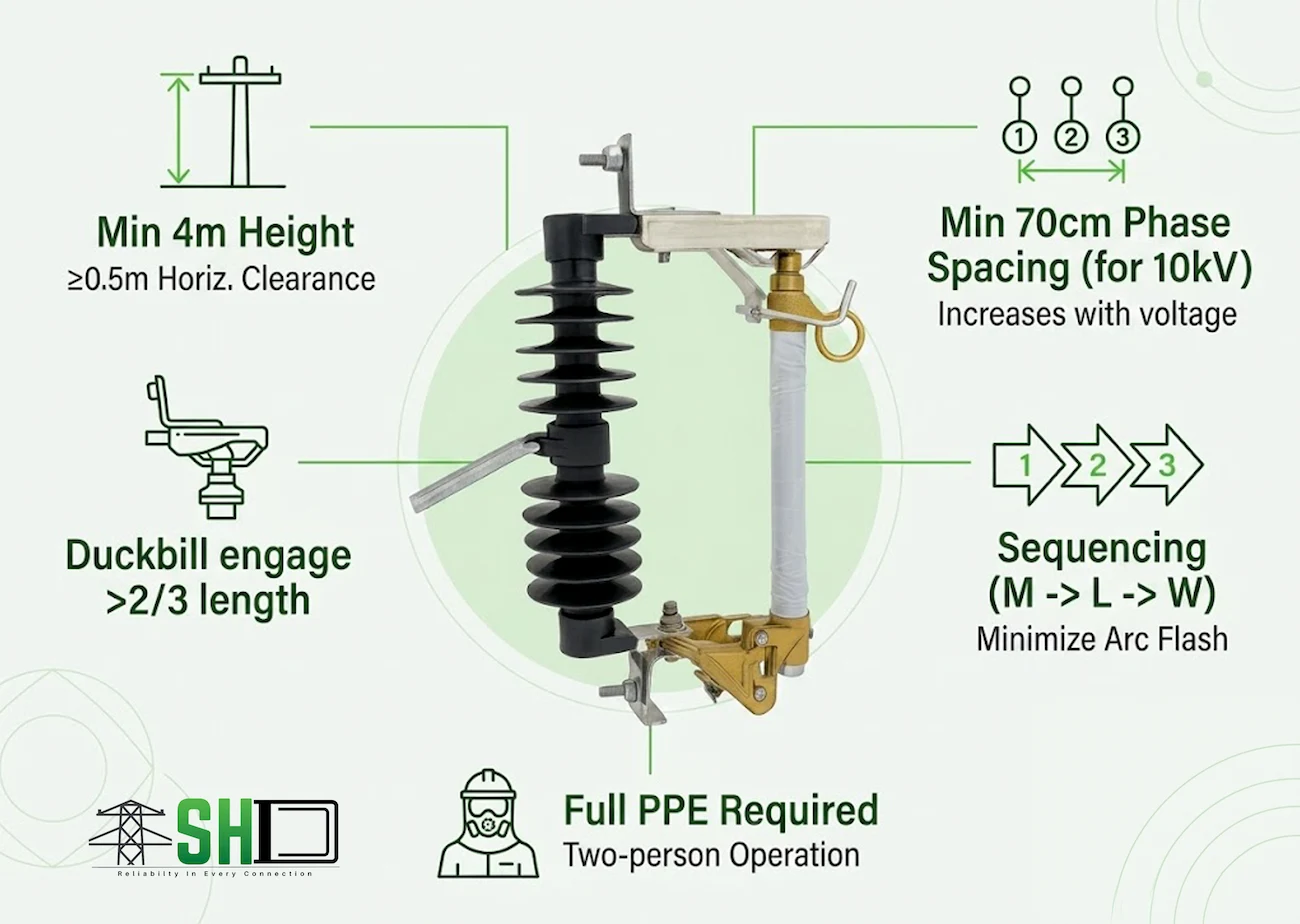
Installation Guidelines for the dropout fuse of transformer:
Correct installation of the dropout fuse of transformer is critical for reliable operation, Key requirements per IEEE C37.42 and field practice include:
- Mounting height: Minimum 4 meters from ground to fuse assembly – if mounted above the transformer, maintain ≥0.5m horizontal clearance from transformer body to prevent dropped fuse tube contact.
- Phase spacing: Minimum 70 cm between phases for 10 kV installations – increases with voltage class per IEC 60071 insulation coordination requirements.
- Fuse tube length: Adjust so the duckbill contact engages more than 2/3 of contact length when closed – prevents nuisance self-opening under vibration or wind.
- Operating sequence: Always open the middle phase first, then leeward, then windward – this minimizes arc flash exposure during manual switching operations.
- PPE requirements: Insulating rod rated to system voltage, insulating gloves, boots, and goggles mandatory – two-person operation required.
Failure Statistics and Common Mistakes in Dropout Fuse Application:
Per IEEE Xplore lifecycle research, 190 dropout fuses from six manufacturers were tested – finding unqualified components as the major cause of contact erosion and drop-out failure..
- Wrong fuse link current rating: Fuse link must be sized at 1.5–2× transformer rated current – too low causes nuisance blowing on inrush; too high defeats overcurrent protection.
- Insufficient interrupting capacity: Fuse tube rated below available fault current risks catastrophic explosion – always verify against the network fault level at the installation point.
- Porcelain in coastal environments: Salt contamination causes tracking flashover on porcelain – polymer (silicone rubber) insulators required for coastal and high-pollution installations per IEC 60815.
- Loose fuse link installation: Fuse link tension must be approximately 24.5N – insufficient tension causes contact overheating and premature failure.
Read More: HV Fuses for Transformer Protection: Selection Guide.
Routine Operation and Maintenance of Drop Out Fuses:
Regular inspection of every Drop Out Fuse element maintains the dropout fuse of transformer in reliable condition:
- Visual inspection: Porcelain cracks, contact corrosion, fuse tube damage – monthly for coastal, quarterly for inland.
- Contact resistance measurement: Micro-ohm testing identifies high-resistance connections before overheating failure.
- Fuse tube replacement: Replace when inner bore exceeds manufacturer tolerance – never reuse over-operated tubes.
- Fuse link verification: Confirm rating matches transformer capacity and fault level – recalculate after any network change.
Read More: How to Calculate Fuse Size for Transformer? Step by Step.
International Safety Standards for Transformer Fusing:
Every dropout fuse of transformer must comply with applicable standards to ensure the Drop out fuse working principle performs under all fault conditions:
- IEEE C37.42-2016: Class A distribution-class cutouts – 1 through 38 kV; governs construction and interrupting ratings – IEEE C37.42.
- IEC 60282-2:2008: High-voltage expulsion fuses – Europe, Asia, and international projects.
- IEEE C37.48: Application, operation, and maintenance guide – coordination, installation, and field procedures.
- IEC 60815: Pollution severity classification – creepage distance for porcelain and polymer insulators.
Elevating Transformer Protection with Sihedan Manufacturing Excellence:
Sihedan manufactures the complete range of dropout fuse of transformer solutions – certified to IEC 60282-2 and IEEE C37.42 for reliable drop out fuse in transformer protection worldwide:
- Full IEC 60282-2 and IEEE C37.42 certification: Type test documentation for utility tender submissions.
- Polymer and porcelain options: Matched to site pollution severity, voltage class, and environment.
- Hot-dip galvanized hardware: All ferrous parts ≥86μm zinc coating – superior corrosion resistance.
- Full OEM / ODM capability: Custom voltage ratings, current ratings, and fuse link speed per project.
Explore Sihedan Dropout Fuse Products and Solutions:
Sihedan provides a complete dropout fuse portfolio for transformer and overhead line protection:
- Drop Out Fuse (11–36 kV): Expulsion-type with visible drop-out indication – ideal for transformer primary protection.
- Fuse Links K & T Type: EEI-NEMA rated, 1–200A, compatible with 10–36 kV cutouts.
- Polymer Cutout Assemblies: Silicone rubber insulated – superior hydrophobic performance per IEC 60815.
Read More: Types of cut out fuse: A Complete Selection Guide.
To secure your distribution networks with IEEE-certified dropout fuses, explore Sihedan’s premium OEM capabilities. For custom B2B quotes and technical consultations, visit our Contact Us page, message our engineering team directly on WhatsApp, or email us at info@sihedan.com.
FAQs:
Can you replace a drop out fuse without de-energizing the circuit?
Yes – fuse link replaced using an insulated hot stick with feeder energized, Only the faulted transformer is isolated; the main feeder remains live.
Why does a drop out fuse sometimes operate without an electrical fault?
Nuisance operation is caused by undersized fuse links, mechanical vibration loosening contacts, or contamination degrading the fuse element prematurely.
What is the difference between a standard drop out fuse and a load break fuse?
A standard drop out fuse interrupts fault current only. A load break fuse includes an arc-extinguishing chamber that safely interrupts load current during manual switching.
How do you determine the correct size for a transformer dropout fuse?
Size at 1.5–2× transformer rated primary current – tolerates inrush (8–12× rated) without nuisance blowing, while clearing secondary faults per IEEE C37.48.
Leave a Reply