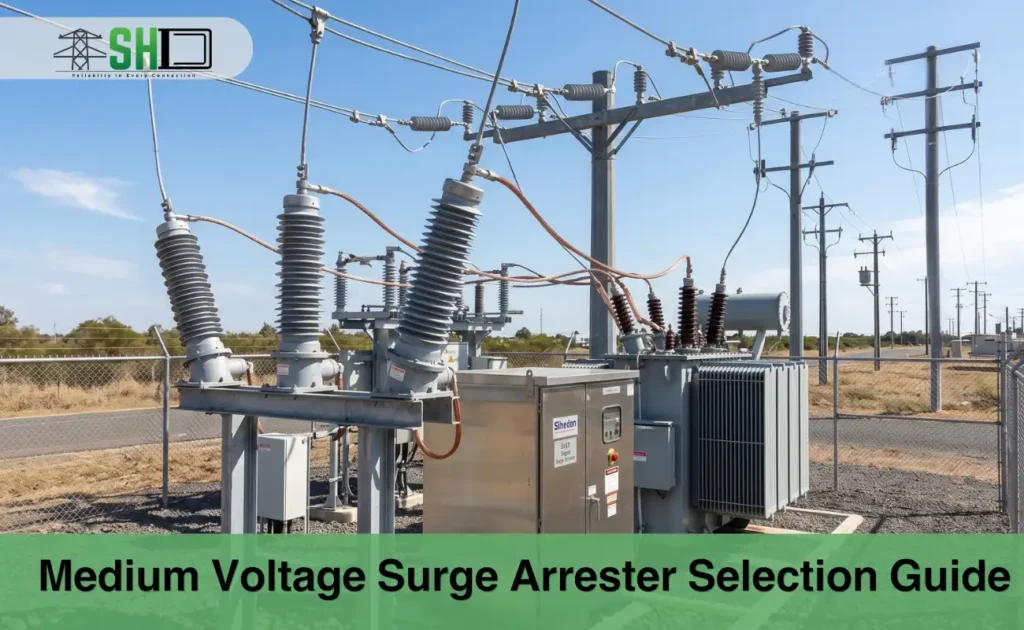
The medium voltage surge arrester selection guide provides essential criteria for protecting electrical distribution systems from transient overvoltages. By evaluating key parameters like Maximum Continuous Operating Voltage (MCOV), nominal discharge current, and energy capability, engineers ensure grid reliability. Proper selection safeguards critical equipment against lightning and switching surges, minimizing costly downtime. For medium voltage surge arrester selection guide must utilize IEEE Standards and manufacturer documentation to guarantee optimal insulation coordination and long-term operational safety in your network.
What is a medium voltage surge arrester?
To understand the medium voltage surge arrester selection guide, you must first know what a medium voltage surge arrester is: a protective device designed to safeguard electrical infrastructure—such as transformers, switchgear, and various Overhead Power Line Hardware—from dangerous transient overvoltages.
By safely diverting excess voltage and current into the ground during lightning strikes or grid switching events, it prevents equipment failure.
What is a medium voltage surge arrester selection guide?
A medium voltage surge arrester selection guide is a technical reference document that helps engineers choose protective devices for systems from 1 kV to 52 kV, ensuring survival under lightning and switching surges.
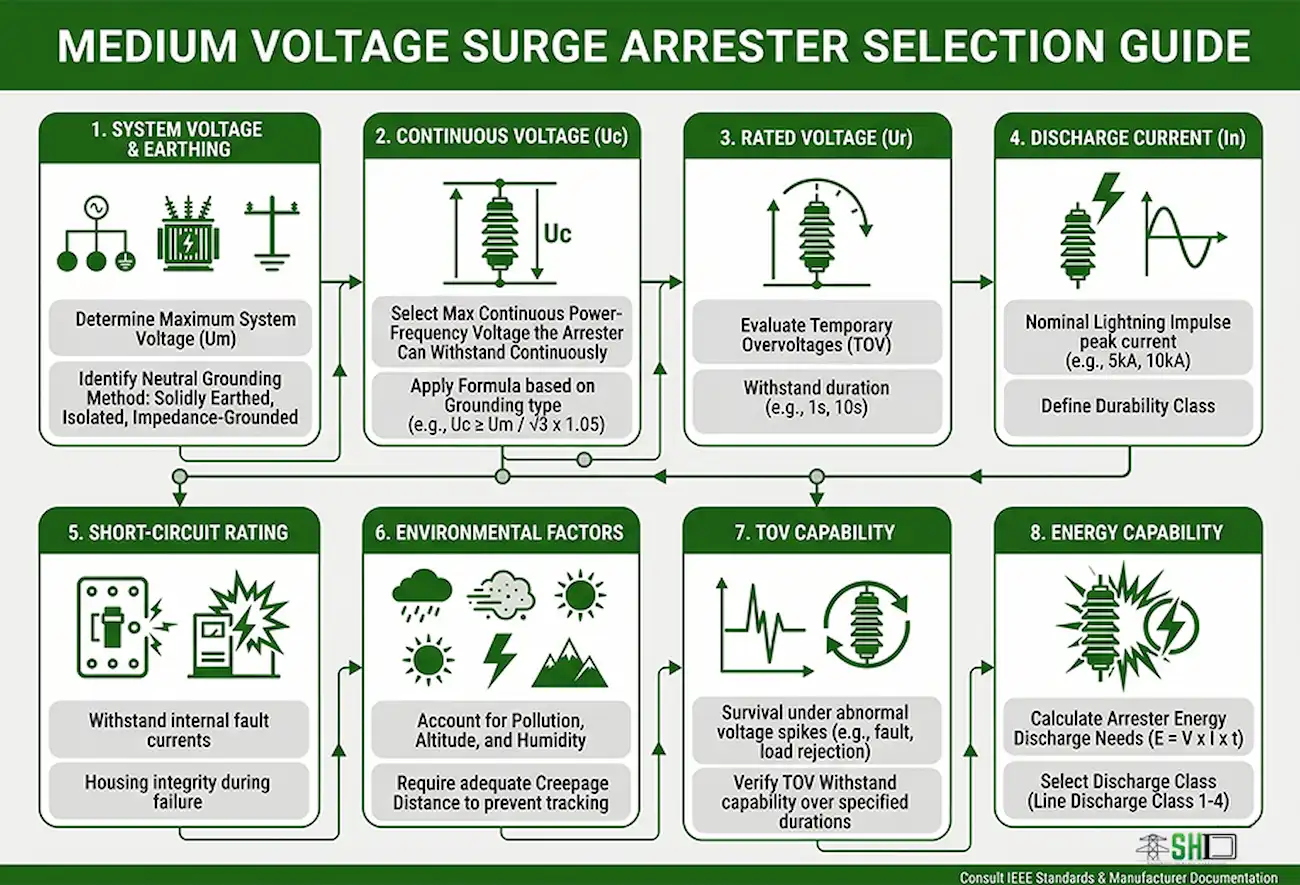
- Continuous Operating Voltage (𝑈𝑐): Maximum power-frequency voltage the arrester can withstand continuously without degrading.
- Rated Voltage (𝑈𝑟 ): Maximum permissible short-duration (often 10 seconds) overvoltage it can handle during temporary power-frequency fluctuations (e.g., faults).
- Earthing System Configuration: Guides selection based on solidly earthed, ungrounded, or impedance-grounded grids, influencing temporary overvoltage (TOV) levels.
- Nominal Discharge Current (𝐼𝑛): Sets the durability class using the peak lightning current impulse.
- Short-Circuit Rating: Confirms the housing can withstand internal fault currents without catastrophic failure.
- Environmental & Creepage Distance: Accounts for pollution, humidity, and altitude to prevent tracking/flashover by requiring adequate external insulation length.
- Maximum Continuous Operating Voltage (MCOV): Maximum continuously applied voltage; guides provide formulas based on system voltage and grounding method.
- TOV Capability: Verifies the arrester can survive abnormal temporary voltage spikes (e.g., sudden load rejection) and return to normal operation.
- Discharge Class / Energy Capability: Determines the amount of energy the arrester can absorb and safely dissipate.
How to choose the right continuous Uc and rated Ur voltages first?
To understand the medium voltage surge arrester selection guide must select the correct Continuous Operating Voltage (𝑈𝑐) and Rated Voltage (𝑈𝑟), which is the foundation of how to select surge arrester rating, ensuring stability and reliable grid operation.
- Determine highest system voltage (𝑈𝑚): Find the maximum continuous power-frequency voltage of your MV network (e.g., nominal 11 kV →𝑈𝑚 typically 12 kV; nominal 22 kV →𝑈𝑚 typically 24 kV).
- Calculate 𝑈𝑐 for solidly earthed networks: Ensure 𝑈𝑐 equals or exceeds the maximum phase-to-ground voltage: 𝑈𝑐 ≥(𝑈𝑚 /√ 3) ×1.05 (the 1.05 factor adds margin for harmonics and voltage regulation). This equation applies to solidly earthed networks; different grounding types may require different criteria.
- Calculate 𝑈𝑐 for unearthed/compensated (isolated) networks: For single phase-to-earth faults raising phase-to-ground voltage to near line-to-line level, use: 𝑈𝑐≥𝑈𝑚
- Evaluate temporary overvoltages (TOV) to set 𝑈𝑟: Determine the maximum TOV magnitude and its expected duration (commonly about 1–10 seconds, depending on the fault). Verify the arrester’s 𝑈𝑟 can withstand it without failure.
- Select the minimum valid standard 𝑈𝑟: Choose the next higher manufacturer catalog rating above the calculated TOV requirement, but keep it as low as possible to preserve protective margin for transformer and switchgear insulation.
Read More: Differentiate Between Fuse and Circuit Breaker Specs in MV.
How to calculate energy discharge needs for your grid?
To understand the medium voltage surge arrester selection guide must know how to calculate energy discharge needs for your grid, which means translating worst-case voltage and surge conditions into arrester energy and current requirements for safe, reliable protection.
- Determine MCOV: Select the Maximum Continuous Operating Voltage so it equals or exceeds the maximum continuous line-to-earth system voltage, as defined by your grid’s earthing/grounding method.
- Assess TOV capabilities: Evaluate Temporary Overvoltages from faults or events (e.g., load rejection) and ensure the arrester can withstand those voltage levels for the specified durations using manufacturer TOV withstand data.
- Calculate discharge current 𝐼 (lightning surges): Estimate from system insulation and surge parameters, commonly using 𝐼 =2 × BIL / 𝑍0 where 𝑍0 is the line surge impedance.
- Compute energy dissipation 𝐸: Determine how much energy the arrester must absorb using 𝐸 = 𝑉 × 𝐼 × 𝑡, where 𝑉 is the arrester residual (clamping) voltage, 𝐼 is discharge current, and 𝑡 is surge duration.
- Select the arrester class: Choose an arrester class (e.g., Line Discharge Class 1–4) based on computed energy, repetitive charge transfer capability, and the arrester’s short-circuit performance.
- Verify protective margins: Confirm the residual clamping voltage provides at least a 20% margin below the equipment’s Basic Impulse Insulation Level (BIL) using the arrester application/clamping data and your insulation coordination requirements.
Read More: Polymer vs Porcelain Insulator: Key Differences.
Polymer or porcelain which housing is better for outdoor use?
To understand the medium voltage surge arrester selection guide, know that Polymer (silicone rubber) housings are generally preferred for outdoor medium-voltage surge arresters because they resist contamination well, are safer in failure, and are easier to install.
| Feature | Polymer (Silicone Rubber) Housing | Porcelain Housing |
| Safety Under Fault | Excellent. Will reduce or scatter shrapnel when it fails, minimizing risk to nearby equipment or personnel. | Poor. Brittle ceramic can shatter violently, sending shrapnel over a wide radius upon heavy failure. |
| Weight & Handling | Lightweight. Typically, 60–90% lighter than porcelain, making it safer and much easier to transport and install. | Heavy. Requires more manpower, lifting equipment, and more robust support structures. |
| Pollution & Coastal | Excellent. A hydrophobic surface helps prevent moisture bridging and reduces tracking. | Fair. Can accumulate contaminants (salt/smog), often requiring periodic washing or a higher creepage distance. |
| Seismic/Impacts | High resistance. Absorbs vibrations and impacts without damage (non-fragile). | Vulnerable. Brittle; more susceptible to cracking during transport, installation, or heavy earth movements. |
| Installation | Very flexible. Can be mounted in multiple orientations (horizontal, vertical, hanging). | Strict. Often requires specific vertical mounting orientations. |
| Life Expectancy | Good (15–25 years). Can be impacted by UV or severe chemical degradation if the silicone quality is not high. | Excellent (25–30+ years). Ceramic typically doesn’t degrade from sunlight, but micro-cracks can develop over time. |
Read More: HV Fuses for Transformer Protection: Selection Guide.
Why Sihedan arresters are built for bulk buyers not just lab tests?
Sihedan surge arresters are built for bulk buyers because mass production, customization, and consistent performance matter more than one-off lab results in real grid projects.
Some of the Sihedan products:
Sihedan’s 33kV arrester, 11kV arrester, and ZnO polymer overhead-line arrester are engineered for bulk buyers with scalable production, OEM options, and consistent, tested protection beyond lab proofs.
- 33kV Surge Arrester 10kA Metal Oxide Lightning Protection: Medium/high-voltage surge protection using a metal oxide arrester to conduct surge energy to earth, protecting MV/HV equipment.
- Lightning Arrester ZnO Polymer For Overhead Lines: ZnO (metal oxide) arrester in a polymer, hydrophobic housing designed for fast over-voltage response and outdoor overhead-line reliability.
- 11kV Surge Arrester 10kA Metal Oxide Lightning Protection: 11kV metal-oxide lightning arrester intended to safeguard switchgear and transformers from atmospheric and switching overvoltages.
For custom OEM manufacturing, bulk pricing, or expert technical support regarding your grid’s overvoltage protection, visit our Contact Us page, reach out directly via WhatsApp, or email us at info@sihedan.com to secure your infrastructure today.
FAQs:
How to choose between distribution class and station class arresters?
Choose based on system voltage, fault level/short-circuit current, and protection criticality. Distribution arresters suit lighter duty networks; station class suits substations with higher energy.
How to test a bulk shipment of arresters before installation?
Bulk-test via visual inspection, then electrical checks: insulation/watts loss, reference and residual voltage (Vref/Vres), continuity, and leak tests. Compare against manufacturer acceptance values.
What happens if TOV rating is lower than your system needs?
If TOV rating is too low, arrester MOVs overheat under sustained overvoltage, causing thermal runaway, possible internal rupture, shorting, housing damage, and prolonged outages.
Leave a Reply