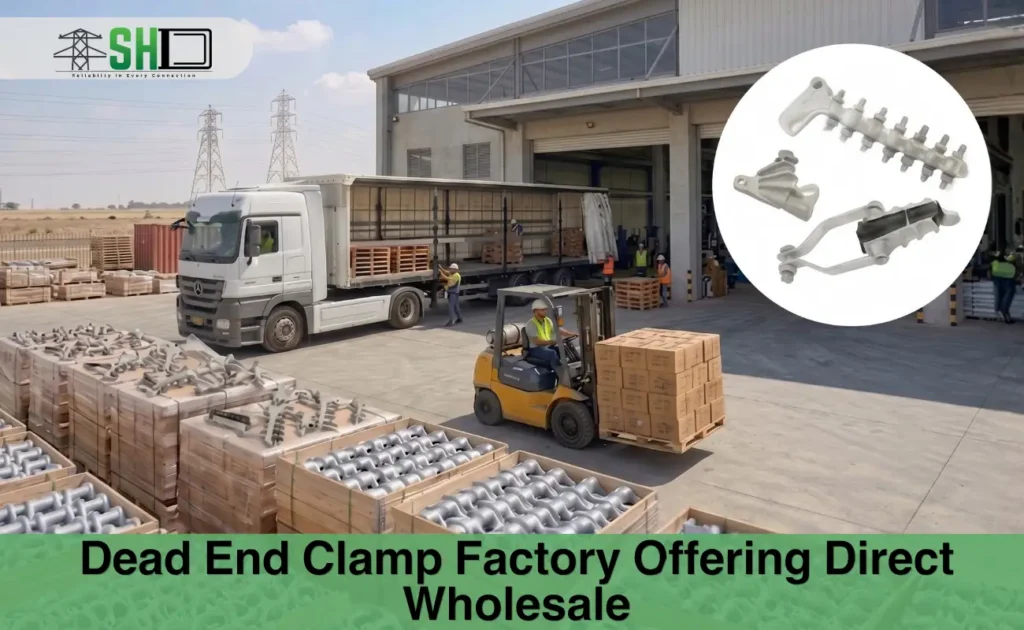
Dead end clamp factory operations play a vital role in modern power transmission and telecommunication networks, used across construction, manufacturing, and industrial maintenance. These specialized manufacturing plants produce heavy-duty hardware designed to secure overhead cables and conductors under extreme mechanical tension. By utilizing advanced forging and galvanizing techniques, a modern dead end clamp factories facility ensures that every utility clamp withstands severe environmental pressures such as wind, ice, and thermal expansion. You’ll learn which materials and standards matter most, how production workflows minimize defects, and how this prevents costly grid failures and maintains continuous power delivery across vast public infrastructure systems.
What Is a Dead End Clamp in Overhead Power Lines?
A dead end clamp (also called an anchor or tension clamp) is a heavy-duty mechanical fitting used to securely anchor and terminate electrical conductors at poles, towers, or sharp directional turns. It bears the full horizontal tensile strain of the wire to secure and stabilize the conductor.
Read More: Dead End Clamp Function: Applications & Selection Guide.
What Types of Hardware Does a Dead End Clamp Factory Produce?
A dead end clamp factory produces pole line hardware and overhead power line fittings used to anchor and tension cables. Their core product lines include wedge-type, bolted, and compression dead end clamps for bare or insulated wires, alongside related components like preformed grips, suspension clamps, and structural brackets.
- Wedge-Type Clamps: Self-tightening with different materials and design units, with internal wedges used for low-voltage aerial bundled conductors (ABC).
- Bolted Strain Clamps: Adjustable aluminum or malleable iron bodies secured with U-bolts and nuts, ideal for distribution lines.
- Compression Dead End Clamps: High-strength, permanent tubular sleeves hydraulically crimped onto transmission cables like ACSR.
- Straight-Line / Side-Opening Clamps: Swing-away or side-loading designs allowing fast placement on continuous spans.
- Preformed Dead-End Grips: In China helical dead-end tension clamp factory made of helical-formed wires designed to wrap securely around specific cables without special tools.
Read More: Types of Overhead Line Conductors: Comparison & Specs Guide.
What Materials Are Used in Dead End Clamp Manufacturing?
Dead end clamps are manufactured using high-strength metals and durable polymers like aluminum alloys, hot-dip galvanized steel, stainless steel, and UV-resistant thermoplastics. Dead end clamp factories use these materials to provide the mechanical strength and weather resistance needed to anchor power and communication lines.
- Aluminum Alloy: Used for the clamp body because it is light, strong, and prevents galvanic corrosion when paired with aluminum or ACSR power lines.
- Hot-Dip Galvanized Steel: Used for bolts, nuts, and high-load bodies to provide heavy-duty tension support and rust protection.
- Stainless Steel: Used for flexible bail wires, bails, and retaining pins due to its high resistance to rust and weathering.
- Reinforced Thermoplastics / Polymers: Used for wedge inserts and plastic bodies in aerial bundle cable (ABC) clamps to protect cable insulation without damage.
How to Choose a Reliable Dead End Clamp Factory?
To choose a reliable adss dead end clamp factories, verify their compliance with international electrical standards (such as IEC 61284 or ANSI C119.4), assess their material quality and testing capabilities for tensile and corrosion resistance, and request physical samples to test grip strength and build.
- Certifications & Standards: Ensure the adss dead end clamp factory holds ISO 9001 and manufactures products meeting recognized utility standards like IEC 61284 or NFC.
- Raw Material Quality: Check if they use high-strength aluminum alloys for bodies and UV-resistant polymers or hot-dip galvanized steel for bails and hardware.
- Testing Facilities: Confirm they conduct mechanical slip, tensile strength, and salt-spray corrosion tests in-house or via certified labs.
- Sample Validation: Order initial samples to verify bolt alignment, torque ratings, and grip stability on actual project cables before placing bulk orders.
Read More: Main Components of Overhead Transmission Lines.
What to Inspect Before Placing Bulk Dead End Clamp Orders?
Before placing bulk dead end clamp orders, you must check the conductor size range, material compatibility with the cable and environment, mechanical strength ratings for tension loads, and compliance with certified industry standards like NFC 33-041 or ANSI/C135.
- Conductor Range: Match the clamp size to your exact cable diameter and cross-section.
- Material Quality: Ensure aluminum alloy or hot-dip galvanized steel parts resist local weather and rust.
- Tensile Strength: Verify the grip can handle the maximum rated breaking load of the span.
- Wedge and Bail Design: Check that the wedge moves smoothly and the flexible bail resists fatigue.
- Standard Compliance: Confirm tests meet recognized safety codes like IEC, NFC, or ASTM.
- Sample Testing: Request lab test reports for slip strength and corrosion resistance.
- Visual Check: Look for smooth edges, no sharp burrs, and clear part markings.
- Supplier Audit: Buy only from certified factories with proven quality systems.
How Are Dead End Clamps Packaged and Shipped for Export?
Dead end clamps for export are packed in strong wooden or corrugated cardboard boxes with waterproof plastic liners. Workers in the dead end clamp factory secure the boxes on wooden pallets and wrap them with stretch film. Shippers send them worldwide via container ships, air freight, or international land transport.
- Rust Prevention: Workers coat metal parts with anti-rust oil or wrap them in anti-corrosion paper.
- Inner Protection: Workers place clamps in heavy plastic bags to block moisture and dust.
- Outer Cartons: Workers pack items into sturdy corrugated boxes or reinforced wooden crates.
- Palletizing: Workers stack boxes on wooden pallets and tie them down with strong plastic bands.
- Labeling: Workers add shipping marks, weight details, and handling symbols to the outside.
Shipping Methods
- Sea Freight: Shippers load pallets into full or shared cargo containers for cheap global transit.
- Air Freight: Shippers use airplanes for fast delivery of urgent or lightweight orders.
- Land Freight: Shippers use trucks for nearby cross-border trade.
Why Choose Sihedan Dead End Clamp Factory for Your Projects?
Choose Sihedan Dead End Clamp Factory as your trusted source for complete Overhead Power Line Hardware. We manufacture dependable, high-strength dead end clamps built for secure terminations and long service life. Benefit from consistent quality, efficient manufacturing, and tailored project support.
- Reliable performance: Engineered for strong, stable terminations under load.
- Consistent quality: Tight production controls for uniform fit and durability.
- Project-focused support: Guidance on selecting the right clamp for your application.
- Durable materials & finishes: Built to resist wear, weather, and corrosion.
- Efficient supply: Scalable production to support small and large jobs.
- Easy installation: In Sihedan Dead End Clamp Factory designs that help reduce downtime and improve on-site efficiency.
Ready to secure your overhead power lines with premium, certified hardware? Visit our Contact Us page, reach out instantly via WhatsApp, or email us at info@sihedan.com for custom B2B quotes and bulk factory pricing.
FAQs
What is the standard MOQ for a dead end clamp factory?
Most dead end clamp factories set a standard minimum order quantity between 500 and 1,000 pieces per item. This threshold helps cover basic production setup costs and material preparation for standard overhead line hardware.
Can a dead end clamp factory produce custom designs from drawings?
Yes, most factories can produce custom designs from your technical drawings or 3D models. They use OEM and ODM services, though custom tooling and sample mold fees usually apply for new product developments.
How do bulk orders affect pricing from a dead end clamp factory?
Bulk orders lower the price per unit significantly. When you buy in large volumes, factories spread fixed production and material costs across more pieces, which gives you a cheaper rate per clamp.
Are product samples provided for testing before bulk orders?
Most manufacturers provide product samples for quality testing before you place a large order. You usually pay for the courier shipping cost, and sometimes you also pay a small fee for the sample itself.
Leave a Reply