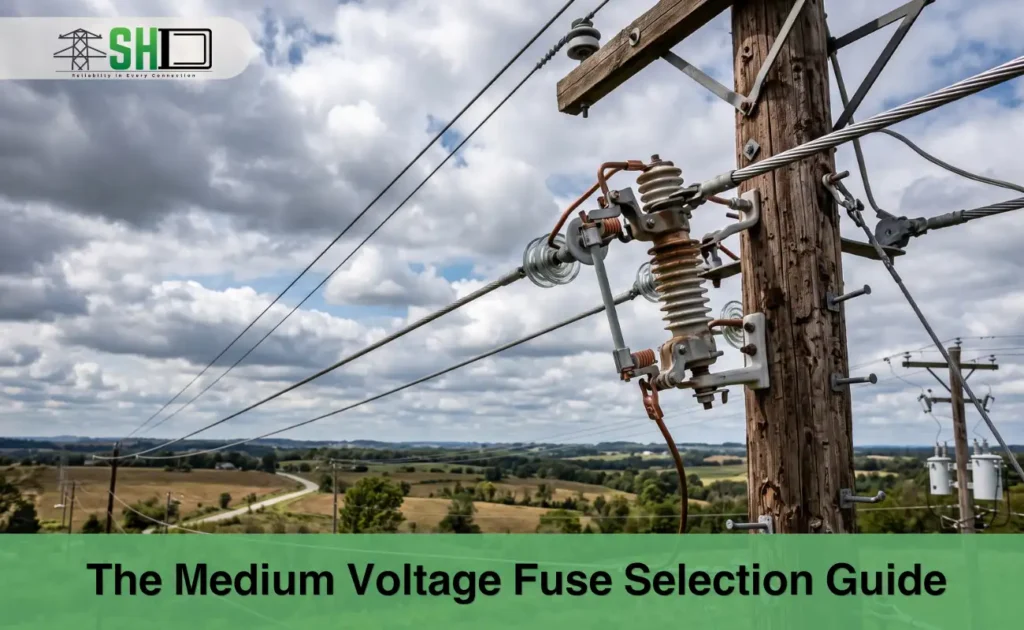
The medium voltage fuse selection guide is the ultimate key to safeguarding your electrical infrastructure from catastrophic overcurrent events. By understanding key parameters like continuous current ratings, minimum breaking capacity, and ambient temperature derating factors, you can prevent costly downtime and hazardous failures. This medium voltage fuse selection guide demystifies the selection process, empowering you to match the precise fuse type to your transformers, motors, and distribution networks with absolute confidence.
What Is a Medium Voltage Fuse?
In this medium voltage fuse selection guide, you will learn what a medium voltage fuse (MV) is, a safety device used to interrupt overcurrents and short circuits in electrical systems operating between 1.5 kV and 38 kV. It contains specially engineered fuse elements that melt when current exceeds safe limits, creating an arc that is safely extinguished to prevent damage to cables, transformers, switchgear, and other critical infrastructure protected by reliable High Voltage Fuses.
Read More: What is an Expulsion Fuse? A Complete Technical Guide.
Key Parameters for Selecting Medium Voltage Fuses
The medium voltage fuse selection guide (2.4 kV–38 kV) depends on five key parameters to ensure correct ratings, proper fault interruption, and reliable protection without nuisance blowing during normal transients.
- Medium voltage fuse voltage rating: Rated voltage must be ≥ maximum system operating voltage (Ungrounded/Single-phase: ≥115%; Grounded wye: ≥100%).
- Current & Continuous Ampere Rating: Fuse current set by equipment FLC; sizing allows transients (Transformers: 1.5–3× FLC; Motors: 1.25–1.75× FLC, up to 2× for high-inertia).
- Interrupting Rating (Breaking Capacity): Must exceed maximum available short-circuit current (symmetrical and asymmetrical) at the installation point.
- Time-Current Characteristics (TCC): Minimum melting curve above inrush/motor/start curves; total clearing curve below equipment damage curve for coordination.
- Application Constraints & Environment: Must meet minimum breaking current and correct class designator (E-rated general-purpose; R-rated backup for motors); derate for enclosed compartments, high ambient, or altitude >1000 m.
Read More: Types of cut out fuse: A Complete Selection Guide.
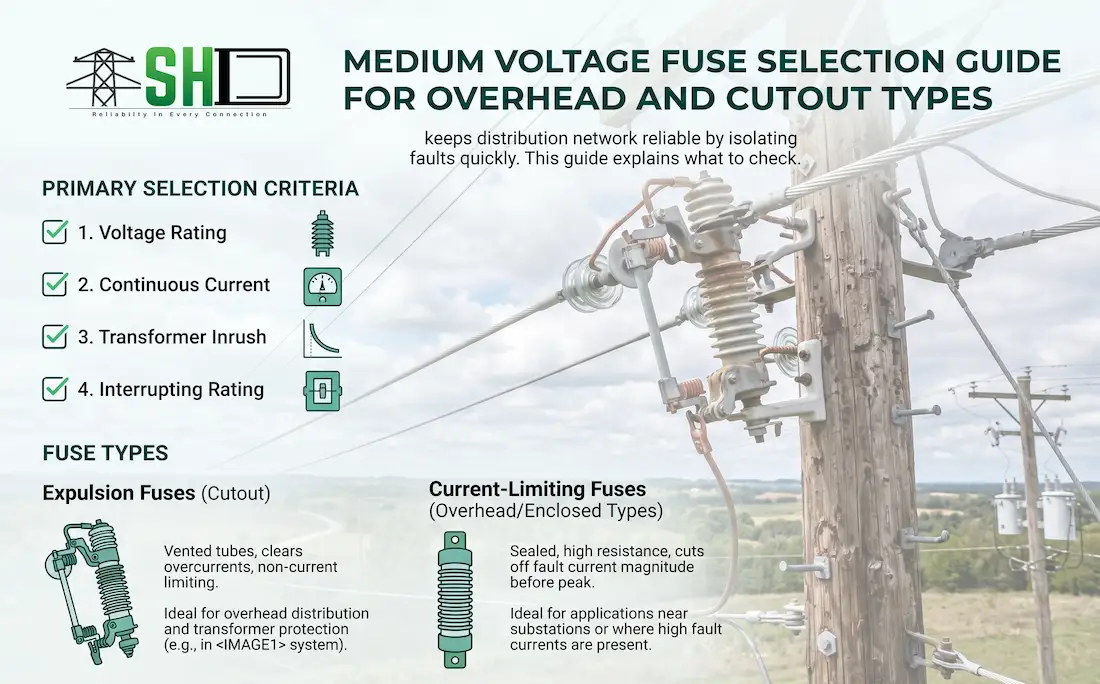
Medium Voltage Fuse Selection Guide for Overhead and Cutout Types
Medium Voltage Fuse Selection Guide for overhead and cutout fuses keeps distribution networks reliable by isolating faults quickly. This selection guide explains exactly what to check so the right fuse clears major events without nuisance blowouts.
- Voltage Rating: Fuse rated voltage ≥ maximum system line-to-line voltage (e.g., 15 kV fuse for a 12.47 kV circuit).
- Continuous Current: Fuse continuous ampere rating > maximum expected load current, including seasonal peaks.
- Transformer Inrush (TCC Check): Fuse TCC must withstand magnetizing inrush (typically ~12× full-load current for 0.1 s).
- Interrupting Rating (kA): The maximum available fault current at the installation point must be lower than the fuse interrupting capacity:
Medium voltage fuses are categorized by how they clear faults:
- Expulsion Fuses (Cutout): Vented tubes that use arc-generated gases to extinguish the spark. They clear overcurrents but do not limit the peak magnitude of the fault current. Ideal for overhead distribution and transformer protection within your Overhead Power Line Hardware system.
- Current-Limiting Fuses (Overhead/Enclosed Types): Sealed, non-venting fuses that introduce high resistance to abruptly cut off fault current magnitude before it peaks. Ideal for applications near substations or where high fault currents are present.
Read More: Dropout Fuse of Transformer: Premium OEM Solutions.
Step by Step MV Fuse Sizing Process
In the medium voltage fuse selection guide, you know how selection Size MV Fuse the correct link matches the voltage, load current, transients, and fault levels—protecting equipment while avoiding nuisance operation.
- Identify system baseline: System voltage (e.g., 11 kV, 33 kV), maximum full-load current (FLA), maximum prospective fault current at the fuse location, and load type.
- Set voltage rating: Fuse rated voltage ≥ maximum system operating voltage.
- Select continuous current rating: Transformers typically 1.25–1.50× FLA; motors typically 1.25–1.75× FLA (for acceleration without nuisance blowing).
- Verify inrush/transients: Transformer magnetizing inrush can be ~10–25× FLA for brief periods (e.g., up to 0.1 s); motors must withstand start/acceleration without melting.
- Check TCC coordination: Ensure the fuse TCC coordinates with upstream/downstream protection (relays/breakers).
- Confirm interrupting rating (kA): The fuse interrupting rating must exceed the maximum available fault current at the installation point.
- Apply derating: If hot/enclosed/high ambient conditions (e.g., >40°C), derate per manufacturer guidance.
- Choose standard medium voltage fuse sizes: Select the next available fuse rating ≥ calculated minimum continuous rating.
Read More: How to Calculate Fuse Size for Transformer? Step by Step.
Common Mistakes in Medium Voltage Fuse Selection
In the medium voltage fuse selection guide must know Mistakes in Medium Voltage Fuse Selection to prevent equipment damage, long outages, or repeated nuisance operations. Avoid common mistakes in ratings, transient handling, and coordination to ensure the fuse clears faults without causing unnecessary trips.
- Mismatching voltage rating: Fuse voltage must be ≥ maximum system line-to-line voltage, not just nominal voltage.
- Ignoring interrupting rating: Fuse interrupting (kA symmetrical) must exceed the maximum available short-circuit current at the location.
- Overlooking derating: Hot, enclosed, or high-altitude installs reduce capacity; use manufacturer derating curves.
- Sizing only for full-load current: A tight match often causes nuisance trips from normal load variation.
- Ignoring transformer inrush: Don’t size too tightly; energization can be ~10–12× full-load for ~0.1 s.
- Mishandling motor starting: Use appropriate time-delay/slow-blow behavior to tolerate locked-rotor currents.
- Poor coordination: Verify TCC coordination with upstream relays/breakers and downstream fuses to prevent widespread outages.
- Mixing fuse types: Replacing current-limiting with expulsion (or vice versa) without changing the protection scheme.
- Using fuses for overloads: MV fuses are for short-circuit; use thermal/electronic overload relays for overloads.
- Arbitrarily oversizing: Larger fuses defeat protection and can leave cables/transformers exposed to internal damage.
Read More: HV Fuses for Transformer Protection: Selection Guide.
Why Partner with Sihedan for MV Fuse Solutions?
Partnering with Sihedan means working with a company focused on reliable electrical protection hardware for both MV/LV network applications. From demanding industrial environments to rural and residential distribution, Sihedan delivers solutions designed to improve safety. Advantages of Sihedan’s MV Fuse Solutions
- High safety performance: Designed to interrupt and protect against severe overloads and short-circuit conditions.
- Standards-aligned engineering: Products are built around recognized safety and testing expectations (e.g., IEC/BS/GB compliance mentioned across product lines).
- Robust-rated fault capacities: Fuse cutouts and fuse links are specified for strong breaking/interruption performance.
- Field-friendly design: Features like slide-fit front covers help simplify installation and maintenance.
- Wide current/voltage coverage: Options spanning multiple rated currents and voltage ratings to fit different grid requirements.
- Commercially supportive procurement: B2B-oriented ordering flexibility, including zero MOQ on initial order(as stated on the product pages).
Some Example Sihedan Products:
- Heavy Duty Cut Out MC300 HDCO 80kA Protection Base:
A vandal-resistant heavy-duty cutout base built to protect street-level and exposed junction points, supporting up to 80kA breaking capacity, with a current rating range 40A–300A and voltage options 415/500/550VAC. - Overhead Fuse Cutout 400A For Low Voltage Grids:
A pole-mounted low-voltage disconnector/cutout designed for rural and municipal distribution protection, compatible with NH1/NH2 fuse links. It supports 400A with a fuse / 600A with blades, operates at 500V, and provides 100kA interruption capacity with IP23 outdoor protection, suitable for conductors 70–300 sqmm (Cu/Al).
For expert engineering support or to order our reliable electrical protection solutions, visit our Contact Us page, message us directly on WhatsApp, or email us at info@sihedan.com to get started today.
FAQs
Can MV fuses protect against overload or only short circuits?
Medium voltage (MV) fuses can protect against both. General-purpose fuses clear all current faults from low overloads to high short circuits, while backup fuses only interrupt high fault currents and require series devices for overload protection.
What is the difference between drop out and overhead cutout fuses?
Drop-out fuses are a type of overhead cutout. When they blow, the fuse tube physically drops out of the top contact to provide a visible open circuit, whereas non-dropout cutouts remain static.
Is it safe to interchange MV fuses from different manufacturers?
Yes, it is generally safe if ratings (voltage, current, interrupting capacity) and standards (e.g., E or K rating) are identical. Always verify that physical dimensions and time-current curves match the specific application.
Leave a Reply